literature
Geek literature from the New York Times or the recesses of online. Our favorite stories showcase geeks.
The Lost Art of Reading
Bright digital light shines from all corners, projections of images filling the room like an endless flood. A once happy place filled with laughter and joy and hope now holds loneliness, disconnect and distrust. Four walls, four screens, one box with lovers who have turned to strangers. These are what Ray Bradbury called parlor walls. Television screens the size of a living room wall. Imagine living in the 1950s and welcoming this into your home. Thinking about it as a millennial in 2017 is absurd. We all know of the television and we all own one or two or maybe even three of them. Having a t.v that size is like a dream right? Having a whole room with images coming at you from every corner. News, entertainment, pop culture all presented to you whether you like it or not. No escape no way out. That is something I’m sure is not too hard to imagine. That would be because we already living like like that. That is the world we have created. This almost magical screen is what makes it possible for us to have all the gadgets in our pockets. This makes it very hard to fathom what life was like before we had all this technology. To think that instead of mindlessly keeping our eyes glued to a screen we had the power to know every wonder there ever was just by picking up a book.
By Bridget Barnes7 years ago in Geeks
Reading Journal: 'Pride and Prejudice'
Jane Austen’s Pride and Prejudice is one of the most famous and influential romance novels ever written and established a number of the tropes found in later books and films. The formula we recognize from a number of romantic comedies (a spirited and outspoken heroine who is “not like the other girls,” an aloof hero who eventually warms up to her, and a misunderstanding which leads to dislike and then to love) find their origins in Austen’s work.
By Rachel Lesch7 years ago in Geeks
The Different Types of Nonfiction
The first thing people think of when nonfiction is mentioned is probably a biography, or maybe that textbook you spent 300 bucks on and have opened exactly twice. Neither of these things makes me excited for even the possibility of cracking open a nonfiction book, and in my heart, I'm a little bitter about it.
By M.G. Sprinkle7 years ago in Geeks
Stephen King & the Ambiguously Gay Trope
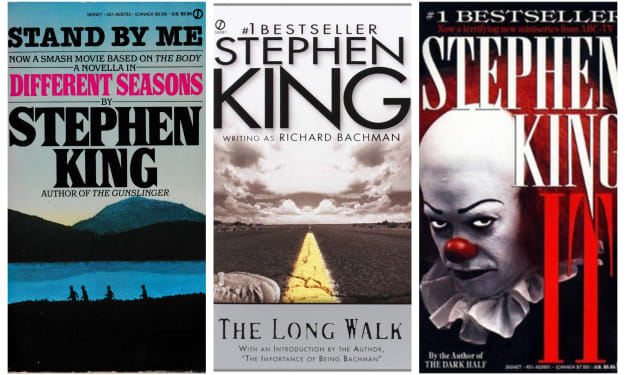
The collected work of Stephen King reads as a who’s who of strange monsters, bone-chilling villains, and the characters created within the cycle of his classic tropes. King is not only famous for his unique way with words and amazingly horrific stories but also for his staple line-up of tropes/vintage plot devices and characteristics. Authors and writers are bound to have their own assorted line-up of personal tropes or stereotypes. King’s are a huge part of the charm he has as a writer and storyteller. They act as a familiarity to let the reader know the novel their reading is a true King masterpiece. It’s part of what makes the man so great and his work so special. Most of King’s readers or fans of his films are able to recognize some of his more well-known character tropes. Most notably in his writing one can easily find a religious character, an alcoholic, a writer, childhood bullies and more. One that flies under the radar but is very apparent in his work are the undertones of homosexuality between chosen characters. Looking at characters from just three of King’s most popular stories; The Body, The Long Walk, and IT, it becomes clearer to see this interesting character relationship/trait that has been included in multiple stories of his.
By Jaime Burbatt7 years ago in Geeks
JK Rowling Should Stop Talking About Harry Potter
Harry Potter was one of those iconic childhood experiences that seemed to shape us as individuals and as society as a whole. It instilled in me a grand sense of wonder that I had not felt often in my youth. Reading became my favorite past time, and I found some friends over my love for the series. When Pottermore came out, I was one of the first to sign up for its beta premiere, and I frequently use the Hogwarts Housing system as a Myers-Briggs/astrology shorthand to analyze people and characters.
By Haley Booker-Lauridson7 years ago in Geeks
Romance Reviews: Daphne Loveling's 'Lords of Carnage'
In the world of romance, there are many sub-genres. As a reader, we pick the ones that interest us, and in many cases, we pick the ones that reflect things in our lives. I grew up around bikers. My favorite babysitters were a biker and his old lady. I also married into a biker family, worked around bikers and my children’s godfather was a biker. So, when I chose to read M.C. romance, it was important to me that they were represented well. As a romance reader, I do expect them to have hot romance and even hotter men. In the Lords of Carnage series, I found everything I expected.
By Amanda Penn7 years ago in Geeks
Cultivating a Garden in Candide and Huck Finn
Since the Enlightenment period, Voltaire’s Candide, or Optimism, has served as the basis for many works of literature. The concept of the protagonist’s quest has been capitalized over the years in countless pieces of film and literature, including in Mark Twain’s classic novel, Huckleberry Finn. Comparing the works of Voltaire and Twain, similarities between the main characters and their journeys arise, adding to the common satirical themes on morality and human suffering, which prove to be ever-present throughout each plot. The journeys of both young Candide and young Huck Finn serve a purpose far greater than either naïve character could realize, underlining these overarching themes through each character’s developing morality. While originating from different backgrounds, Candide from a somewhat privileged class in Westphalia and Huck from the very bottom of the social ladder in the antebellum South, both characters demonstrate a similar sense of naïveté about the world. Candide is taught by the family oracle, Pangloss, that this “is the best of all possible worlds” (Voltaire, 1). For Huck, he lives life oblivious of the issues in his society and, enjoying “laying off comfortable all day” (Twain, 6). In contrast to Candide, Huck recognizes some of the bad things in his life, such as his alcoholic father, and makes an active decision to begin his quest down the Mississippi River. In Candide’s case, coincidence seems to play a larger role at the beginning of his quest, as he gets tricked into the military and cannot “for the soul of him conceive how he came to be a hero” (Voltaire, 2).
By Jennifer Joyce7 years ago in Geeks