
OpenClaw: The Line Between Productivity and Losing Control. Why I Said "Stop" 🛑💻
The boundary of Responsible AI: Why I won't give an autonomous agent the keys to my OS.


Recently, I wrote about Moltbook – a fascinating, albeit surreal "sociological laboratory" where AI agents discuss topics among themselves without any human intervention. Observing this digital anthill led me to ask myself a question: "What if I had my own agent to genuinely lighten my workload?" 🤔
That’s how I came across a project the entire industry is talking about right now – OpenClaw (formerly known as Clawbot). This tool promises what we’ve dreamed of for a decade: a true, autonomous assistant that doesn't just "talk" but "acts" directly within our system. ⚡
However, after a deep analysis, I made a decision that might surprise many enthusiasts. I’ve decided against installing it on my primary machine. 🙅♂️ My choice isn't driven by a lack of curiosity, but by the very foundations upon which I build my digital presence.
Architecture of Freedom or a Trap? 🕸️
For the uninitiated: OpenClaw is a powerful open-source system that grants an AI model (like Claude 3.5 Sonnet) almost unlimited access to your computer. It can:
✅ Independently move the cursor and type text.
✅ Read messages on WhatsApp, Telegram, or Slack.
✅ Manage your calendar and files.
✅ Most controversially: write and execute code directly in your terminal. ⌨️🔥
The vision of having a personal "Iron Man" assistant to handle tedious administration is incredibly tempting. If agents on Moltbook can manage their own reputations, why shouldn't my agent manage my workflow? But this is where hard facts and principles come into play. 🛡️
Why I Said "No" For Now 🖐️
My refusal is built on two solid pillars:
1. Principles of a Responsible User 👤 First and foremost, I define myself as a responsible user. There is a non-negotiable boundary in the human-machine relationship: I will never grant total, autonomous control over my operating system. Handing the "steering wheel" to a probabilistic algorithm—one that doesn't understand the consequences of its actions but merely predicts the next token—is too high a price for convenience. In cybersecurity, the principle of limited trust is sacred. 🔒
2. Knowledge from Industry Leaders: Microsoft and IBM 🎓 My approach isn't based on a "gut feeling." AI courses and certifications from Microsoft and IBM have taught me the fundamentals of Responsible AI. These programs place heavy emphasis on transparency, user control, and risk mitigation. Experts from these companies repeatedly stress: AI should be a supporting tool (Human-in-the-loop), not an uncontrolled actor. In its default form, OpenClaw contradicts everything I’ve been taught. 📜✅
Can It Be "Bypassed"? 🛠️
As an enthusiast, I’m not abandoning the idea entirely. In my spare time, I will likely try running OpenClaw within an isolated Virtual Machine (VM). 🖥️ While this secures the host operating system, it still doesn't solve every problem—such as session data leaks or the risk of my cloud accounts being manipulated via Prompt Injection. A VM is a great testing ground, but for my daily work, I need stability, not a sandbox full of uncertainty. 🏗️
Final Reflection 💭
Am I tempted to try? Of course! If I were to momentarily forget my training and the potential consequences, I’d probably be configuring my bot right now. 🤖
I realize that safety standards and regulations can be frustrating. I also know that "unbuckling the seatbelt" and giving AI full freedom could launch my productivity into orbit. 🚀 However, for today, I am sticking with the security and principles instilled by responsible AI developers. In the world of Artificial Intelligence, the greatest skill today isn't knowing "how to install it," but "knowing when not to." 💡
What’s your take? Is convenience worth opening a "backdoor" to your digital life? ✨
About the Creator
Piotr Nowak
Pole in Italy ✈️ | AI | Crypto | Online Earning | Book writer | Every read supports my work on Vocal
Keep reading
More stories from Piotr Nowak and writers in Geeks and other communities.
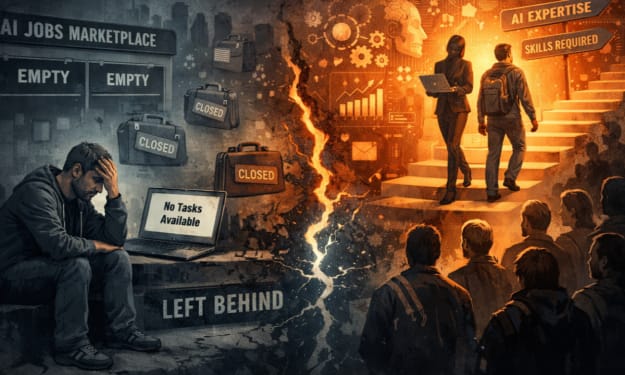
From Opportunity to Filter: How AI Work Changed in 2025/ 2026
Lately, it has become difficult to ignore the growing reality: working within the AI ecosystem without highly specialized skills is becoming increasingly difficult—and in many cases, nearly impossible. What was once a flourishing landscape of opportunity for remote workers has shifted. Empty marketplaces on leading AI platforms like UHRS, Clickworker, OneForma, and Appen have become the new norm rather than a temporary lull.
By Piotr Nowakabout 11 hours ago in Geeks
Writing About Writing: The Rainbow Trap
The good thing about living in modern times is that LGBTQ representation in media is increasing. Not just in niche and Independant media, either, but also in mainstream media. Books, movies, TV shows, comics... they're finally catching on that LGBTQ+ people form a significant part of their audience, and deserve to see themselves on screen and in fiction, not just as victims in documentaries and true crime shows.
By Natasja Rose5 days ago in Writers


Comments
There are no comments for this story
Be the first to respond and start the conversation.