
From Opportunity to Filter: How AI Work Changed in 2025/ 2026
The End of the Digital "Gatherer" Era: Why the AI Market is No Longer a Place for Everyone

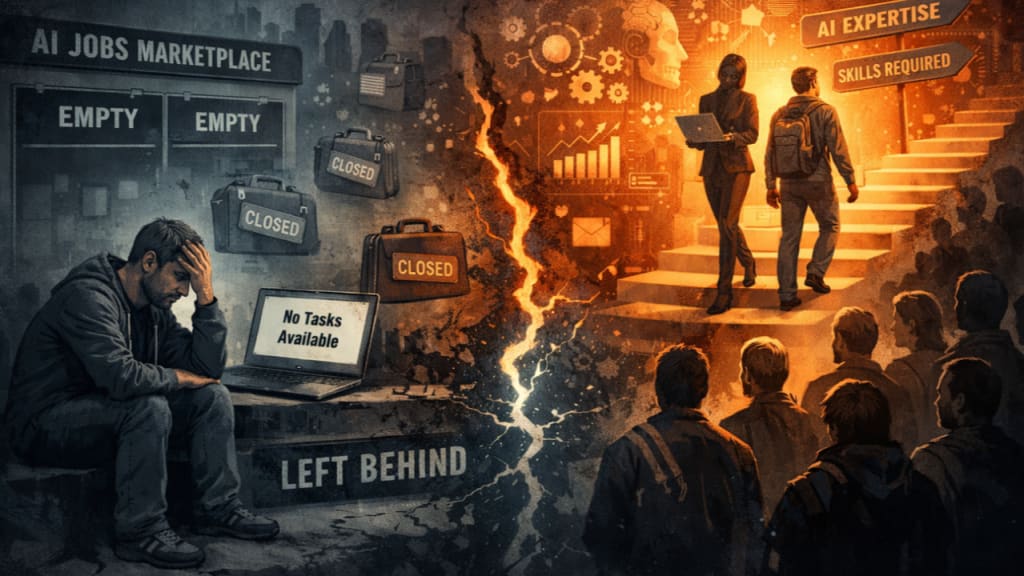
Lately, it has become difficult to ignore the growing reality: working within the AI ecosystem without highly specialized skills is becoming increasingly difficult—and in many cases, nearly impossible. What was once a flourishing landscape of opportunity for remote workers has shifted. Empty marketplaces on leading AI platforms like UHRS, Clickworker, OneForma, and Appen have become the new norm rather than a temporary lull.
As AI moves forward at a breakneck pace, we are witnessing a technological feedback loop where more advanced models are now being used to train, refine, and validate less sophisticated ones. In this rapidly tightening environment, human workers are left with two stark choices: radically upskill to meet higher technical demands or pivot to an entirely different career path.
The "Empty Marketplace" Phenomenon
This perspective isn't just a hunch; it is a sentiment echoed across Reddit and various industry forums. The same theme appears consistently: this is no longer a market for generalists. Long-time users of crowdsourcing platforms describe identical, discouraging patterns. Task boards sit empty for days; when projects do appear, they are often small-scale, short-lived, and vanish within minutes—snatched up by thousands of workers competing for the same crumbs.
For many, this feels like the first true "winter" in the industry. However, this isn't a traditional economic recession. It is a structural evolution. Companies that previously required an army of human workers for basic image tagging or text transcription have refined their internal models to a point where human intervention is no longer cost-effective for low-level tasks.
The Disappearance of "Gateway" Roles
It is important to clarify that this isn't simply a case of AI "taking jobs" overnight. The current shift is more nuanced. AI has effectively crippled the creation of new entry-level and low-complexity roles—the very positions that once served as a natural gateway into the tech and data industries.
Companies are increasingly moving away from the "crowd" model in favor of:
Proprietary In-house Models: Using existing high-level AI to handle the heavy lifting of data preparation.
Automated Validation: Systems that can now perform their own QA (Quality Assurance) and annotation with minimal human oversight.
Hyper-Specialization: A demand for "Domain Experts" (lawyers, doctors, engineers, or linguists) rather than broad, generic task-takers.
The Crisis of the "In-Between" Worker
The most significant source of frustration comes from "in-between" workers. These are individuals who are no longer beginners—they understand the ecosystem and have experience—but they lack a specific, rare specialization that sets them apart from the masses. This group is currently the most vulnerable.
The market hasn't disappeared; it has become surgically selective. We are seeing a brutal realization: AI does not replace people—it replaces the absence of clear, unique value. If a task can be taught to a human in five minutes, it has likely already been taught to a model. Consequently, those with focused skills—be they technical, analytical, or industry-specific—are still finding lucrative opportunities. Meanwhile, repetitive and easy-to-train tasks are being phased out because that is precisely what AI was designed to master.
A Turning Point, Not a Temporary Dip
This is why more voices are calling this moment a definitive turning point. The era of AI as an "easy online side-hustle" is fading into history. The "digital gold rush," where anyone with a laptop and an internet connection could contribute to the data supply chain, is over.
We are entering a phase where AI is no longer the work itself, but rather a sophisticated tool for highly skilled professionals. This isn't a crisis in the sense of a broken system; it is a filter. It is a global re-calibration of what human effort is worth in an automated world.
Ultimately, the most important takeaway is one of realism: AI as a gateway for the unskilled is closing, but AI as a force multiplier for the expert is just beginning. As the filter tightens, many of us are finding out exactly which side of that divide we stand on. The question is no longer whether the work will return, but whether we can offer something that a model cannot yet replicate.
About the Creator
Piotr Nowak
Pole in Italy ✈️ | AI | Crypto | Online Earning | Book writer | Every read supports my work on Vocal
Keep reading
More stories from Piotr Nowak and writers in Geeks and other communities.
The AI Paradox: Is Artificial Intelligence Boosting Our Brainpower or Killing Our Creativity? 🧠🤖
The pace of technological change in the last few years has been nothing short of breathtaking. We are witnessing a revolution where Artificial Intelligence is no longer a futuristic concept but a daily reality. It fuels business growth, optimizes complex supply chains, and introduces a level of automation—especially through autonomous AI agents—that was unthinkable just a decade ago. 🚀
By Piotr Nowakabout 3 hours ago in Geeks
Push the Button
In today’s hyper-connected world, the phrase “Push the Button” has taken on profound implications beyond its literal sense. While it may evoke images of launching rockets or triggering alarms in popular culture, in the modern digital era, it is a metaphor for the immense power that rests at our fingertips. Whether it is sending a crucial email, posting on social media, or activating sophisticated technological systems, pushing a button can set off a chain of events that may be irreversible. As society becomes increasingly reliant on technology, understanding the responsibility behind this simple action is more crucial than ever.
By Ayesha Lashari3 days ago in Geeks
📢 Raise Your Voice Thread: 02/05/2026
Our “Raise Your Voice Threads” are hosted most alternating Thursdays at 12PM ET to offer creators more avenues to uncover exceptional stories on Vocal. As we are continuously searching for fresh creators and inspiring stories, this thread provides an opportunity to exchange and discuss the stories that have moved and motivated us on Vocal.
By Raise Your Voice by Vocal4 days ago in Resources




Comments
There are no comments for this story
Be the first to respond and start the conversation.