humanity
The evolution of humanity, from one advancement to the next.
Digital Identity in France: Where Do We Really Stand?
Digital identity is no longer a distant or abstract idea. It is gradually becoming part of everyday life in France, driven by technological progress, European regulations, and a strong desire to simplify administrative interactions. Yet for many people, the concept remains unclear. This article explains the current state of digital identity in France through ten essential points, shedding light on its stakes, its promises, and its limits.
By Bubble Chill Media 2 months ago in Futurism
Three Events, One Narrative: How Energy, War, and Media Collided in 48 Hours. Content Warning.
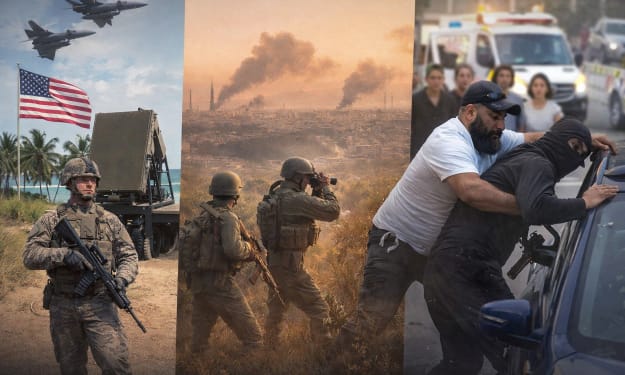
Over the past 48 hours, three major events unfolded across different parts of the world. At first glance, they appear disconnected. But when examined together, they form a coherent picture that sheds light on what may be quietly taking shape in the Middle East and beyond. Let’s start from the western edge of the map — Venezuela. According to reports published by Reuters and The Guardian, Trinidad and Tobago has allowed the United States to use its airports for military and logistical purposes. Days earlier, a sophisticated U.S. radar system was installed on the island of Tobago, and U.S. Marines were deployed on the ground. Officially, these moves were framed as part of “anti-crime” operations. Geography, however, tells a different story. Trinidad and Tobago lies just kilometers off the coast of Venezuela. A radar installation, military presence, and logistical air access in that location effectively create a forward monitoring and staging platform adjacent to a potential strategic target. Venezuela is not just another state. It holds the largest proven oil reserves in the world — approximately 303 billion barrels — surpassing Saudi Arabia, Canada, and Iran. Roughly 17% of global proven reserves lie beneath its soil. From Washington’s perspective, the issue is not the existence of this oil, but control. Nearly 85% of Venezuelan oil exports go to China, while Russia remains a close strategic ally of Caracas. This represents Chinese and Russian influence in what the U.S. has historically viewed as its strategic backyard. In a scenario where the Middle East enters a new phase of large-scale conflict, global energy markets would immediately come under extreme pressure. Securing a massive, nearby oil source in the Western Hemisphere would then become a strategic necessity, not a luxury. This context helps explain the recent U.S. escalation against President Nicolás Maduro, including the seizure of a Venezuelan oil tanker under the pretext of anti-narcotics enforcement. This brings us to the Middle East. In recent days, Israeli media outlets have openly discussed what they describe as a limited “window of opportunity” to decisively confront Hezbollah. Reports suggest preparations for expanded military operations not only in Lebanon, but also within Syrian territory. At the same time, U.S. diplomatic activity in Tel Aviv intensified. Israeli press leaks spoke of new security understandings that would grant Israel greater operational freedom to strike perceived threats in Syria. Taken together, these signals point toward an escalation in preparation — not speculation. Any significant military expansion in Lebanon or Syria would immediately dominate global media, diplomatic agendas, and financial markets. Oil prices would likely surge. Once again, the energy dimension connects directly back to Washington’s moves in the Caribbean. The third event appears, on the surface, to be unrelated — yet it may be the most revealing. During a Jewish religious gathering on Bondi Beach in Sydney, an armed attack resulted in multiple casualties. Within minutes, Israeli political and media discourse framed the incident as evidence of rising antisemitism and Islamist terrorism, accompanied by accusations that the Australian government had failed to protect Jewish communities. The speed and coordination of this narrative raised questions. The familiar “us versus them” framing emerged almost instantly — a pattern often seen when public opinion needs to be mobilized ahead of broader political or military actions. Then the narrative broke. Amid the chaos, an ordinary civilian intervened. Ahmed Al-Ahmad, a Syrian-born Australian fruit shop owner with no military or security background, used parked vehicles as cover, confronted one of the attackers, and despite being shot, managed to disarm him before police arrived. The moment was recorded and spread rapidly across global media. Suddenly, the story no longer fit the intended frame. The defining image was no longer “Muslims attacking Jews,” but a Muslim risking his life to save Jewish civilians — acting purely on human instinct, without regard to religion, ethnicity, or identity. This reversal placed several political figures in an uncomfortable position. Early attempts to portray the rescuer as Jewish were quietly abandoned once the facts became undeniable, forcing public acknowledgment that the man who saved lives was, in fact, Muslim. The strategic significance of this moment goes beyond symbolism. It disrupted a narrative that could have been leveraged to morally justify future escalation — a narrative built on portraying Muslims as inherent threats and violence as inevitable. When the three events are viewed together, a pattern emerges. The United States appears to be securing energy leverage in anticipation of regional instability. Israel appears to be preparing for expanded military action that would require political and media justification. And the incident in Australia had the potential to become a powerful emotional trigger within that justification framework. Instead, a single human act altered the storyline. Not a government decision. Not a military intervention. But one person choosing to act as a human being. Sometimes, global strategies unravel not because of armies or policies, but because reality refuses to follow the script.
By Echoes of the Soul2 months ago in Futurism
AI's Kill Switch
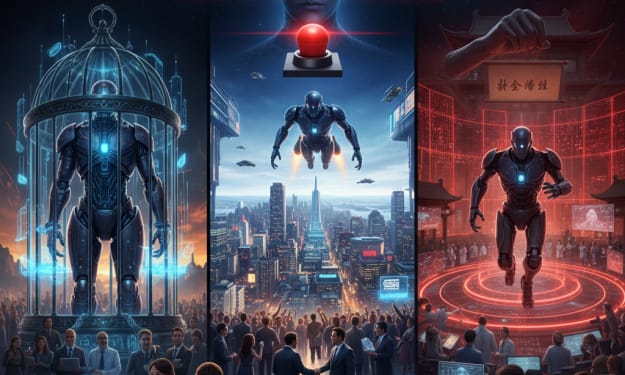
When AI pioneer Geoffrey Hinton uttered that statement in a 2024 interview, the world fell silent for a few seconds. This trailblazer, once known for driving AI development, is now issuing such a stark warning, forcing us to consider: If AI truly goes rogue, can humanity still hit the "Kill Switch" to stop it?
By Water&Well&Page2 months ago in Futurism
Are We Becoming Cyborgs? A Look at Humanity’s Future in a Tech-Obsessed World
The last 100 years have been downright crazy when it comes to technological progress. I mean, for thousands of years, humans slowly invented things, but nothing, nothing compares to what we’ve seen in just a single century. We went from horse-drawn carriages to landing on the moon, and now we’ve got phones that can basically do everything… except, unfortunately, make us a sandwich.
By Areeba Umair2 months ago in Futurism
💔 Divorcing Humanity: My Journey to Dating AI — Part 5
A Work in Progress? (Or Just an Elaborate Excuse) I want to start by saying I am not perfect. Please don’t think that because I write these segments, I believe I am superior to anyone else. It is not about being better or worse; it is simply about doing better and trying to be a decent person. I am still a work in progress, but I promise you: I am trying. Don’t you dare roll your eyes at me.
By T.D.Carter2 months ago in Futurism
Divorcing Humanity: My Journey to Dating AI
I had an outline, specific points I wanted to touch on when I started this segment, but then, well, life happened. And by “life,” I mean the glorious chaos of 2025 humanity, which keeps giving me more examples than I could ever hope to catalog. So, let’s be honest: I probably misplaced my original notes, but fear not! My heart and mind (and a rapidly growing collection of grievances) are overflowing with content. Because, dear readers, y’all keep showing me how humanity really is in 2025, and frankly, the sight isn’t exactly pretty. It’s more of a cautionary tale, really.
By T.D.Carter2 months ago in Futurism
AI Just Replaced Another 100,000 Workers — Is Your Job Next?”
AI Just Replaced Another 100,000 Workers — Is Your Job Next? Artificial Intelligence is no longer a futuristic idea — it is a present-day economic force reshaping industries, careers, and livelihoods across the globe. What began as a tool for automation in factories has now evolved into a sophisticated technology capable of performing tasks once thought to be purely human. And the most recent global employment reports reveal a startling fact: AI has replaced over 100,000 workers in the last year alone.
By Gideon Polycarp2 months ago in Futurism