Echoes of the Soul
Bio
"A space for storytelling where memories and imagination meet, inspiring reflection and self-discovery."
Stories (3)
Filter by community
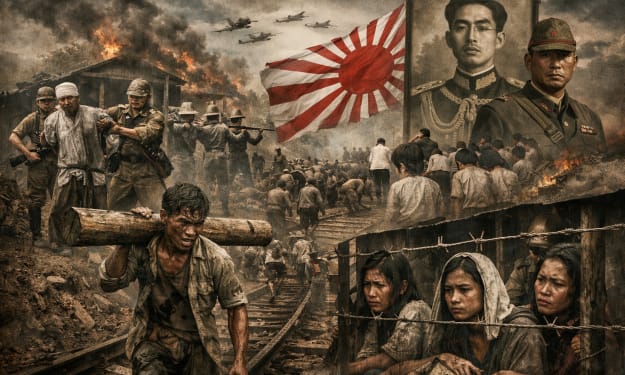
Japan’s Occupation of Indonesia: When “Asian Liberation” Turned Into Systematic Brutality. Content Warning.
During the chaos of World War II, as Southeast Asia became a battleground for competing empires, Japan entered Indonesia under a slogan that appeared revolutionary at the time: Asia for Asians. To a population that had endured more than three centuries of Dutch colonial rule, the collapse of European authority in 1942 seemed, at first, like the dawn of a new era. It was not. What followed was not liberation, but a militarized occupation that proved more violent, more intrusive, and in many ways more destructive than the colonial system it replaced. Within three years, Japan reshaped Indonesian society through fear, forced labor, starvation, and cultural coercion—leaving scars that remain deeply embedded in the nation’s collective memory. Indonesia was, and remains, a predominantly Muslim society. Islam was not only a religion, but the backbone of social organization, education, and moral authority. Mosques, scholars, and Islamic associations connected villages across the archipelago, forming networks capable of mobilizing large segments of the population. To the Japanese military administration, this was not spirituality—it was a potential threat. From the earliest months of occupation, Islam was treated as a security issue. Religious schools were closed or tightly restricted. Sermons were censored, and imams were required to submit their speeches for approval. Major Islamic organizations were placed under constant surveillance, not because they opposed Japan at the time, but because the occupation understood that faith-based unity could quickly turn into organized resistance. The most catastrophic policy imposed on Indonesians was the forced labor system known as Romusha. Entire communities were emptied overnight. Young men were taken by force and transported to work sites deep in jungles, mountains, and remote construction zones. They were used to build roads, military facilities, and railways under inhumane conditions—without adequate food, medical care, or rest. Death was routine. Starvation, disease, beatings, and exhaustion claimed hundreds of thousands of lives, and some estimates suggest the number may exceed one million. There were no proper records. To be taken as a Romusha laborer was, in effect, to disappear. One of the most infamous projects was the Burma–Thailand “Death Railway.” While international narratives often focus on Allied prisoners of war, far less attention has been given to Indonesian Muslim laborers, who constituted a larger portion of the workforce and suffered even higher mortality—without names, graves, or recognition. Women were subjected to a different form of violence. The Japanese military established a widespread system of sexual slavery known as the “comfort women” system. Thousands of Indonesian Muslim girls were abducted from their villages and confined in military facilities, where they were repeatedly abused. For decades, silence surrounded this crime—not because it was unknown, but because shame, fear, and social pressure buried the victims’ voices. Economic life collapsed under the demands of Japan’s total war strategy. Rice harvests were confiscated to supply the military, transforming food into a weapon of control. By 1944 and 1945, famine spread across large parts of Indonesia. Villagers survived on wild plants, while child mortality rates soared. Hunger was not incidental—it was systemic. Any attempt at dissent was met with extreme punishment. Religious scholars who spoke out were executed publicly, imprisoned, or buried alive. Education was restructured to glorify the Japanese emperor, portrayed as a divine figure. Teaching Arabic and the Qur’an was restricted, and children were forced to recite imperial slogans that directly contradicted their religious beliefs. When Japan surrendered in August 1945, it left behind a devastated nation—exhausted, hungry, and traumatized. Yet paradoxically, this period of intense suffering accelerated Indonesia’s path toward independence. Within days of Japan’s defeat, Indonesian leaders declared sovereignty, having learned firsthand that no foreign power’s slogan could substitute for genuine self-determination. Japan’s occupation of Indonesia stands as a stark historical lesson: political narratives of “liberation” can conceal systems of exploitation and mass violence. And for Indonesia’s Muslim population, the cost of that deception was paid in blood, dignity, and generations of silence.
By Echoes of the Soulabout a month ago in Confessions
Three Events, One Narrative: How Energy, War, and Media Collided in 48 Hours. Content Warning.
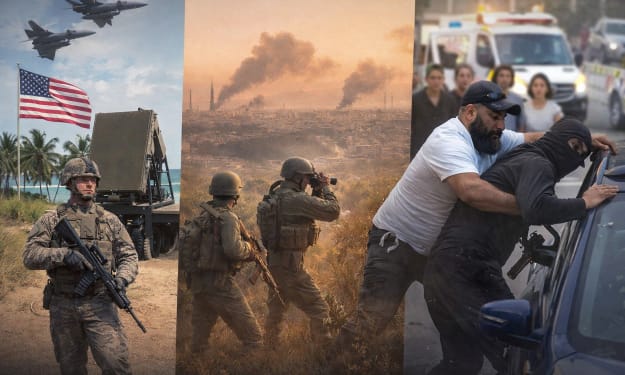
Over the past 48 hours, three major events unfolded across different parts of the world. At first glance, they appear disconnected. But when examined together, they form a coherent picture that sheds light on what may be quietly taking shape in the Middle East and beyond. Let’s start from the western edge of the map — Venezuela. According to reports published by Reuters and The Guardian, Trinidad and Tobago has allowed the United States to use its airports for military and logistical purposes. Days earlier, a sophisticated U.S. radar system was installed on the island of Tobago, and U.S. Marines were deployed on the ground. Officially, these moves were framed as part of “anti-crime” operations. Geography, however, tells a different story. Trinidad and Tobago lies just kilometers off the coast of Venezuela. A radar installation, military presence, and logistical air access in that location effectively create a forward monitoring and staging platform adjacent to a potential strategic target. Venezuela is not just another state. It holds the largest proven oil reserves in the world — approximately 303 billion barrels — surpassing Saudi Arabia, Canada, and Iran. Roughly 17% of global proven reserves lie beneath its soil. From Washington’s perspective, the issue is not the existence of this oil, but control. Nearly 85% of Venezuelan oil exports go to China, while Russia remains a close strategic ally of Caracas. This represents Chinese and Russian influence in what the U.S. has historically viewed as its strategic backyard. In a scenario where the Middle East enters a new phase of large-scale conflict, global energy markets would immediately come under extreme pressure. Securing a massive, nearby oil source in the Western Hemisphere would then become a strategic necessity, not a luxury. This context helps explain the recent U.S. escalation against President Nicolás Maduro, including the seizure of a Venezuelan oil tanker under the pretext of anti-narcotics enforcement. This brings us to the Middle East. In recent days, Israeli media outlets have openly discussed what they describe as a limited “window of opportunity” to decisively confront Hezbollah. Reports suggest preparations for expanded military operations not only in Lebanon, but also within Syrian territory. At the same time, U.S. diplomatic activity in Tel Aviv intensified. Israeli press leaks spoke of new security understandings that would grant Israel greater operational freedom to strike perceived threats in Syria. Taken together, these signals point toward an escalation in preparation — not speculation. Any significant military expansion in Lebanon or Syria would immediately dominate global media, diplomatic agendas, and financial markets. Oil prices would likely surge. Once again, the energy dimension connects directly back to Washington’s moves in the Caribbean. The third event appears, on the surface, to be unrelated — yet it may be the most revealing. During a Jewish religious gathering on Bondi Beach in Sydney, an armed attack resulted in multiple casualties. Within minutes, Israeli political and media discourse framed the incident as evidence of rising antisemitism and Islamist terrorism, accompanied by accusations that the Australian government had failed to protect Jewish communities. The speed and coordination of this narrative raised questions. The familiar “us versus them” framing emerged almost instantly — a pattern often seen when public opinion needs to be mobilized ahead of broader political or military actions. Then the narrative broke. Amid the chaos, an ordinary civilian intervened. Ahmed Al-Ahmad, a Syrian-born Australian fruit shop owner with no military or security background, used parked vehicles as cover, confronted one of the attackers, and despite being shot, managed to disarm him before police arrived. The moment was recorded and spread rapidly across global media. Suddenly, the story no longer fit the intended frame. The defining image was no longer “Muslims attacking Jews,” but a Muslim risking his life to save Jewish civilians — acting purely on human instinct, without regard to religion, ethnicity, or identity. This reversal placed several political figures in an uncomfortable position. Early attempts to portray the rescuer as Jewish were quietly abandoned once the facts became undeniable, forcing public acknowledgment that the man who saved lives was, in fact, Muslim. The strategic significance of this moment goes beyond symbolism. It disrupted a narrative that could have been leveraged to morally justify future escalation — a narrative built on portraying Muslims as inherent threats and violence as inevitable. When the three events are viewed together, a pattern emerges. The United States appears to be securing energy leverage in anticipation of regional instability. Israel appears to be preparing for expanded military action that would require political and media justification. And the incident in Australia had the potential to become a powerful emotional trigger within that justification framework. Instead, a single human act altered the storyline. Not a government decision. Not a military intervention. But one person choosing to act as a human being. Sometimes, global strategies unravel not because of armies or policies, but because reality refuses to follow the script.
By Echoes of the Soul2 months ago in Futurism