future
Exploring the future of science today, while looking back on the achievements from yesterday. Science fiction is science future.
Why 3D Printing Will Change the World
1984, Orwell’s prophetic year of Big Brother, saw the release of the Mac which broke the idea that centralized control could ever be what it was before. That year also saw the first workable prototype for a 3D printer. Built by Charles Hull, the technology was then known as stereolithography. We know it as 3D printing, and that’s a term that covers a variety of different processes which may revolutionize all stages of the global manufacturing and distributing process. In that very science fictional year, Hull set off a revolution that is only now seeing fruition. 3D printing continues to threaten the social and economic structures which preceded it. When we speak about 3D printing, we’re speaking of a general technique of printing successive layers to form a three dimensional object at the end. From powder to paper to human tissue, these thin membranes are laid down like the construction of a plaster mask. From that simple concept, the 3D printer offers the reverse of Ford’s mass production revolution. Printing one item is now as cost effective in some cases as manufacturing a thousand items in the traditional way.
By Chris Lites9 years ago in Futurism
Ghosts Amongst the Stars
The old man sat on the rock near the top of the small hill as he had for many years now and watched the first stars begin to peek out of the deepening purple sky. The boy at his side, watched solemnly, as he had for most of his young life. They sit in silence.
By Futurism Staff9 years ago in Futurism
Freeman Dyson's Vision of the Future
Professor Freeman J. Dyson has been discussing mind-boggling concepts in a calm, matter-of-fact, one-should-expect way since 1956. 'One should expect that within a few thousand years of its entering the stage of industrial development, any intelligent species should be found occupying an artificial biosphere which completely surrounds its parent star.' It is his hobby he says disarmingly, something that grew up alongside his career as one of the finest mathematical physicists of the last century. To his former colleagues at Princeton's Institute for Advanced Studies, Dyson was known for his understanding of what goes on in the core of a star or in the interaction of high-energy beams of subnuclear particles—contributions that earned him the American Institute of Physics' Heineman Prize and the Royal Society's Hughes Medal.
By George Gott9 years ago in Futurism
Is Technology Making Us Dumb?
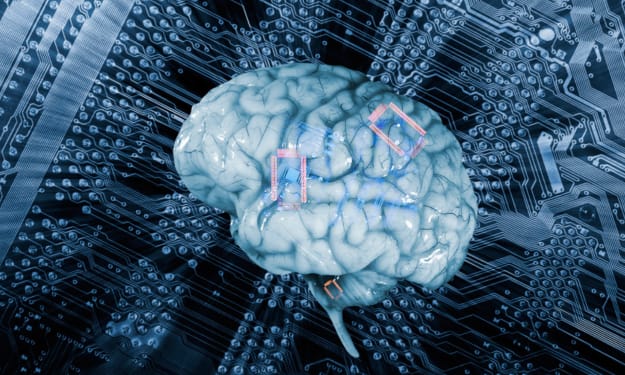
It won’t be long before computers can think faster and better than humans. Artificial Intelligence exists, and it is getting smarter at an incredible rate. As so many focus on how well machines can think, alarmingly few people are concentrating on how well humans are thinking (or rather, how they aren’t thinking as well as they used to). A side effect of epic proportions has accompanied our ventures into superior technology. We have become inseparable from our computers and, as time goes on, we are relying on them for more and more of our daily cognitive functions. The brain needs exercise. When you don't use it often enough, your abilities deteriorate. The resources at our disposal are enabling us to perform more advanced tasks faster than ever before, but when it comes to plain old thinking, is technology making us dumb? The answer is two sided. On one hand, our ability to locate information is exponentially higher. On the other, we are retaining far less than we ever have.
By Chelsea Pullano9 years ago in Futurism
The Five Holy Wounds of a Second Coming
9:00 am –– Thursday, April 14th 2033 There wasn't any room for the light. It could echo and bounce with no destination beyond entropic, move along little light. Presenter understood this, he felt most at home in the shadows, and their molesting reach dimming the flesh, dimming the speckled reminders. Pushing his sweat damaged linens off his gaunt frame, Presenter’s now upright body took aim at its beckoning stage. Joints cracked, or were they bones? Doesn't matter. He moved onwards, rising from the bed. The cracked and crusted eye sockets of his pale face were wiped and cleared, christened with the softness of the escaping sunlight. He wet his eyes with a yawn and unburdened himself with a throat clearing cough; reluctant to focus his sight, the parabolic flight of expulsion went unknown. Firmly composed, a blasé pace took Presenter over the refuse and across the threshold; entering the open concept kitchen, obeying his mandate.
By Joseph Somers9 years ago in Futurism
Can Technology Help Mankind's Moral Compass?
Guide, like most new technologies, began in a billionaire's dream of reason. The PR-generated story of Guide's origin posited it as a passion project of Metra's cofounder and longtime CEO. Its aim was simple, universal: help people act more rationally.
By Ken Baumann9 years ago in Futurism
3D Bioprinting is the Future of Transplants
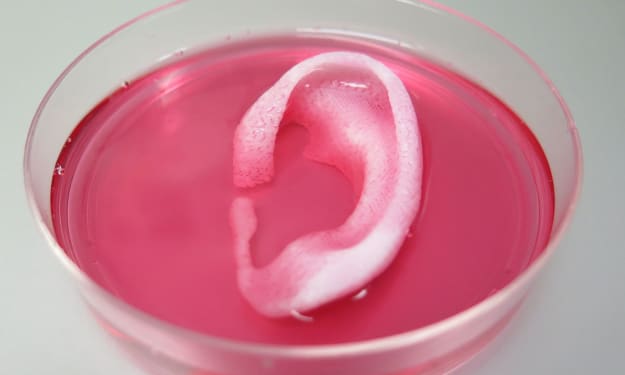
Imagine a world where there was no organ donor waiting list. A world where you would be able to get the organ you needed straight from a printer. According to Quartz, a Philadelphia-based company, BioBots, has released a printer that lets users 3D print human tissue and (potentially) human organs. In May of 2014, BioBots publicly launched at TechCrunch Disrupt in New York and printed a replica of Van Gogh’s ear for everyone to see. Currently, the printer works with a liquid mixture of different cells called “bio-ink.” This liquid is pressed through an extruder and fused together on the printer bed using blue light. A representative from the company told Quartz that the system could print out an object that has blood vessels and organ tissue at once, and the goal is to use this to create livers for drug testing and skins for cosmetic testing. This would eliminate the need for testing on humans and animals. However, BioBots isn’t the only company to create 3D printing for organs.
By Futurism Staff9 years ago in Futurism