
Exoplanets That Defy Classification — Even in Theory
Space

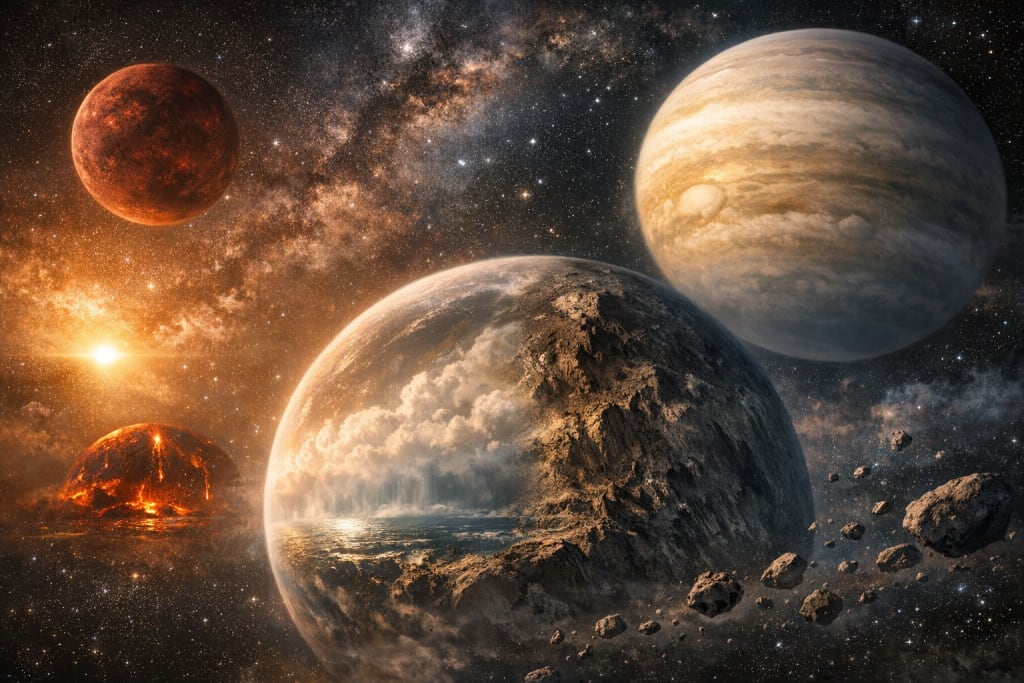
In 1990s, many expected them to resemble familiar worlds: rocky planets like Earth, gas giants like Jupiter, or icy bodies similar to Neptune. The assumption was simple—different systems, same basic categories. Reality, however, turned out to be far more imaginative.
Today, with more than five thousand confirmed exoplanets, scientists are facing an unexpected problem: some worlds simply refuse to fit into any existing classification. These planets are not just difficult to categorize due to limited data—they challenge planetary theory itself.
### Why Classifying Exoplanets Is So Difficult
Traditional planetary classification is built on our own Solar System. Planets are grouped by size, composition, and distance from their star. But exoplanets exist under conditions that have no local analogs: extreme temperatures, ultra-short orbital periods, bizarre atmospheric chemistry, and densities that seem physically contradictory.
Complicating matters further, most exoplanets are detected indirectly. Astronomers infer their properties by observing how a planet dims its star during a transit or causes the star to wobble gravitationally. From this, scientists estimate mass and radius—but not internal structure. As a result, the same planet can be interpreted in multiple, often conflicting ways.
### The Super-Earth or Mini-Neptune Dilemma
One of the most confusing categories involves planets between about 1.5 and 2.5 times Earth’s radius. These worlds—often labeled *super-Earths* or *mini-Neptunes*—do not exist in our Solar System.
Some of them may be rocky planets with thick, hydrogen-rich atmospheres. Others may be gas-dominated worlds with small, dense cores. But there are planets whose average density falls in between, making neither explanation fully convincing.
In some theoretical models, these planets could contain vast layers of supercritical water—neither liquid nor gas—hidden beneath a dense atmospheric envelope. Such worlds are not quite rocky, not quite gaseous, and not truly ocean planets either. They occupy a gray zone that planetary science is still struggling to define.
### The Mystery of “Puffy” Planets
Even more perplexing are the so-called *puffy* exoplanets. These planets can have radii comparable to Jupiter but masses closer to Saturn—or even less. Their densities are so low that, in theory, they could float in water.
The leading explanation is intense heating from their host stars, which causes their atmospheres to expand dramatically. However, some puffy planets orbit stars that are not energetic enough to explain their enormous size. This suggests that unknown internal heat sources, tidal effects, or exotic atmospheric chemistry may be at work.
For theorists, these planets are deeply uncomfortable. They exist, they are observable—but no model fully explains them.
### Planets That Change Their Nature
Some exoplanets are not just hard to classify—they may actively change their physical state over time. On highly eccentric orbits, a planet may swing extremely close to its star, losing much of its atmosphere, only to cool down and partially recover it later.
At one point in its orbit, such a planet may resemble a gas-rich world; at another, it may look like a stripped rocky core. This raises a fundamental question: what is the “true” identity of the planet? Is it defined by its core, its atmosphere, or its average condition over time?
From a classification standpoint, these planets are a nightmare.
### Where Planets Blur Into Brown Dwarfs
There is also a mass range where planets begin to overlap with brown dwarfs—objects too large to be planets in the traditional sense, yet too small to sustain full stellar fusion.
These massive exoplanets, often between 10 and 20 times the mass of Jupiter, may look like planets in orbit—but their formation history tells a different story. Some likely formed the way stars do, through the collapse of a gas cloud, rather than by slowly accumulating material in a disk.
Should classification depend on mass, formation mechanism, or internal physics? Astronomers still disagree, and these borderline objects remain in conceptual limbo.
### Worlds With No Earthly Physics
Some exoplanets push physics itself to the edge. On ultra-hot worlds with surface temperatures exceeding 2,500°C, rock vaporizes. Their atmospheres contain metal vapors like iron, titanium, and silicon. On the night side, these metals may condense and fall as metallic rain.
These are often called *lava planets*, but even that term feels inadequate. Their geology, weather, and atmospheric circulation operate in regimes where standard planetary science barely applies. They are not simply “hot Earths”—they are something fundamentally different.
### Why These Unclassifiable Planets Matter
Ironically, the most confusing exoplanets may be the most scientifically valuable. They expose the limits of our theories and force astronomers to rethink how planets form, evolve, and survive.
Each unclassifiable world is a natural experiment—one that cannot be recreated on Earth. By studying them, scientists gain insight not only into distant systems, but into the deeper principles governing matter, gravity, and planetary evolution.
### A Future Full of Anomalies
As next-generation telescopes begin to probe exoplanet atmospheres in greater detail, some mysteries will be solved. But many researchers suspect that clarity will come with a price: even more planetary oddities.
The universe, it seems, has little interest in fitting neatly into our categories. And perhaps that is the most exciting discovery of all. Exoplanets that defy classification remind us that science advances not when everything makes sense—but when it doesn’t.
About the Creator
Keep reading
More stories from Holianyk Ihor and writers in Futurism and other communities.
Worlds with an Extremely Short Daylight Cycle
On Earth, the rhythm of life is deeply tied to a simple and familiar pattern: day follows night, night follows day, and one full cycle takes 24 hours. This steady cadence has shaped everything from human biology to global climate systems. But beyond our Solar System, this comforting regularity quickly breaks down. In the vast diversity of exoplanets discovered so far, astronomers have identified worlds where daylight lasts only a few hours—or even less. On such planets, the Sun barely rises before it sets again, and the very concept of a “day” becomes something alien.
By Holianyk Ihorabout 5 hours ago in Futurism
Australia Wearables Market: Smart Gadgets, Consumer Tech & the Future of Connected Living
According to IMARC Group, the Australia wearables market reached a value of USD 3.0 Billion in 2025 and is projected to expand significantly to USD 10.0 Billion by 2034, exhibiting a strong compound annual growth rate (CAGR) of 14.16% during 2026–2034. This rapid expansion reflects the growing integration of wearable technology into everyday life, as consumers increasingly rely on smart devices to monitor health, enhance safety and stay connected. Wearables have evolved from basic fitness trackers into multifunctional personal technology platforms, combining advanced sensors, connectivity and design-driven appeal. As healthcare awareness, aging demographics and digital lifestyles converge, wearable devices are becoming essential tools for preventive health management and personalized data insights across Australia.
By Shrestha Roy2 days ago in Futurism
Why Is the B2B Payments Market Undergoing a Major Digital Transformation?
Business-to-business payments form the backbone of global trade and commerce. Every transaction between manufacturers, suppliers, distributors, wholesalers, and service providers depends on reliable payment systems. Unlike consumer payments, B2B payments often involve large transaction values, longer payment cycles, multiple approval layers, and complex documentation. Because of this complexity, B2B payments have traditionally relied on manual and paper-based processes.
By Rohit Shah4 days ago in Futurism
~ Fired ~
— Ai Intrusion ~ Are you Next ~ Is Ai Evolution after your job? — Few workplaces haven't been affected. Ai is in supermarkets, at doctors' offices, and even monitoring farms. I just can't think of anything this machine is not getting into, can you? For instance: Education ~ Law and Tech jobs will one day have a major influence or be taken over by these inanimate machines, with accuracy and vigor. From mechanics' diagnoses to a wide variety of everyday jobs, including fast food workers, with this input having the ability to cut their unnecessary work hours. I'm certain all of us have been touched by this with our short stories and colorful headings, have you? Even comments are very questionable 'Non-Robot' insertions.
By Jay Kantor5 days ago in Journal




Comments
There are no comments for this story
Be the first to respond and start the conversation.