
Worlds with an Extremely Short Daylight Cycle
Space

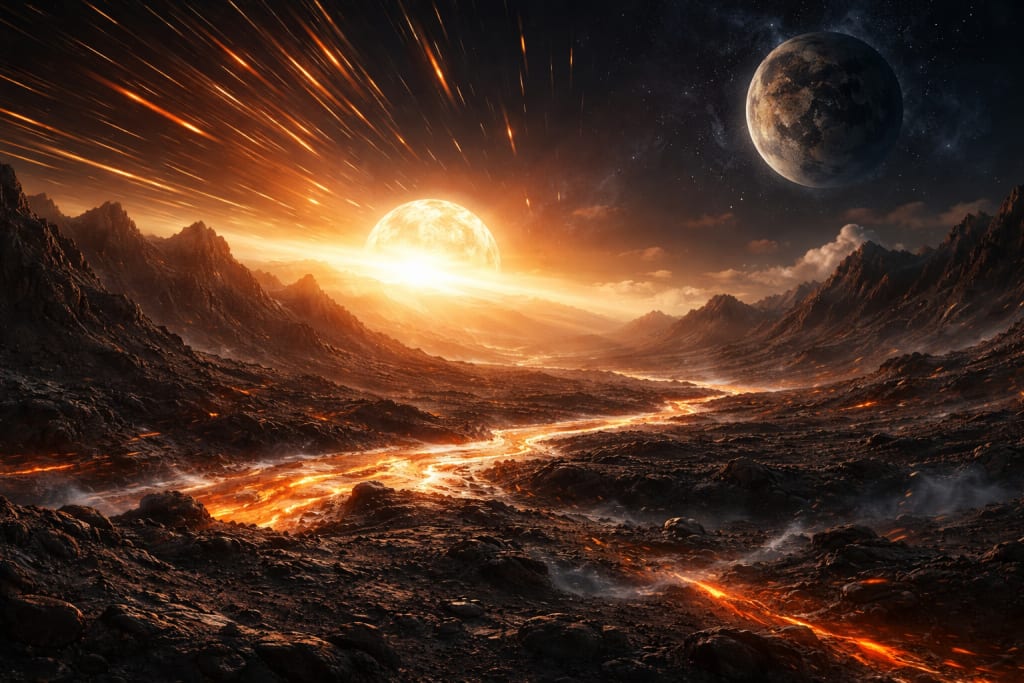
On Earth, the rhythm of life is deeply tied to a simple and familiar pattern: day follows night, night follows day, and one full cycle takes 24 hours. This steady cadence has shaped everything from human biology to global climate systems. But beyond our Solar System, this comforting regularity quickly breaks down. In the vast diversity of exoplanets discovered so far, astronomers have identified worlds where daylight lasts only a few hours—or even less. On such planets, the Sun barely rises before it sets again, and the very concept of a “day” becomes something alien.
### What Determines the Length of a Day?
A planet’s daylight duration depends primarily on how fast it rotates on its axis. Faster rotation means a shorter day. While Earth completes one rotation in 24 hours, some planets spin much more rapidly. In our own Solar System, Jupiter holds the record, completing a full rotation in just under 10 hours. But Jupiter is a gas giant—large, fluid, and structurally different from rocky planets.
Among exoplanets, especially young and violent planetary systems, rotation rates can be even more extreme. Planetary collisions, gravitational interactions with nearby bodies, or the chaotic aftermath of formation can impart enormous angular momentum. The result is a planet spinning like a cosmic top, with daylight cycles measured in mere hours.
### Rocky Planets That Spin at Breakneck Speed
The most fascinating candidates for ultra-short daylight cycles are rocky exoplanets. Theoretical models suggest that some solid worlds could rotate once every two to four hours. On such a planet, the host star would race across the sky, rising and setting with startling speed. A sunrise might last only minutes, followed by a brief, intense noon and an equally rapid sunset.
Unlike Earth, these planets would struggle to develop stable climate zones. There would be no long afternoons, no gradual cooling toward evening. Instead, the surface would be locked in a constant cycle of rapid heating and cooling, forcing both geology and atmosphere into a state of near-permanent instability.
### A Sky in Constant Motion
Standing on the surface of a planet with an extremely short daylight cycle would feel profoundly disorienting. Shadows would stretch, shrink, and disappear in a matter of minutes. The sky would change color rapidly, with frequent transitions between the bright glare of daylight and the deep hues of twilight.
If the planet has an atmosphere, light scattering could produce repeated flashes of red, orange, and violet as the star repeatedly grazes the horizon. Instead of a single sunrise and sunset each day, the planet would experience a rapid-fire sequence of them, creating a sky that never truly settles.
### Climate Without Balance
On Earth, the length of the day helps regulate temperature. Land and oceans absorb heat during the day and slowly release it at night, smoothing out extremes. On a fast-spinning planet, this balance breaks down.
Surface temperatures could swing dramatically within hours. Rocks might heat to extreme levels during brief daylight, then cool rapidly once darkness falls. This constant expansion and contraction of the crust could trigger intense tectonic activity—frequent earthquakes, volcanic eruptions, and possibly global lava flows.
If oceans exist, they would never be calm. Rapid temperature changes and powerful winds driven by atmospheric instability could generate enormous waves and persistent storms. Weather on such a planet would not follow predictable patterns; instead, it would resemble a planet-wide state of chaos.
### The Challenge for Life
Life as we know it would struggle under these conditions. Biological processes on Earth are tuned to relatively stable day-night cycles. Photosynthesis, circadian rhythms, and temperature tolerance all depend on predictable patterns.
However, astrobiology teaches us not to underestimate nature’s adaptability. On worlds with ultra-short days, any potential life would likely avoid the surface altogether. Subsurface environments—beneath thick rock layers or under deep oceans—could offer protection from extreme temperature swings.
Alternatively, life might rely on chemical energy rather than starlight, similar to Earth’s deep-sea organisms near hydrothermal vents. In such ecosystems, the length of the day would be largely irrelevant.
### Why Scientists Study These Extreme Worlds
Planets with extremely short daylight cycles are more than just curiosities. They serve as natural laboratories for understanding the limits of planetary physics. By studying them, scientists learn how fast a rocky planet can rotate before it begins to tear itself apart, and how atmospheres behave under extreme rotational forces.
These worlds also provide clues about planetary evolution. Many planets may begin their lives spinning rapidly, only slowing down over billions of years due to tidal interactions with their stars. Observing fast rotators allows astronomers to glimpse what planets might look like in their youth—including what early Earth could have been like shortly after its formation.
### Rethinking the Meaning of a “Day”
Worlds with extremely short daylight cycles challenge one of our most basic assumptions: that a day is something long, gentle, and predictable. On these planets, daylight is fleeting, the sky is restless, and the environment never truly settles into equilibrium.
They remind us that Earth’s calm, 24-hour rhythm is not a universal standard, but a fortunate exception. Somewhere in the galaxy, there are planets where noon comes and goes in the time it takes us to drink a cup of coffee—and where night falls almost as soon as the Sun appears.
By studying these strange, fast-spinning worlds, we expand not only our scientific knowledge, but our imagination. They show us just how flexible the concept of a “world” can be—and how diverse the universe truly is.
About the Creator
Keep reading
More stories from Holianyk Ihor and writers in Futurism and other communities.
Exoplanets That Survived Planetary Collisions
When we imagine planets, we often think of calm, stable worlds tracing predictable paths around their stars for billions of years. But the reality of planetary systems—especially in their early stages—is far more violent. Young systems are chaotic environments where worlds migrate, gravitationally interact, and sometimes collide at unimaginable speeds. Remarkably, some exoplanets we observe today appear to have *survived* massive collisions with other planets, carrying the scars of ancient cosmic disasters.
By Holianyk Ihora day ago in Futurism
Data Center Generator Market Outlook: Power Reliability and Growth Opportunities
Rising demand for uninterrupted power supply, rapid expansion of data centers, and increasing reliance on cloud computing are driving growth in the data center generator market. According to IMARC Group's latest research publication, The global data center generator market size was valued at USD 7.81 Billion in 2024. Looking forward, IMARC Group estimates the market to reach USD 12.45 Billion by 2033, exhibiting a CAGR of 4.77% during 2025-2033.
By James Whitman5 days ago in Futurism
Payment Monitoring Market Outlook: Fraud Prevention and Growth Opportunities
According to IMARC Group's latest research publication, The global payment monitoring market size was valued at USD 20.36 Billion in 2024. Looking forward, IMARC Group estimates the market to reach USD 68.49 Billion by 2033, exhibiting a CAGR of 14.43% from 2025-2033.
By Michael Richardabout 18 hours ago in Futurism
Writing About Writing: The Rainbow Trap
The good thing about living in modern times is that LGBTQ representation in media is increasing. Not just in niche and Independant media, either, but also in mainstream media. Books, movies, TV shows, comics... they're finally catching on that LGBTQ+ people form a significant part of their audience, and deserve to see themselves on screen and in fiction, not just as victims in documentaries and true crime shows.
By Natasja Rose3 days ago in Writers




Comments
There are no comments for this story
Be the first to respond and start the conversation.