
Exoplanets That Survived Planetary Collisions
Space

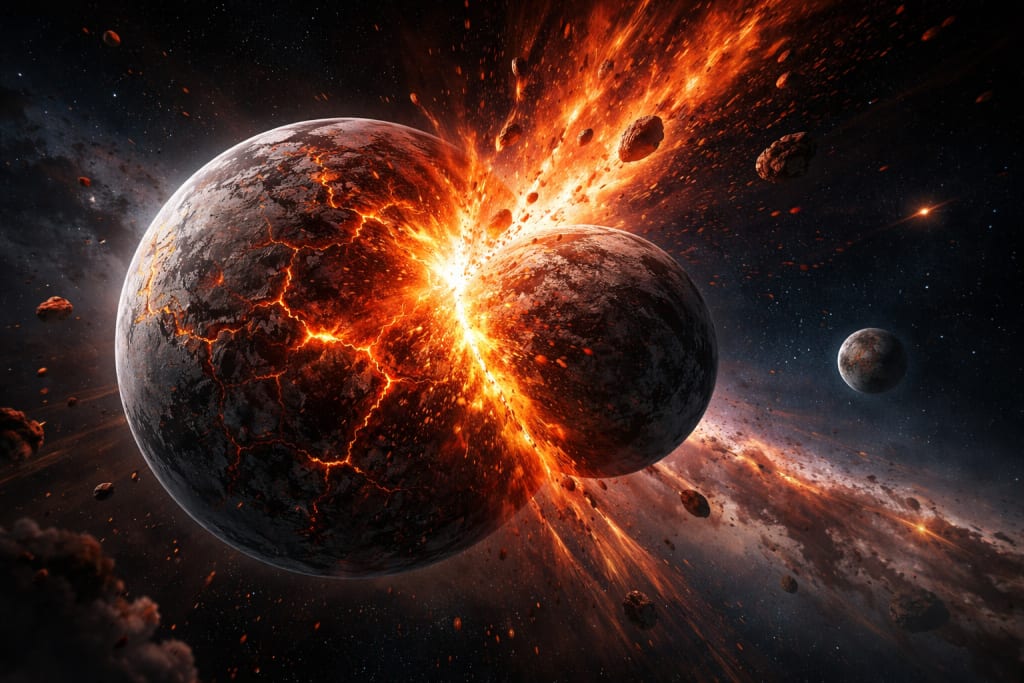
When we imagine planets, we often think of calm, stable worlds tracing predictable paths around their stars for billions of years. But the reality of planetary systems—especially in their early stages—is far more violent. Young systems are chaotic environments where worlds migrate, gravitationally interact, and sometimes collide at unimaginable speeds. Remarkably, some exoplanets we observe today appear to have *survived* massive collisions with other planets, carrying the scars of ancient cosmic disasters.
### A Violent Beginning for Planetary Systems
Modern theories of planet formation suggest that most planetary systems begin in turmoil. After a star is born, it is surrounded by a protoplanetary disk of gas, dust, and debris. Within this disk, countless small bodies collide and merge, gradually forming larger planetary embryos. These early planets do not immediately settle into stable orbits. Instead, they drift, resonate, and frequently cross each other’s paths.
During this unstable phase, close encounters between planets are common. Some worlds are flung out of their systems entirely, becoming rogue planets drifting through interstellar space. Others spiral into their stars. And in some cases, two planets collide directly—releasing more energy than billions of nuclear weapons detonating at once.
### What It Means to “Survive” a Collision
A planetary collision does not always result in total destruction. The outcome depends on several factors: the masses of the bodies involved, their relative velocities, and the angle of impact. A head-on collision at high speed may completely shatter one or both planets. But a glancing blow can produce a very different result.
An exoplanet that survives a collision may lose its atmosphere, shed part of its mantle, or experience dramatic changes in rotation and orbit. If the remaining body stays gravitationally bound and continues to orbit its star, astronomers consider it a survivor—albeit a heavily altered one.
### Dense Super-Earths as Collision Survivors
One of the strongest pieces of evidence for ancient planetary collisions comes from unusually dense exoplanets. Some super-Earths—planets several times more massive than Earth—have radii that are surprisingly small for their mass. This implies extremely high density and an unusually large metal content.
Scientists believe these planets may be the exposed cores of once-larger worlds. A colossal impact could have stripped away much of the rocky mantle, leaving behind a metal-rich remnant dominated by iron. In essence, we may be observing the naked core of a former planet. Mercury in our own Solar System is sometimes considered a mild example of this process, but some exoplanets appear to be far more extreme.
### Atmospheres Lost to Catastrophe
Another telltale sign of a past collision is the absence of an atmosphere. Planetary impacts generate tremendous heat, briefly turning solid rock into magma oceans. This intense heating can blow away thick atmospheres into space, especially if the planet’s gravity is weakened or its orbit shifts closer to its star.
Some rocky exoplanets found very close to their stars appear to be airless, scorched worlds. While stellar radiation certainly plays a role in atmospheric loss, collisions may have delivered the initial blow—removing the atmosphere and leaving the planet vulnerable to further erosion by stellar winds and radiation.
### Altered Rotation and Tilt
Collisions do more than reshape a planet’s composition; they can radically alter its motion. A powerful impact can change how fast a planet spins or tilt its axis to an extreme angle. In our Solar System, Uranus is thought to have been knocked onto its side by a massive collision early in its history.
For exoplanets, directly measuring axial tilt is extremely difficult. However, astronomers can sometimes infer unusual rotational or thermal behavior. For example, strange temperature distributions across a planet’s surface or unexpected atmospheric circulation patterns may hint at an extreme axial tilt inherited from a violent past.
### Debris, Moons, and Second Chances
Planetary collisions can also create, rather than merely destroy. When two rocky worlds collide, enormous amounts of debris may be thrown into orbit around the surviving planet. Over time, this debris can form disks and eventually coalesce into moons—or even smaller secondary planets.
While such systems have not yet been definitively observed around exoplanets, they remain a compelling possibility. Future telescopes may detect moons or debris structures that serve as direct evidence of ancient planetary impacts.
### Why These Worlds Matter
Exoplanets that survived collisions are invaluable to planetary science. They act as natural laboratories for studying extreme physics—pressures, temperatures, and compositions far beyond anything found on Earth. By examining these planets, scientists can test and refine models of planetary formation and evolution.
They also challenge our assumptions about what makes a planet “normal” or “stable.” A world that appears quiet today may have endured catastrophes that reshaped it completely. Understanding this violent history helps astronomers better interpret the diverse and often surprising exoplanets now being discovered.
### The Universe as a Record of Ancient Violence
Every exoplanet tells a story. In some cases, that story includes colossal impacts that forever changed the planet’s destiny. Dense metal-rich worlds, airless rocky planets, and systems with unusual dynamics may all be survivors of planetary collisions that occurred billions of years ago.
As detection methods improve and new observatories come online, astronomers will likely identify even more of these cosmic survivors. Each one adds another chapter to the story of how chaotic, destructive, and yet remarkably creative the process of planet formation truly is.
In the end, planetary collisions are not rare anomalies—they are a fundamental part of how the universe builds its worlds.
About the Creator
Keep reading
More stories from Holianyk Ihor and writers in Futurism and other communities.
Worlds Where the Night Is Hotter Than the Day
On Earth, the rhythm of temperature feels intuitive. When the Sun rises, the ground warms. When darkness falls, heat slowly leaks back into space. Day means warmth; night means cooling. This pattern is so deeply ingrained in our everyday experience that it feels almost universal. Yet beyond the Solar System, astronomers have discovered worlds where this logic completely breaks down. On some distant planets, night is not a time of cooling at all. Instead, the darkness can be hotter than the blazing day.
By Holianyk Ihorabout 17 hours ago in Futurism
Abrasives Market: Metal Fabrication Demand, Precision Grinding & Market Growth
According to IMARC Group's latest research publication, The global abrasives market size reached USD 49.9 Billion in 2024. Looking forward, IMARC Group expects the market to reach USD 74.4 Billion by 2033, exhibiting a growth rate (CAGR) of 4.31% during 2025-2033.
By James Whitman7 days ago in Futurism
The Last Sunrise on Mars
The red dust stretched endlessly under the thin Martian sky, glowing softly as the first rays of the sun crept over the horizon. Commander Tariq Alvi stood on the observation deck of the settlement, his gloved hands pressed against the cold, reinforced glass. This was the moment he had been waiting for—the last sunrise he would witness on Mars before returning to Earth.
By Sudais Zakwana day ago in Futurism
Self Help: Grifters' Gospel
On Self-Help, Snake Oil, and the Illusion of Change Psychology professionals and students can be imagined on two opposite sides of a line called self-help books: likely a larger group opposes pop-science and step-by-step manuals filled with talk of success, journaling, and not giving a f**k; others love them, but they aren’t many.
By Avocado Nunzella BSc (Psych) -- M.A.P 4 days ago in BookClub


Comments
There are no comments for this story
Be the first to respond and start the conversation.