
The Weight of Unfinished Melodies
A Requiem for the Echoes We Chose to Leave Behind


The dust motes in Julian’s apartment didn’t just float; they performed a slow, agonizing ballet in the shafts of the late afternoon sun. To Julian, they looked like the debris of a thousand forgotten conversations, settling on the mahogany surface of a piano that hadn't felt the warmth of human fingertips in over a decade. He sat in his velvet armchair, a glass of amber liquid trembling slightly in his hand, watching the shadows stretch across the floorboards like ink spilling over a pristine map.
Julian had been a prodigy once. The kind of name that was whispered in the hallowed halls of the Vienna Conservatory with a mixture of awe and envy. They called his technique "transcendental," as if his hands weren't made of bone and sinew, but of the very vibrations that connected the earth to the stars. But that was before the silence. That was before the night the music died, not with a bang, but with the soft click of a door closing—a door Clara had walked through, taking the rhythm of his heart with her.
He looked at the piano now. It was a Steinway, a beast of iron and ivory that seemed to mock him in its stillness. Clara had loved that piano. She would sit on the bench, her auburn hair falling like a curtain over her shoulders, and play Satie with such a delicate touch that the air itself seemed to weep. Julian would watch her from the doorway, his chest tightening with a love so fierce it felt like a physical weight. They were supposed to compose a life together—a grand, sweeping symphony of shared dreams and crescendos. Instead, they had become a dissonant chord that simply stopped mid-measure.
"You're haunting yourself, Julian," his sister, Elena, had told him a week ago, her voice sharp with a concern he didn't want to hear. "The world is still turning. There are new songs being written every day. You can't stay in this mausoleum forever."
But Julian knew better. He wasn't staying; he was waiting. He was waiting for the one note that would make sense of the void. He was waiting for the courage to touch the keys and find that the music was still there, buried under layers of grief and static.
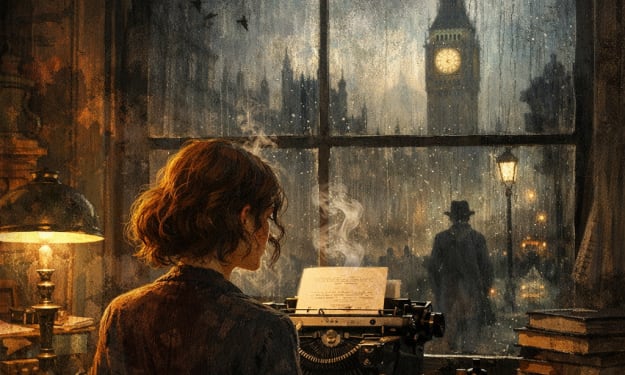
He stood up, his joints protesting the movement, and walked toward the window. Below, the streets of London were alive with the frantic energy of people who still believed in the future. They hurried along the pavement, clutching umbrellas and cell phones, their lives a blur of motion and sound. Julian felt like a ghost watching a film from a projection booth—present, but entirely disconnected from the narrative.
His gaze fell on a small, leather-bound notebook resting on the windowsill. It was Clara’s. He hadn't opened it in ten years. He reached out, his fingers brushing the worn cover, and felt a jolt of electricity that made his breath catch. He opened it to the middle, where a single sheet of staff paper had been tucked away.
It was a composition, handwritten in Clara’s elegant, hurried script. “The Unfinished Waltz for a Rainy Tuesday.”
Julian’s eyes scanned the notes. It was a melody he didn't recognize, a haunting, minor-key theme that seemed to spiral upward before abruptly cutting off at the bottom of the page. There were no markings for tempo or dynamics. It was just a skeleton of a thought, a fragment of a soul left behind in the rush of departure.
Suddenly, the silence in the room became unbearable. It pressed against his eardrums like the weight of the ocean. Without thinking, Julian moved toward the piano. He sat on the bench, the leather cool beneath him. He lifted the fallboard, revealing the keys—pristine, white, and terrifying.
He placed his right hand on the middle C. His skin looked pale against the ivory, his veins standing out like blue rivers. He took a deep breath, the scent of lemon polish and old wood filling his lungs, and pressed the first note of Clara’s unfinished waltz.
Plink.
The sound was lonely. It hung in the air, vibrating against the walls, before fading into nothingness. He played the next note, then the next. Slowly, tentatively, his fingers began to find the rhythm. The melody was bittersweet, a conversation between two people who were no longer on speaking terms. It spoke of missed opportunities, of words swallowed in the heat of an argument, and of the quiet, devastating realization that some things can never be repaired.
As he reached the end of the written notes, Julian didn't stop. His left hand joined in, providing a deep, resonant bass that gave the melody wings. He began to improvise, his mind visualizing Clara standing by the window, her silhouette framed by the fading light. He played for the nights they spent talking until dawn. He played for the way she used to hum in her sleep. He played for the anger, the betrayal, and finally, for the crushing loneliness of the aftermath.
The music filled the apartment, breaking through the layers of dust and stagnant air. Julian wasn't a prodigy anymore; he was a man breaking a fever. His movements grew more frantic, his hands flying across the keys with a desperate, beautiful violence. The symphony was no longer Clara’s; it was theirs. It was the sound of a decade of silence being shattered in a single, glorious moment of expression.
When he finally struck the last chord—a resounding, defiant major seventh—the room seemed to vibrate with the force of it. Julian sat still, his chest heaving, his forehead resting against the wood of the piano. He waited for the echoes to die down, for the silence to return and reclaim its territory.
But the silence was different now. It wasn't a void anymore. It was a space that had been cleared.
He looked at the notebook, at the unfinished waltz that he had finally brought to a close. He realized then that Clara hadn't taken the music with her. She had simply left him the task of finishing the song.
Julian stood up, walked to the kitchen, and poured the remainder of his drink down the sink. He looked at the reflection in the window—a man who was older, tired, but finally, undeniably, alive. He picked up his coat and walked toward the door. For the first time in ten years, he didn't look back at the piano. He didn't need to. The melody was no longer in the room; it was in his stride.
As he stepped out into the London night, the rain began to fall, tapping out a brand new rhythm on the pavement. Julian adjusted his collar, took a deep breath of the damp air, and started to walk. He didn't know where he was going, but for the first time in a long time, he was eager to hear what happened next.
About the Creator
Cordelia Vance
Lost in the ink-stained corridors of a life lived through pages. I write to capture the whispers of ghosts we pretend not to hear and the shadows we call home. Welcome to my attic of unspoken truths.
Keep reading
More stories from Cordelia Vance and writers in Fiction and other communities.
The Anatomy of a Silent Room
In the quietest hour of the night, when the rest of London is nothing but a distant hum of neon and regret, my attic room begins to breathe. It’s a rhythmic, dusty inhalation that smells of old paper and the lingering scent of Earl Grey tea that went cold hours ago. I am Cordelia, and I am a collector of silences. People think silence is a void, a lack of sound. They are wrong. Silence is a heavy, velvet thing; it has texture, weight, and if you listen long enough, it has a voice that sounds remarkably like your own, but from a life you’ve forgotten to live.
By Cordelia Vanceabout 18 hours ago in Fiction
Kitten's Kitchen
In a charming little town, nestled among blooming gardens and surrounded by quiet meadows, there once lived a kind and worthy widow whom everyone simply called Grandmother. Her given name had long faded from people’s memory, for she had never sought fame, but only to be of service to others. Her small cottage, with its carved shutters, stood at the edge of town beside an old lilac bush that blossomed each spring so abundantly it seemed to comfort its mistress with fragrance alone.
By Ludmila Pachadgiabout 2 hours ago in Fiction
This Is What I Do When People Throw Rocks At Me
Rocks have been thrown at me for a greater part of my life. Some have been small and missed hitting me. When people don't get a reaction from me, they throw bigger rocks with a better aim. Many have been hurled at me with precision over the years. For a long time, I thought my only options were to dodge them or be crushed by them.
By Margaret Minnicks4 days ago in Confessions


Comments
There are no comments for this story
Be the first to respond and start the conversation.