history
Iconic food and gustatory moments in history.
The "Champagnes" of the Food World
Most of us are familiar with Champagne, along with other drinks like Bourbon and Scotch, whose very existence and identity is defined by geographical origins. If your sparkling wine does not come from France’s Champagne region, then it is not Champagne; it is merely sparkling wine. There’s a vast array of alcoholic beverages that are identifiable strictly by their provenance, the importance of their place of origin. But what you might not know is that the food world is very much the same. Much like alcoholic beverages, there are both international and regional legal mechanisms that have been put in place to protect the provenance of various foods. This ranges from cheeses (the kingpin of global food provenance and geography-based protections), to tea, to potatoes, and across all corners of the globe, from Roquefort-sur-Souizon, France, to Yunnan in China, to Idaho in the United States. This list is by no means exhaustive, but rather it is merely a glimpse into the extremely important role that geography and politics play in the foods we eat every day. These are some of the "Champagnes" of the food world.
By Logan Carmichael8 years ago in Feast
5 Ways the Cold War Shaped Today's Global Food Landscape
Unless you're over the age of 30, you probably haven't lived through, or don't remember, the Cold War, a decades-long ideological battle between the American-led West and Soviet-led East. But regardless of whether you recall the Cold War or not, its legacy lives on in some unexpected ways, including in the way we eat food across this planet. Here are just a few of the ways that the Cold War shaped our foods today.
By Logan Carmichael8 years ago in Feast
Blessed Be Thy Pretzel. Top Story - December 2017.
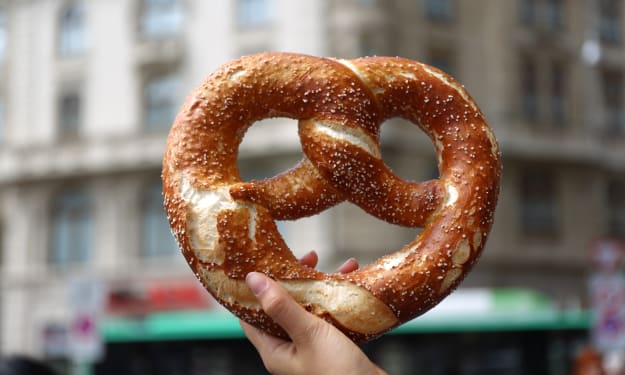
Ahhh, pretzels. Undeniably the most popular party snack and an absolute staple of modern-day American mall food. Restaurants serve them as appetizers and main dishes, and hell, there are even entire companies based around the production of pretzels, whether they be bagged or handmade at a stand in their one of their many forms. They can be crunchy or doughy, big or small, salted or unsalted, covered in cinnamon or covered in cheese—as a food, they are an absolute marvel.
By Brittany K. King8 years ago in Feast
Is the Sushi You're Eating Really Sushi?
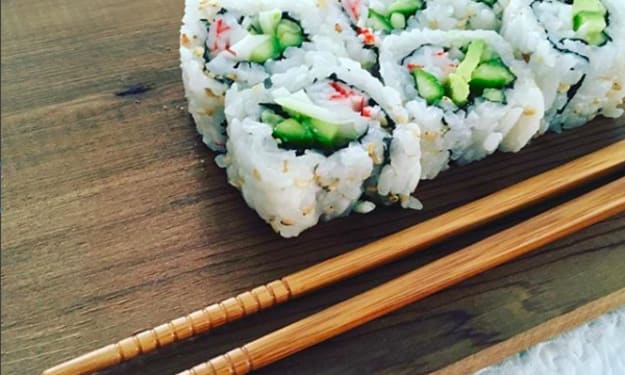
Well this is the start of what hopefully will be a successful food tirade from a young aspiring Canadian chef. I thought however, why not start off my "Vocal" food profile with mine and millions of others' favourite food, sushi.
By Francesco Sacco8 years ago in Feast
Peeling Back the Banana Industry
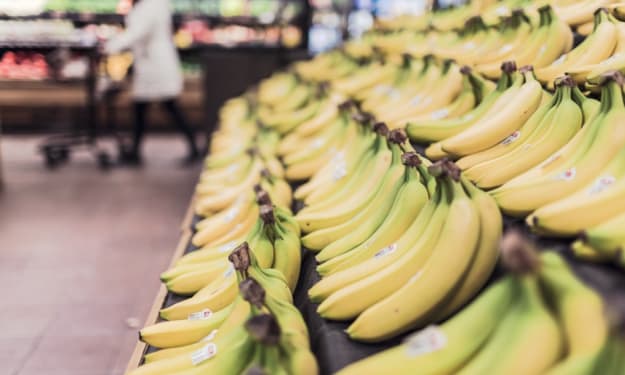
I’ve got beef with the banana industry. Why? It’s hard to believe that peeling back the familiar yellow facade reveals such a dark and abusive industry. Bananas are the favourite fruit of a number of the world’s developed countries, including — but certainly not limited to — the United States, Britain, and Canada, with 7.1 billion, 2.5 billion, and 3 billion banana consumed annually, respectively, in 2015. With over 107 million tonnes produced per year, bananas comprise a massive industry, one that is highly, highly concentrated in the hands of three major corporations: Dole, Del Monte, and Chiquita.
By Logan Carmichael8 years ago in Feast
The Jewish History of Honey
Israel: a sacred land for Jews, Christians, Islam, Druze and Bahá'í Faith—a land of milk and honey. Honey, a simply delicious golden syrup that is made by bees and devoured by humans. Honey has a very cozy place in my heart. I could eat an entire jar of fresh local honey in a day: on top of toast, in my tea, on yogurt and granola, or on a spoon. It is very often eaten during one specific holiday, Rosh Hashanah. Parents tend to give their kids sweets made with honey: honey cake, honeycomb candy, and Bit-O-Honey, as a treat for the New Year. My family was more traditional and did honey and challah bread dipped in local honey.
By Emma Bukovsky8 years ago in Feast
Plen-tea to Talk About...
Tea. The national drink of Britain. We cannot get enough of the stuff. Whether it’s a warm or cold day, we will still faithfully put the kettle on like the automatons that we are. Forget the pop culture of today surrounding tea, let’s explore the deeper, and arguably murkier, depths that revolve the academic study of it.
By Elisabeth Millard8 years ago in Feast
Gender, Age, and Rationing
The traditional family structure in its idealized form has the father working and earning money to support his wife and children, the wife running the home, and the children going to school and playing, blissfully innocent and carefree. In the best case scenario, the father is able to provide for his family and they benefit from his labor, but the best case scenario very rarely reflects reality. In times of war, the traditional workers and breadwinners are sent off to fight and the civilians at home must step out of their usual roles. Women take on jobs outside the home to help the war effort and to support themselves and their children. A child’s innocence is threatened by the harsh and brutal realities of war. Both have to do without the pleasures they had previously enjoyed and often suffer from outright deprivation. The experiences of civilians during the First and Second World Wars, especially in rationing and the efforts to keep them fed, illustrate how war reverses society’s roles: In peacetime, men work to support women and children while in wartime, women and children must fend for themselves.
By Rachel Lesch9 years ago in Feast
How People Prepared Food in the Dark Ages
Cooking is one of the most human acts that you can perform. The art of cooking is something that has bonded people together, become a part of our cultural identities, and also become part of our history. Though the very basics of cooking never seem to change, the truth is that cooking styles do change over the years.
By Ossiana Tepfenhart9 years ago in Feast
What Is Umami?
The other day, I got my friend to try a Vegemite sandwich. Though I'm American, I absolutely love Vegemite. I love the umami taste it offers, and I tried to explain why it's so tasty to people who aren't from New Zealand and Australia before. It's not easy. The conversation usually goes like this:
By Ossiana Tepfenhart9 years ago in Feast