
Why Edge Computing Is Gaining Momentum in 2026?
As artificial intelligence workloads intensify, real-time applications become mainstream, and data sovereignty pressures mount across regions, computing is moving closer to where data is generated — not as a theoretical shift, but as an operational necessity reshaping network design, enterprise architecture, and the economics of digital infrastructure.

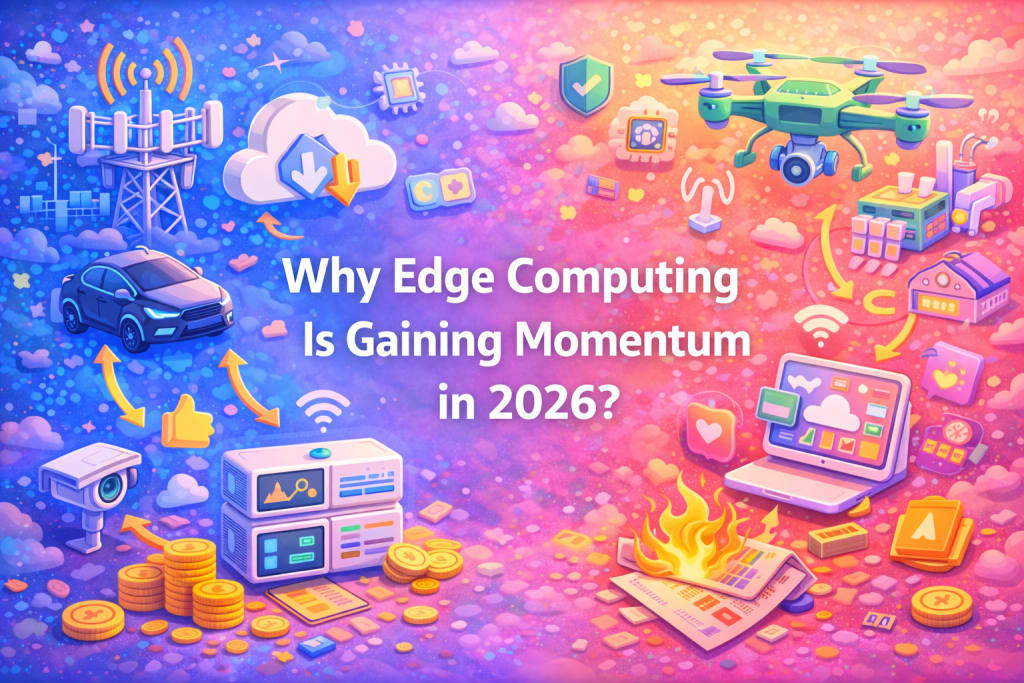
In the early cloud era, distance did not seem to matter.
Data traveled to centralized data centers. Applications processed requests in massive server farms. The physical location of compute felt abstract — something handled by infrastructure teams far removed from user experience.
That abstraction is eroding.
In 2026, milliseconds carry measurable economic weight. Autonomous systems, immersive media, AI inference engines, industrial automation, and real-time analytics demand near-instant response. When latency becomes visible to users — or machines — centralized architectures reveal their limits.
Edge computing is not replacing the cloud. It is redefining its boundaries.
Latency as Competitive Differentiator
The technical case for edge computing begins with latency.
According to Ericsson’s 2025 Mobility Report, global 5G subscriptions surpassed 2.5 billion, with average mobile data consumption exceeding 30 GB per smartphone per month. High-bandwidth applications — video conferencing, cloud gaming, augmented reality — place pressure on networks to deliver seamless performance.
Google research shows that page load delays beyond 2 seconds increase bounce rates significantly. In interactive applications such as multiplayer gaming or financial trading platforms, even 20 to 30 milliseconds can affect user perception.
Edge computing reduces physical distance between users and processing nodes. By distributing compute capacity closer to population centers, response times shrink.
When experience becomes the product, proximity becomes strategy.
AI Inference Is Driving Decentralization
Artificial intelligence is accelerating this shift.
Training large models often occurs in centralized hyperscale data centers. But inference — running AI models to generate predictions — increasingly happens at the edge.
Gartner predicts that by 2026, more than 50% of enterprise data will be processed outside traditional centralized cloud environments, compared to less than 25% just a few years earlier.
The reason is efficiency.
Sending every sensor input, image frame, or voice request to distant servers introduces latency and network costs. Edge nodes can filter, preprocess, and execute inference locally, reducing bandwidth usage and accelerating decision-making.
In manufacturing environments, this matters.
A Capgemini Research Institute study found that 57% of large industrial firms are investing in edge-enabled AI systems to support predictive maintenance and automation.
The closer intelligence sits to activity, the faster systems respond.
Data Sovereignty and Regulatory Pressures
Momentum behind edge computing is not purely technical.
Governments worldwide are tightening data localization requirements. The European Union’s data protection regulations, along with similar laws emerging in Asia and the Middle East, require certain categories of data to remain within geographic boundaries.
According to IDC, nearly 60% of multinational enterprises now operate in regions with some form of data sovereignty mandate.
Edge infrastructure allows companies to process and store sensitive information locally while still integrating with centralized cloud platforms for broader analytics.
Distributed architecture becomes a compliance strategy.
The Economics of Bandwidth
Bandwidth is not infinite — nor inexpensive at scale.
As IoT devices proliferate, network strain increases. Statista projects that global IoT connections will exceed 30 billion by 2026. Each connected sensor, camera, and device generates streams of data.
Transmitting raw data continuously to central servers is costly.
By processing information closer to its origin, organizations reduce upstream bandwidth consumption. Only relevant or summarized data travels to central clouds.
Telecommunications providers have taken note.
Many are investing in multi-access edge computing (MEC) infrastructure integrated with 5G networks. By embedding compute nodes within telecom exchanges, carriers position themselves as part of the distributed computing ecosystem.
Network operators become infrastructure partners rather than simple bandwidth providers.
Industry-Specific Momentum
Certain industries are pushing edge adoption faster than others.
Healthcare systems rely on real-time monitoring devices. Financial services firms require ultra-low latency for algorithmic trading. Logistics companies use edge nodes to coordinate fleet operations.
Retail environments are deploying edge-enabled computer vision systems for inventory tracking and checkout automation. McKinsey estimates that AI-enabled retail automation could reduce operational costs by up to 20% in high-volume environments.
These use cases share a common requirement: immediate response without dependence on distant servers.
Edge computing transforms physical spaces into computational environments.
Cloud Providers Are Expanding Outward
Hyperscale cloud providers are not resisting edge computing. They are incorporating it.
Amazon Web Services offers edge services through products like AWS Local Zones and Outposts. Microsoft and Google have launched similar distributed infrastructure programs.
Synergy Research data indicates that hyperscale operators are expanding regional presence at the fastest rate since 2020, deploying smaller footprint facilities closer to metropolitan centers.
Rather than centralization versus decentralization, the architecture is becoming layered.
Central data centers handle large-scale analytics and training workloads. Edge nodes manage localized processing and real-time inference.
Hybrid models dominate.
Developer Ecosystems and Distributed Design
For developers, edge computing introduces architectural shifts.
Applications must manage state across distributed nodes. Data synchronization becomes more complex. Security boundaries expand.
Teams engaged in mobile app development Indianapolis and other regional tech hubs increasingly account for latency optimization and edge compatibility when designing performance-sensitive applications.
Frameworks now include tools for routing traffic intelligently, balancing loads across geographies, and caching content at edge locations.
Edge awareness is moving into mainstream development practice.
Energy and Sustainability Considerations
Energy efficiency plays a role as well.
The International Energy Agency reports that global data center electricity consumption accounts for approximately 1% to 1.5% of global energy demand. Distributed edge facilities may reduce long-haul data transmission but increase localized power consumption.
Designers must balance efficiency gains against environmental impact.
Some providers are experimenting with micro data centers powered by renewable energy in urban areas, aligning sustainability goals with distributed architecture.
Energy strategy intersects with infrastructure design.
Security in a Distributed World
Distributed systems introduce new security challenges.
Each edge node becomes a potential attack surface. According to a 2025 Fortinet cybersecurity survey, 62% of organizations cite securing edge environments as more complex than protecting centralized data centers.
Encryption, zero-trust frameworks, and real-time monitoring become essential components of edge strategy.
Security architecture must evolve alongside infrastructure distribution.
Why 2026 Feels Different
Edge computing has existed conceptually for years. What distinguishes 2026 is convergence.
5G networks have reached maturity in many regions. AI inference workloads are mainstream. IoT deployments are expanding rapidly. Regulatory pressures are tightening. Consumer expectations for seamless experience are rising.
These forces align.
A Deloitte technology outlook report notes that nearly 70% of surveyed executives expect edge deployments to increase over the next two years, primarily to support AI-driven applications.
Momentum builds when multiple trends reinforce each other.
The Future Is Not Centralized or Decentralized — It Is Both
The narrative surrounding edge computing often frames it as a challenge to centralized cloud dominance.
In practice, the future appears layered.
Massive hyperscale data centers remain essential for global analytics and training large AI models. Edge nodes handle time-sensitive, localized processing. Hybrid orchestration tools connect the two.
Computing is becoming geographically aware.
The question is no longer where data lives, but how quickly it moves — and how intelligently it is processed along the way.
Infrastructure Moving Closer to Life
Edge computing gains momentum because the world it serves has changed.
Applications are no longer static web pages. They are interactive systems embedded in transportation networks, manufacturing lines, medical devices, retail stores, and personal devices.
When digital interaction blends with physical reality, distance matters again.
In 2026, computing is shifting closer to human activity — not as a novelty, but as a requirement.
The cloud remains foundational. But the edge is where immediacy happens.
And in an economy increasingly defined by speed, immediacy carries weight.
About the Creator
Ash Smith
Ash Smith writes about tech, emerging technologies, AI, and work life. He creates clear, trustworthy stories for clients in Seattle, Indianapolis, Portland, San Diego, Tampa, Austin, Los Angeles, and Charlotte.
Why Stars Near the Horizon Look Distorted
The Role of Earth’s Atmosphere When starlight travels toward Earth, it moves through the vacuum of space without interference. However, once it enters Earth’s atmosphere, it must pass through layers of gases, dust, water vapor, and temperature variations.
By shahkar jalalabout 13 hours ago in Education
Wine Terms Made Easy for Beginners: A Simple Guide to Understanding Wine Language
Wine can seem confusing at first. Bottles have labels with many words. Tasting notes sound fancy. You may hear terms that feel hard to understand. The good news is that learning about wine does not have to be difficult. This guide will break down wine terms made easy for beginners. You will learn simple meanings and feel more confident the next time you choose a bottle.
By Joel Barjenbruch5 days ago in Education
This Is What I Do When People Throw Rocks At Me
Rocks have been thrown at me for a greater part of my life. Some have been small and missed hitting me. When people don't get a reaction from me, they throw bigger rocks with a better aim. Many have been hurled at me with precision over the years. For a long time, I thought my only options were to dodge them or be crushed by them.
By Margaret Minnicksa day ago in Confessions




Comments
There are no comments for this story
Be the first to respond and start the conversation.