Advocacy
The Last Message from Earth
The sky was no longer blue. It had been years since anyone remembered the gentle hue of morning, the soft brush of clouds drifting lazily across the horizon. Now, the heavens burned crimson, streaked with ash and smoke, a permanent reminder of humanity’s final mistake.
By noor ul amin3 months ago in Earth
Animals Are Warning Us
Wildlife is not getting meaner. Animals are not “turning on us.” What is changing is something larger and far less comfortable for people to admit: the energetic field we share with them. For months now I’ve been hearing real accounts from the field and reading incident logs that all point in the same direction.
By Dr. Mozelle Martin3 months ago in Earth
The Quiet Transport Revolution
by Futoshi Tachino When most people picture the electric transition, they see cars. Yet the biggest and least acknowledged gains are happening on two and three wheels. In dozens of countries, small electric motorcycles, scooters, and rickshaws are cutting oil demand, shrinking urban air pollution, and saving drivers money — often much faster than electric cars can. In 2024, two- and three-wheelers (2/3-Ws) were the most electrified road segment on earth: over 9% of the global fleet was already electric, and roughly 15% of new 2/3-W sales were electric — about 10 million vehicles that year [1, 2].
By Futoshi Tachino3 months ago in Earth
The Under-The-Radar Shipping Pivot
by Futoshi Tachino Maritime transport seldom makes sustainability headlines, yet the sector has moved from pilot projects to concrete deployment. Three forces are converging: binding rules that now bite on real voyages, an orderbook filled with ships capable of running on cleaner fuels, and a rapid return of wind—this time via rotor sails and wings. The result is a structural shift in how ships will be powered and paid for over the coming decade [1–3, 13].
By Futoshi Tachino3 months ago in Earth
Turning Post Industrial Plastic Scrap Into Real ROI for Automotive OEMs
By Mathew Zachariah The automotive industry has always been shaped by pressure. Pressure to innovate. Pressure to improve safety. Pressure to reduce waste and cut costs without sacrificing quality. As automakers look for new ways to streamline production one opportunity continues to stand out yet often goes unnoticed. The value of post industrial plastic scrap.
By Jonathan Riedel3 months ago in Earth
The Earth's Secrets: Lost Worlds That Might Still Be Hidden
For centuries, people have been sharing incredible tales of lost worlds and civilizations. Back when the maps had huge, blank spaces, it was easy to believe that these mysterious lands might exist, tucked away somewhere. Nowadays? The whole idea of a "lost world" seems more like a punchline than a possibility. I think that's because many of us feel like we've charted every inch of the planet. We've got satellites everywhere, and photos of everything. But here’s the thing: those images can’t show you what lies at the bottom of the deep ocean trenches. They can’t see into the Earth’s complex cave systems. Even scientists admit that over 85% of Earth's species are still unknown! If we haven't found the life, how can we be sure we've found all the land? So, before we completely dismiss the idea, I’m encouraging everyone to keep an open mind about the following famous Lost Worlds. Some of them might just be waiting for the right person to stumble upon them.
By Areeba Umair3 months ago in Earth
Did a Nuclear War Wipe Out Life on Mars?
We are truly living in a mind-blowing era. Think about it: the things we used to read about in science fiction novels are basically just everyday reality now. We've gone from dreaming about the stars to actually landing craft on other celestial bodies. Remember when the idea of a hoverboard was pure fantasy? Now, they exist! Every single one of these breakthroughs, from discovering the building blocks of the universe to sending probes to faraway comets, just invokes this incredible sense of awe and wonder. It makes you realize how quickly we're advancing, and it naturally pushes us toward the biggest, most profound question of all: Are we alone? Is there intelligent, breathing life out there somewhere else in the vast, dark expanse of the cosmos? For me, the answer is a resounding yes. I don't just think there's life out there; I believe there's probably a whole lot of it. My reasoning is simple: the universe is so unbelievably, impossibly ginormous that the odds of Earth being the only successful experiment seem ridiculously low. When you really stop and think about the scale of things, it's humbling. We are literally residing on a tiny, insignificant speck of dust in a cosmic neighborhood that is endless. So, yeah, I'm happy to be a simple woman who accepts that alien civilizations must exist. I don't need NASA or any official hard-and-fast proof to convince me. The sheer, overwhelming size of the universe is proof enough.
By Areeba Umair3 months ago in Earth
Where the River Drew Us Together
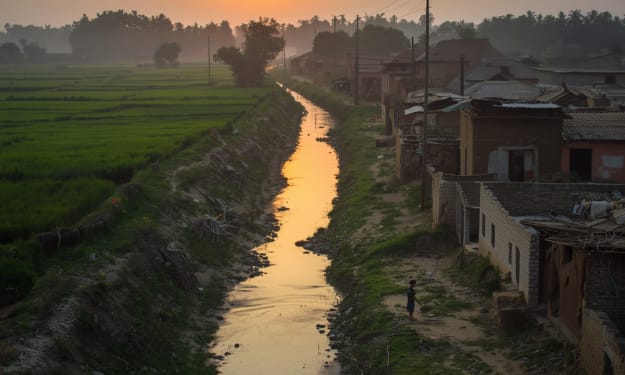
Where the River Drew Us Together In the quiet village of Shalmani, where fields shone like gold every evening and the air smelled of wet soil, life moved slowly. People woke with the sun, worked with their hands and trusted the land that fed them. It was a place where every small sound meant something. The call of a rooster, the wind in the wheat and the river that carried stories from one season to another.
By Wings of Time 3 months ago in Earth
Northern Lights Illuminate the Night: A Rare Aurora Borealis Shines Across the U.S.
The Northern Lights, also known as the Aurora Borealis, have once again captured the world’s attention after a major solar storm caused the colorful display to be visible across much of the United States. From Colorado and Chicago to as far south as Texas, people have witnessed a glowing night sky filled with hues of green, pink, and purple.
By KAMRAN AHMAD3 months ago in Earth
Colors of Hope: The Magic of the Rainbow
After a long day of endless rain, the world seemed quiet, almost breathless. The gray clouds that had swallowed the sky for hours slowly began to drift apart, revealing soft rays of sunlight. And then, as if painted by an invisible artist, a rainbow arched gracefully across the sky — bold, bright, and beautiful. Maya stood by her window, her eyes widening at the sight. She had always loved rainbows, not just for their beauty but for what they represented — hope after hardship, light after the storm. It reminded her that even when the world seems covered in clouds, something beautiful is always waiting to shine through. She quickly ran outside, letting the damp grass soak her feet. The rainbow stretched endlessly, its colors glowing like a promise from the heavens. “Red, orange, yellow, green, blue, indigo, violet,” she whispered softly, remembering the words her grandmother had taught her. Each color had its own meaning, she recalled — a message from nature itself. Red, her grandmother said, was for courage — the fire that pushes us forward when life feels uncertain. Orange was for joy, reminding us to find happiness in simple moments. Yellow symbolized hope, like the sun returning after a long night. Green stood for growth, a promise that even in difficult times, we keep learning and changing. Blue brought peace, soothing the heart and calming the mind. Indigo spoke of wisdom, the quiet understanding that comes with time. And violet, the last color, carried spiritual strength, connecting us to something greater than ourselves. As Maya watched the rainbow fade slowly into the clouds, she thought about her own life — the struggles she had faced and the moments that had shaped her. She had lost her job earlier that year, and the uncertainty had felt heavy. Yet, here was nature, reminding her that storms never last forever. Later that evening, she decided to take a walk through her neighborhood. The puddles glistened with reflections of the sky, and the air smelled fresh, like new beginnings. Children were laughing and splashing in the water, their carefree joy infectious. One of them pointed up and shouted, “Look, another rainbow!” Sure enough, a faint second arc appeared above the first, softer but equally magical. Maya smiled. Sometimes, life gives us not one but two rainbows — two chances to start again. She felt a warmth rise inside her, as if the colors had brushed her soul. That night, she opened her old notebook and began to write again, something she hadn’t done in months. Words flowed like rivers, carrying feelings of peace and renewal. Days turned into weeks, and Maya’s story of the rainbow took shape — a tale of light, color, and courage. She shared it online, and soon messages from strangers began to pour in. People from all around the world thanked her for reminding them that beauty always follows struggle. One message read, “Your story helped me see hope again after losing everything in the flood. Thank you.” Another said, “I showed your rainbow story to my daughter, and now she looks for rainbows after every rain.” Maya realized then that rainbows don’t just appear in the sky — they appear in people’s hearts too. Every act of kindness, every moment of love, every small spark of hope adds color to the world. From that day onward, whenever dark clouds rolled in, Maya no longer felt afraid. She would smile, whisper her grandmother’s words, and wait for the colors to return. Because that’s what the rainbow teaches us — that no matter how heavy the storm, the sun will always shine again. And when it does, it paints the sky with a message for everyone who dares to look up: “Don’t lose hope. Even after the rain, there is beauty waiting to be found.”
By Muhammad Saad 3 months ago in Earth
Seven Colors of the Rainbow
The world of colors is one of nature’s most beautiful gifts, and among all its wonders, few sights inspire awe quite like the rainbow. Appearing as a luminous arc painted across the sky, the rainbow captures the hearts of dreamers, scientists, and poets alike. Its seven radiant hues — red, orange, yellow, green, blue, indigo, and violet — are more than just a stunning spectacle; they represent science, symbolism, and the timeless beauty of the natural world. The Science Behind the Spectrum Rainbows are not magic, though they certainly look like it. They are, in fact, the result of light, water, and a touch of perfect timing. When sunlight passes through raindrops in the atmosphere, the drops act as tiny prisms. The light bends (refracts), bounces (reflects), and spreads (disperses) into its different color components. Each color bends at a slightly different angle — red at about 42 degrees and violet at about 40 — creating the curved, multi-colored arc we see from the ground. This process, first explained scientifically by Sir Isaac Newton, reveals the hidden spectrum of sunlight. What we perceive as “white light” is actually a blend of many colors, waiting to be released through nature’s prism — the raindrop. The Seven Colors and Their Meanings Every color of the rainbow carries its own charm and symbolism: Red stands for energy, strength, and passion — the first and boldest hue that catches our eye. Orange radiates creativity and enthusiasm, blending the warmth of red with the cheerfulness of yellow. Yellow glows with happiness and optimism, symbolizing the brilliance of sunlight itself. Green represents balance, nature, and growth — a color of life and renewal. Blue brings calm, peace, and trust, like the sky and the sea. Indigo embodies wisdom and intuition, a deep, thoughtful color that connects the mind and spirit. Violet shines with imagination and spirituality, closing the rainbow with a sense of mystery and beauty. Together, these seven colors reflect the harmony of nature and the diversity of life. A Symbol Across Cultures Throughout history, the rainbow has carried deep meaning across different cultures. In Greek mythology, it was believed to be a path connecting the Earth to the heavens, created by Iris, the messenger goddess. In the Bible, it is a symbol of peace and promise — the sign of God’s covenant after the great flood. For many Indigenous cultures, rainbows represent harmony between people and nature. In modern times, the rainbow has also become a symbol of hope, unity, and diversity — a reminder that beauty often appears after the storm. Rainbows in Art and Imagination Beyond science and symbolism, rainbows have inspired countless works of art, poetry, and music. From the famous song “Somewhere Over the Rainbow” to children’s drawings that fill classrooms with color, the image of the rainbow always brings joy and positivity. It reminds us that light can return even after the darkest of clouds. Artists use the seven colors to represent emotions and ideas, while scientists continue to explore the nature of light and color in even greater depth. Yet, despite all our knowledge, the sight of a rainbow still feels magical — a moment where science meets wonder. A Lesson from the Rainbow Perhaps the greatest lesson the rainbow teaches us is that beauty often comes from contrast. Without rain, there can be no rainbow. The blending of sunlight and storm mirrors life itself — full of challenges and bright moments that coexist to create something extraordinary. So, the next time a rainbow arches across the sky, take a moment to pause and look up. Behind its seven dazzling colors lies the story of light, nature, and hope — a story as old as time and as fresh as the rain that made it.
By Muhammad Saad 3 months ago in Earth