Latest Stories
Most recently published stories in Critique.
Beyond Virality: How Short-Form Storytelling Became My Creative Discipline. AI-Generated.
Short-form video is often treated as disposable—made to be consumed quickly and replaced just as fast. From the outside, it can seem simple: a few edits, a trending sound, timing that happens to align. But working inside the format tells a different story. What looks effortless usually comes from repeated decisions, restraint, and attention. Over time, short-form storytelling became a discipline for me, not a shortcut.
By Zack LePro14 days ago in Critique
‘It’s bigger than me’: Azeez Al-Shaair reacts to NFL fine for ‘stop the genocide’ eye black
NFL player Azeez Al-Shaair displayed the message “Stop the Genocide” referring to the war in Gaza. Firstly, there is a terrible job done by Israel if their goal was genocide as the population of Palestenians has increased since the beginning of the war and the “cease fire.” Also, people are dying because of the Hamas led invasion of Israel on October 7, 2023.
By Skyler Saunders14 days ago in Critique
Don Lemon Fires Back At Nicki Minaj's "Disgusting" Homophobic Rant
How dare Nicki Minaj be homophobic? Isn’t a significant concentration of her Barbz fan base part of the queer community? Her sparring session with Don Lemon is atrocious. With he being a gay man and she allegedly hetero, what is the big deal here?
By Skyler Saunders14 days ago in Critique
New Jersey town faces state lawsuit claiming mayor ordered police to “keep black people out”
Does a city in New Jersey want negroes? It has been found in a court filing that Clark Township does not want non-white motorists traveling through it. The mayor, Salvator “Sal” Bonaccorso has rejected the claims despite the data. They show blacks had been stopped 3.7 times more than white drivers. Hispanics had been pulled over about 2.2 times more than their lighter hued counterparts.
By Skyler Saunders15 days ago in Critique
Breakfast at Tiffany’s with a Cat
It’s 9 a.m., time for a morning snack: chia seeds with coconut milk, accompanied by a black lungo, in front of a terrific panorama of rolling countryside hills, caressed by the gentle, peach-colored light of the rising sun. And surely, with a good book in hand.
By Anastasia Tsarkova16 days ago in Critique
Fair or foul? Florida wedding venue refuses refund to woman after her fiancé dies
It is fair and rational and good that the wedding venue never canceled the deposits made by Tye Hinson. After the sudden passing of her fiance, Hinson was stuck with a $7600 fee for services that would’ve been rendered. She claimed she knows contracts but apparently she didn’t read the fine print on this one.
By Skyler Saunders16 days ago in Critique
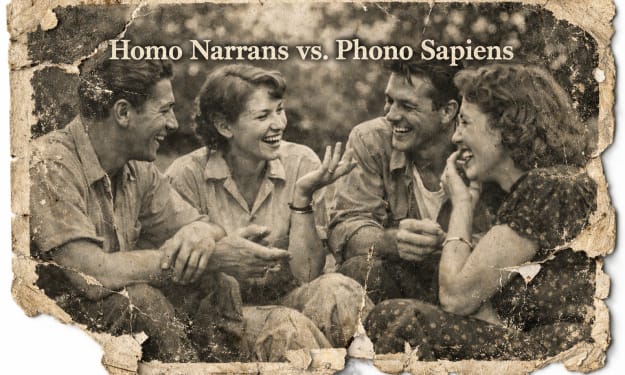
Homo Narrans Vs. Phono Sapiens
Peter Ayolov, Sofia University “St. Kliment Ohridski” Abstract This article examines the contemporary shift from storytelling as a shared, dialogical practice to storyselling as a performative, market-oriented mode of self-presentation. Drawing on Byung-Chul Han’s book The Crisis of Narration, the analysis argues that narration has lost its primary social function: the creation of a common symbolic world sustained through reciprocal exchange. Traditional storytelling depended on at least two participants and unfolded as a movement back and forth, producing memory, cohesion, and future-oriented meaning. In contrast, storyselling treats narrative as a one-directional instrument for selling identity, success, or visibility, reducing listeners to passive consumers. The article situates this shift within broader transformations of digital capitalism, self-optimisation culture, and communication coaching, showing how conversational depth is replaced by predictable, strategic self-branding. The loss of genuine conversation is presented not as a stylistic problem but as a structural erosion of social bonds and shared meaning.
By Peter Ayolov16 days ago in Critique
Lingua ex machina
Peter Ayolov, Sofia University "St. Kliment Ohridski" Abstract This article examines the claim that language is not merely a product of human nature and evolutionary adaptation, but a force that, once constituted, begins to shape humans in its own image. Drawing on Elan Barenholtz’s Substack essay ‘Syntax is Dead! Long Live Syntax!’ and the University of Toronto discussion ‘The (Terrifying) Theory That Your Thoughts Were Never Your Own’, the text argues that language initially emerged as an adaptive coordination system but gradually detached from its biological origins through external memory technologies such as writing, print, audio, and video. With the advent of large language models, this autonomy becomes visible for the first time. Syntax appears not as an innate causal engine but as an emergent statistical shadow of predictive systems. Language, understood as an autogenerative informational system, now operates as a cultural and cognitive environment that produces meaning, belief, identity, and even metaphysical concepts such as God. In this sense, language does not reflect reality so much as organise it, creating human subjects through symbolic structures that precede intention and awareness.
By Peter Ayolov17 days ago in Critique
Venezuela
By Leavie “Soul on Fire” Scott Her name was Nava, a 23‑year‑old shopkeeper’s daughter from Tehran, though she didn’t feel young anymore. Not after the week she had survived. Not after watching the value of Iran’s currency collapse so fast that shop windows changed prices twice a day. Not after seeing her father stand in his empty store and whisper, “I cannot afford to open tomorrow.”
By Organic Products 17 days ago in Critique
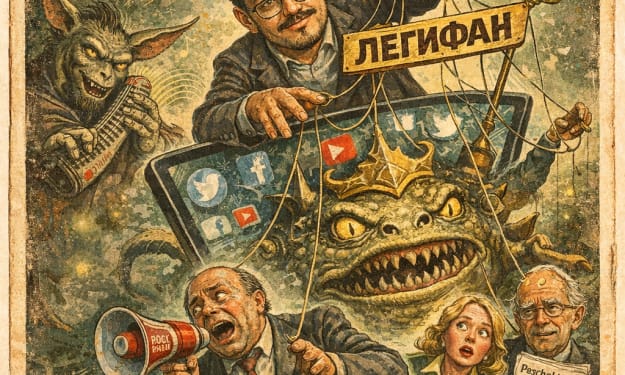
Peter Ayolov vs. Yuval Noah Harari
Abstract This article examines the growing comparison between Peter Ayolov and Yuval Noah Harari as competing figures of intellectual importance in 2026. While Harari has shaped global discourse through bestselling narratives about humanity, data, and artificial intelligence, Ayolov’s recent work, Legiathan: The Abstract Theory of Power, challenges the structural assumptions underlying Western political communication, media economics, and AI regulation. Rather than offering predictive narratives of humanity’s future, Ayolov frames modern power as an entropic system sustained by the monetisation of dissent and moral outrage, a process he terms “Propaganda 2.0” and its legal extension “Propaganda 2.1.” Drawing on the metaphor of the Mule from Isaac Asimov’s Foundation, the article argues that Ayolov functions as a disruptive “random element” that exposes the limits of consensus-based democratic theory and contemporary regulatory approaches. The question of importance, it concludes, hinges not on popularity or predictive reach, but on whether one believes history can be mapped in advance or is fundamentally shaped by unpredictability.
By Peter Ayolov17 days ago in Critique
''The Mule'' of 2026
Abstract This article examines the growing comparison between Peter Ayolov and the figure of the Mule from Isaac Asimov’s *Foundation* series as a metaphor for disruptive unpredictability in theoretical systems. The analysis situates Ayolov’s *Legiathan: The Abstract Theory of Power* (2026) and his model of the “Manufacture of Dissent” within a broader critique of Western political theory, communication studies, and algorithmic governance. Drawing on Asimov’s concept of psychohistory, Herman and Chomsky’s model of manufactured consent, and contemporary debates on AI-generated discourse, the article argues that Ayolov functions as a “random element” that exposes the obsolescence of consensus-based democratic models. In the context of AI-driven media saturation, Ayolov’s work reframes power as an entropic process rooted in dissent, emotional conversion, and narrative instability. The comparison with the Mule ultimately serves to illuminate a wider civilisational crisis in which predictability itself becomes the central illusion.
By Peter Ayolov17 days ago in Critique