

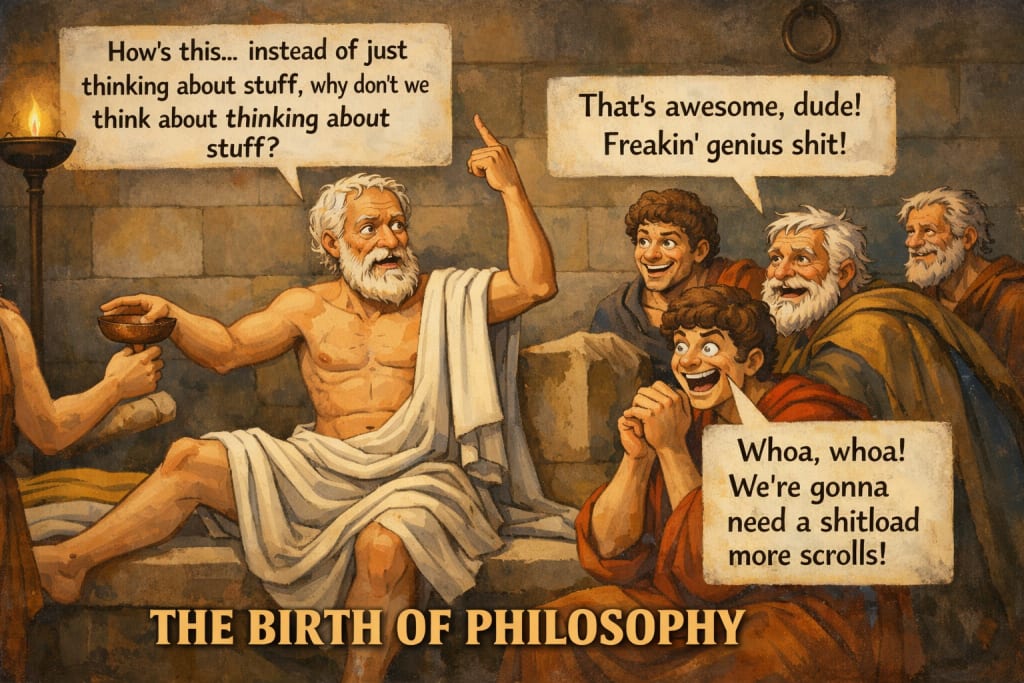
Just Thinkering: Talking about Thinking
Philosophy begins with a strange upgrade to ordinary speech. Instead of talking about things, people start talking about the talking itself, then about the thinking behind the talking, then about the words used to name the thinking. This second level of language feels noble, even heroic: reflection, critique, self-awareness, ‘the examined life’. But it also carries a quieter risk. Once speech turns back on itself, it can become a room full of mirrors. The sound continues, yet nothing moves forward. There is talk about words, talk about thinking, talk about talk, and soon the whole performance becomes a kind of verbal tinkling: elegant, repetitive, self-pleasing noise.
This is where ‘thinkering’ becomes useful as a concept. The word is a hybrid: thinking plus tinkering. Tinkering is not formal engineering; it is informal repair, casual adjustment, small experiments performed without a complete plan. A tinkerer doesn’t begin with a blueprint; a tinkerer begins with a hunch, a problem, a curiosity, a loose screw. That practical spirit, moved into the mind, becomes thinkering: the attempt to repair or improve language and talking through playful, desultory trial-and-error, not through grand systems. It names the activity of messing around with ideas to see how they hold together, where they break, and what might be fixed.
‘I am thinkerling, this is what I am’ (Cogito, hoc sum quod sum.) The phrase is a small parody of philosophy’s most famous self-certainty, but it also captures something essential. The old formula aims at a foundation: the one point that cannot be doubted. The new formula points not to a foundation but to a habit: a life spent adjusting, testing, rephrasing. It replaces metaphysical certainty with mental craft. Instead of ‘I think, therefore I am’, it proposes something like: I keep turning language over in my hands, therefore I remain alive inside it.
The suffix ‘-ling’ makes it even better. A ‘thinkerling’ is not a monumental thinker carved in marble, but a smaller creature: curious, unfinished, slightly comic, always in development. A thinkerling is a mind that treats ideas as prototypes. This is not an insult. It is a correction. It resists the pretence that thought must always appear as final form, as doctrine, as polished argument. The thinkerling admits that most thinking happens in drafts.
The modern world supplies constant proof of this. So much public speech now operates at the second level: commentary about commentary, reactions to reactions, meta-debates about framing, discourse about discourse. People do not merely argue about policy; they argue about the words used to describe the policy, the intentions behind those words, the hidden meanings implied by those intentions, the psychology of the speaker, the ideology of the platform, the moral implications of the tone. It looks sophisticated. It often is. But it also becomes a trap. When language spends too long talking about itself, it risks turning into a self-licking ice cream: consumption without nourishment.
The word ‘tinkling’ helps here because it describes a sound that is pleasant but thin. Tinkling is what happens when language becomes decorative and loses weight. It is the chatter of cleverness that produces no consequence. A culture can become highly articulate and still be shallow, because articulation alone does not guarantee contact with reality. Meta-language can become a refuge: you can always talk about the talk, because it feels safer than confronting the thing itself. The more anxious a society becomes, the more it drifts into this second level, because the second level offers control. It is easier to manage words than events.
And yet the second level is not a mistake. It is one of the great inventions of human intelligence. Talking about thinking is how people learn to reason. It is how mistakes are noticed. It is how logic is built, how biases are detected, how arguments are refined. Without meta-language there is no philosophy, no science, no critical reading, no ethics worthy of the name. The question is not whether to do it, but how to do it without dissolving into babble.
Thinkering offers a practical answer: treat meta-language as a workshop rather than a theatre. A workshop produces noise, scraps, errors, revisions, tools scattered on a table. But it also produces improvement. You can hear the difference between performance and work. Performance wants applause; work wants function. Thinkering is meta-language that tries to fix something.
This is why the contrast between ‘tinkling’ and ‘tinkering’ matters. Both are casual, both can look unserious, but only one changes the object. Tinkling keeps language moving as sound; tinkering changes language as instrument. Thinkering is the mental version of turning a sentence around until it fits what you actually mean, not what you wish you meant. It is the willingness to admit that the first phrasing is usually wrong. It is the refusal to treat words as sacred furniture. It is the craft of re-saying.
A contemporary example appears in the world of sport and celebrity interviews, where unexpected philosophical moments sometimes occur precisely because the setting is not academic. When an athlete says she spends time ‘tinkering’ with her thoughts, she is describing an attitude that philosophers often claim but do not always practise: thinking as training, as iterative improvement, as work on the self. The interesting part is not the motivational surface but the method: treat the mind as something you can practise with, not merely something you possess. That is thinkering in action: not mystical introspection, but small adjustments to attention, framing, and response, repeated over time.
In everyday life, thinkering shows itself whenever someone catches themselves mid-sentence and changes course. It happens when you realise a word is doing harm and you replace it. It happens when you notice that a conversation keeps falling into the same groove and you try a different question. It happens when you recognise that ‘truth’ is being used as a weapon and you ask what kind of truth is meant. It happens when you sense that ‘beauty’ is being used as a moral badge and you ask who benefits from that badge. These are tiny acts, but they are repairs.
Thinkering also clarifies why philosophy was born as ‘talking about thinking about stuff’. The first philosophers did not only ask what the world is made of; they asked what it means to know, what it means to argue, what it means to define. They moved from objects to methods. But the best of that tradition was not a spiral into abstraction for its own sake. It was a search for better instruments: clearer concepts, sharper distinctions, more honest language. Philosophy, at its best, is not endless commentary; it is conceptual maintenance.
A culture that forgets this becomes addicted to the second level. It begins to mistake commentary for reality, critique for action, irony for intelligence, and clever phrasing for understanding. Language becomes a hall of mirrors where everyone is busy interpreting reflections. This is the condition in which “talking about thinking” turns into babble: a constant production of meta-sentences that never return to the world they supposedly illuminate.
The thinkerling is the antidote because the thinkerling remains small enough to stay practical. The thinkerling does not claim to possess the final vocabulary. The thinkerling keeps testing words against experience. The thinkerling tries to make language work again. Thinkering is modest, even playful, but its aim is serious: to improve the tool that shapes perception, judgement, and relation.
In the end, the task is simple to state and difficult to live: use the second level of language as a way back to the first. Talk about words so that words can once again touch things. Talk about thinking so that thinking can once again guide action. Let the tinkling of cleverness fade into the tinkering of repair. And when certainty tries to return as a slogan, answer with a better confession: ‘I am thinkerling, this is what I am.’ (Cogito, hoc sum quod sum.)
About the Creator
Peter Ayolov
Peter Ayolov’s key contribution to media theory is the development of the "Propaganda 2.0" or the "manufacture of dissent" model, which he details in his 2024 book, The Economic Policy of Online Media: Manufacture of Dissent.
Keep reading
More stories from Peter Ayolov and writers in Critique and other communities.
The Beauty of the Word
The Beauty of the Word: When “Beautiful” Becomes Power We rarely say “ugly truth.” We prefer to say “beautiful.” The choice is not innocent. “Truth” sounds like information: a fact, a report, a statement to be verified or dismissed. “Beauty,” by contrast, is an experience. It is not merely known; it is felt. When we call something beautiful, we lift it from the level of data to the level of meaning. We grant it weight, dignity, even sacredness. The word itself performs an elevation.
By Peter Ayolovabout 6 hours ago in Critique
MOVIE TRAILER: "Is God Is" Trailer Drops: Sisters Seek Revenge On Father Who Set Them On Fire As Babies
The trailer to the adaptation to Aleshea Harris’ play is just more Hollywood schlock to pin down the black man and make him out to be a monster. The Color Purple fueled this fire and it continues to burn because it is digestible to white audiences, especially.
By Skyler Saunders5 days ago in Critique




Comments
There are no comments for this story
Be the first to respond and start the conversation.