
The Day the Berlin Wall Fell
How One Night Ended Decades of Division
Introduction: A Wall That Divided the World
On the night of November 9, 1989, history shifted in a way few had predicted and millions had prayed for. The Berlin Wall — a towering concrete barrier that had divided East and West Berlin for 28 years — began to crumble, not under bombs or invasions, but under the weight of human hope.
For decades, the Wall had stood as the most powerful symbol of the Cold War — a physical and ideological divide between communism and democracy, oppression and freedom, East and West. Families were torn apart, lives were lost trying to cross it, and an entire generation grew up in its shadow.
But on that cold autumn night, ordinary people did something extraordinary: they walked toward the Wall — and the Wall opened.
This is the story of how one night ended decades of division.
Germany Divided: The Origins of the Wall
To understand the fall, we must first understand the division.
At the end of World War II in 1945, Germany lay in ruins. The Allied powers — the United States, Britain, France, and the Soviet Union — divided Germany into four occupation zones. Berlin, though located deep within Soviet territory, was also split among the four powers.
As tensions grew between the Soviet Union and Western Allies, ideological differences hardened:
West Germany adopted democracy and capitalism.
East Germany (German Democratic Republic – GDR) adopted communism under Soviet influence.
Berlin became the frontline of the Cold War.
By the late 1950s, East Germany faced a crisis: millions of citizens were fleeing to the West through Berlin, seeking freedom and better economic opportunities. This “brain drain” threatened the survival of the communist state.
So, in the early hours of August 13, 1961, East German authorities began building a barrier — first barbed wire, then concrete walls, watchtowers, and minefields.
The Berlin Wall was born.
Life in the Shadow of Concrete
The Wall stretched roughly 155 kilometers (96 miles) around West Berlin. It wasn’t just a wall — it was a fortified border system:
Guard towers with armed soldiers
Floodlights and patrol dogs
Anti-vehicle trenches
A “death strip” where escape meant likely execution
Families were separated overnight. Friends, lovers, and relatives were cut off with no warning.
Crossing was nearly impossible.
Yet people tried.
More than 5,000 people successfully escaped over the years — tunneling, flying hot-air balloons, hiding in cars. But at least 140 people died at the Wall, shot or killed while attempting freedom.
The Wall became more than concrete. It became a psychological prison.
Cracks in the Iron Curtain
By the 1980s, the Soviet Union itself was changing.
Mikhail Gorbachev, Soviet leader from 1985, introduced reforms:
Glasnost (Openness) — More freedom of expression
Perestroika (Restructuring) — Economic reform
He also signaled that the USSR would no longer use military force to control Eastern Bloc nations.
This was revolutionary.
Across Eastern Europe, communist regimes began to weaken:
Poland legalized the Solidarity movement
Hungary opened its border with Austria
Reform movements grew in Czechoslovakia and East Germany
East Germans saw an opportunity.
Thousands began fleeing through Hungary and Czechoslovakia. Others stayed and protested.
The Protests That Changed Everything
In 1989, mass demonstrations swept East Germany.
The largest took place in Leipzig — the “Monday Demonstrations.”
Week after week, crowds grew:
10,000 protesters
Then 50,000
Then over 300,000
Their message was simple:
“Wir sind das Volk” — “We are the people.”
They demanded:
Freedom to travel
Free elections
Political reform
The East German government was losing control.
Even more critical: the Soviet Union refused to intervene militarily.
Without Soviet backing, East Germany’s hardline regime began to crack.
November 9, 1989: The Announcement
The fall of the Wall wasn’t planned.
It was, in many ways, an accident of history.
On November 9, East German official Günter Schabowski held a press conference to announce new travel regulations meant to ease pressure.
The policy was supposed to allow limited travel — but with bureaucratic procedures starting the next day.
A journalist asked:
“When does this take effect?”
Schabowski, flipping through papers and unsure, replied:
“As far as I know… effective immediately.”
The statement was broadcast live.
East Germans heard one thing:
The border is open.
The March to the Wall
Within hours, thousands of East Berliners gathered at border crossings.
They demanded passage.
Border guards had no clear instructions.
They called superiors — no answer.
Crowds swelled:
Chanting
Cheering
Pressing forward
At the Bornholmer Strasse crossing, tension peaked. Guards feared violence but had no authorization to shoot into massive civilian crowds.
Finally, shortly before midnight, the commander made a decision:
He opened the gate.
The Moment the Wall Fell
When the barriers lifted, East Berliners surged through.
Some cried.
Some laughed.
Some stood frozen in disbelief.
West Berliners welcomed them with flowers, champagne, and open arms.
Strangers hugged in the streets.
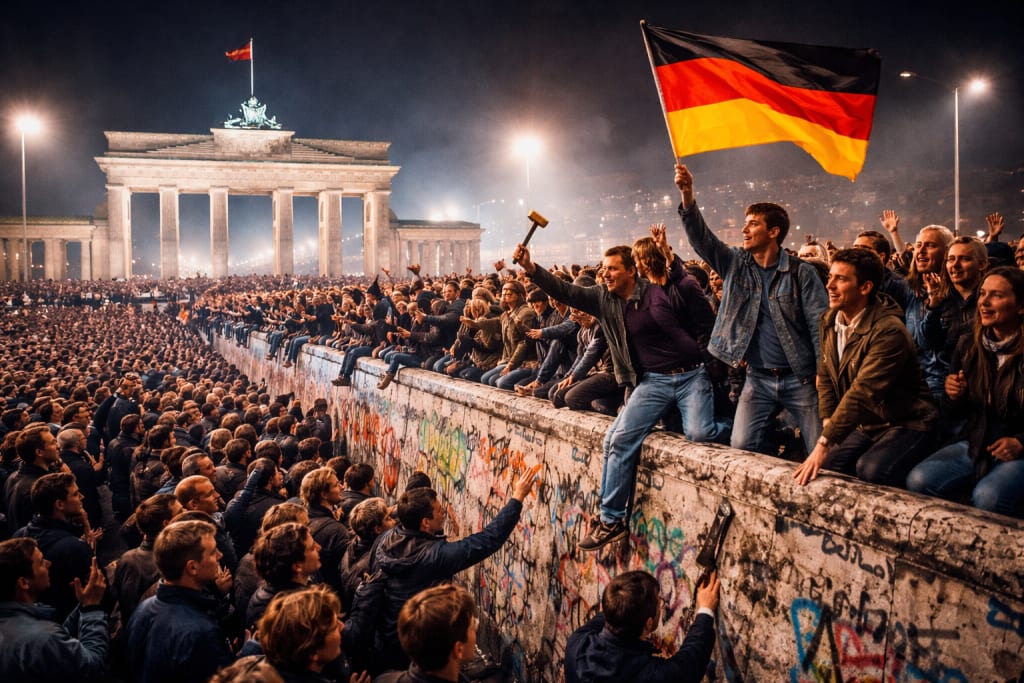
People climbed onto the Wall itself — dancing, waving flags, celebrating under floodlights that once symbolized fear.
Soon, others brought hammers and chisels.
They began chipping away at the concrete.
Each strike echoed like a drumbeat of freedom.
A Night of Global Significance
The scenes were broadcast worldwide.
Television viewers watched history unfold live:
Young people dancing atop the Wall
Families reunited after decades
Border guards smiling instead of aiming rifles
World leaders reacted quickly.
U.S. President George H. W. Bush called it a victory for freedom.
Gorbachev chose restraint, refusing military intervention — a decision that prevented possible bloodshed.
The Cold War’s most visible symbol was collapsing in real time.
The Wall Comes Down — Literally
Though the border opened on November 9, physical demolition took longer.
In the weeks that followed:
Crowds continued dismantling sections
Official crews began removing large segments
Souvenir hunters — “Mauerspechte” (Wall peckers) — chipped off pieces
By 1990, most of the Wall was gone.
Only fragments remained as memorials.
German Reunification
The fall of the Wall set off rapid political change.
Negotiations began to reunify East and West Germany — something once thought impossible.
Key milestones:
Free elections in East Germany (March 1990)
Monetary union with West Germany
Formal reunification on October 3, 1990
Germany became one nation again — less than a year after the Wall opened.
The Human Impact
Reunification brought joy — but also challenges.
East Germans faced:
Job losses as state industries collapsed
Cultural adjustment to capitalism
Economic inequality with the West
Yet freedom of speech, travel, and political participation transformed daily life.
Families separated for decades could finally live together again.
The End of the Cold War
The fall of the Berlin Wall didn’t just reunify Germany — it accelerated the end of the Cold War.
Within two years:
Communist regimes fell across Eastern Europe
The Warsaw Pact dissolved
The Soviet Union itself collapsed in 1991
What began as a border opening in Berlin became a geopolitical earthquake.
Why the Wall Fell Without Violence
One of the most remarkable aspects of November 9 was its peacefulness.
Several factors made this possible:
Mass public pressure — Protests were too large to suppress
Soviet restraint — No military crackdown
Government confusion — Mixed signals paralyzed response
Media broadcast — The world was watching
Human hesitation — Guards didn’t want bloodshed
History turned not on weapons — but on restraint.
The Wall as a Symbol — Then and Now
Before 1989, the Berlin Wall symbolized:
Division
Oppression
Surveillance
The Iron Curtain
After its fall, it symbolized:
Freedom
Unity
The power of people
The fragility of authoritarian regimes
Today, preserved sections stand as memorials — reminders of what once was.
Lessons From That Night
The fall of the Berlin Wall offers enduring lessons:
Walls can fall faster than expected
Public will can overpower regimes
Information — even mistaken — can ignite change
Peaceful protest can reshape history
It also reminds us that division, once normalized, can vanish almost overnight when courage spreads.
Conclusion: One Night That Changed the World
November 9, 1989, was not the result of a single battle, treaty, or revolution.
It was the climax of decades of pressure — political, social, and human.
No missiles were fired.
No armies invaded.
Instead:
Citizens marched
A spokesman misspoke
Crowds gathered
Guards hesitated
Gates opened
And a wall that had defined global politics for nearly three decades lost its power in a single night.
The Berlin Wall did not fall because it was destroyed.
It fell because people no longer believed in it.
And when belief in division collapsed, the concrete soon followed.
About the Creator
Keep reading
More stories from Aiman Shahid and writers in Confessions and other communities.
When Empires Ruled the World
History is, in many ways, the story of empires — vast political and cultural systems that stretched across continents, united diverse peoples, and reshaped the destiny of humanity. For thousands of years, empires ruled the world, rising from humble beginnings to dominate trade, warfare, culture, and innovation. Yet, no matter how powerful, every empire eventually faced decline. Their legacies, however, still echo in our laws, languages, borders, and beliefs.
By Aiman Shahida day ago in Confessions
Blessed 33
So I woke up on the morning of February 5, 2026 and guess what and you know what I realized? It’s my 33rd birthday. Do you know what that means? Yes, technically I’m getting old, but what I couldn’t have guessed was this would be one of the best days of my life.
By Joe Pattersona day ago in Confessions
Spiritual Awakening, Numerology, and Major Life Realizations
We are going through a really difficult time in our world right now. It just so happens that all of that corruption, all of that greed, all of that narcissm, has been impacting our society for decades, branching all the way down to something as small as an American family. What do I mean by that? Well, the ones with all the power, the ones who pull the strings, control the media. That includes movies, TV, you name it.
By Slgtlyscatt3red3 days ago in Confessions
Super Bowl LX Recap: A Team Called Hawks
Sixty. The Super Bowl turned 60! Still amazes me that this was the sixtieth Super Bowl played in NFL history. It seems like yesterday that I watched Super Bowl XXVII, the first SB I ever watched. The QB who won Super Bowl XXVII has since called a few SBs, and will call next year's game, but that's another story. Super Bowl LX took place at Levi's Stadium in Santa Clara, California, the home stadium of the San Francisco 49ers. However, it was one of their division foes who represented the NFC, as the Seattle Seahawks faced off against the New England Patriots.
By Clyde E. Dawkinsabout 22 hours ago in Unbalanced



Comments
There are no comments for this story
Be the first to respond and start the conversation.