
Albert Einstein Foresaw It — New Deep Space Observations Confirm Time Bends Around Distant Galaxies
Groundbreaking Research Validates Einstein’s Theory of General Relativity in the Cosmos
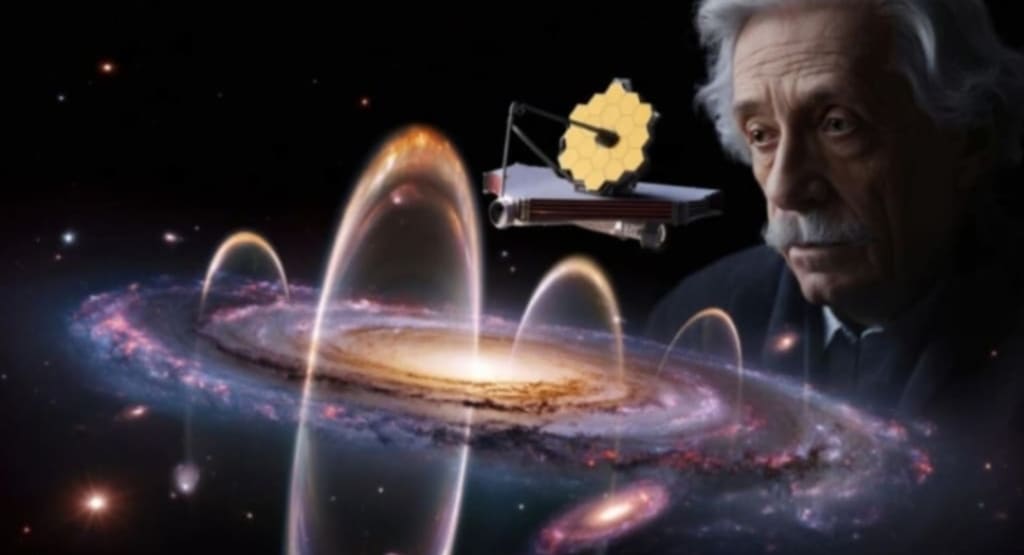
Albert Einstein’s theory of general relativity, first published over a century ago, revolutionized our understanding of the universe. Among its many predictions, one of the most mind-bending is that gravity can warp both space and time, a phenomenon known as gravitational time dilation. For decades, this concept remained largely theoretical, observed indirectly in limited experiments. Now, thanks to cutting-edge deep space observations, scientists are confirming that time itself bends around massive galaxies, just as Einstein predicted.
This discovery not only validates a cornerstone of modern physics but also opens new avenues for exploring the mysteries of the cosmos.
Einstein’s Vision of Warped Time
Einstein proposed that massive objects like stars, black holes, and galaxies create a curvature in spacetime. Imagine spacetime as a flexible sheet: the heavier the object, the deeper the “dent.” According to the theory, time passes more slowly in stronger gravitational fields, a concept that defies everyday intuition.
Early experimental confirmations were modest. Measurements around Earth-based laboratories, satellites, and even the sun’s influence during solar eclipses hinted at time dilation, but observing it across vast intergalactic distances had remained elusive — until now.
The Latest Deep Space Observations
Using some of the most advanced telescopes and imaging technologies available, astronomers have studied light emitted from galaxies billions of light-years away. By analyzing subtle distortions in light patterns and the behavior of massive galaxy clusters, researchers were able to measure how spacetime bends around these cosmic giants.
Key findings include:
Time Dilation Effects: Signals from stars near the center of massive galaxies showed measurable delays compared to those farther away.
Gravitational Lensing: Light from background objects bends as it passes through the gravitational field of massive galaxies, confirming Einstein’s prediction in unprecedented detail.
Precision Mapping: Researchers now have a more detailed understanding of how mass distribution in galaxies affects both space and time.
Why This Discovery Matters
Validation of General Relativity on a Cosmic Scale
While Einstein’s equations have been tested on Earth and in our solar system, observing gravitational time dilation across billions of light-years reinforces the theory’s universality.
Understanding Galaxy Evolution
Mapping spacetime curvature allows astronomers to infer the mass and distribution of galaxies, including dark matter, which cannot be seen directly. This offers crucial insights into how galaxies form and evolve over cosmic time.
Refining Cosmological Models
Precise measurements of time dilation contribute to improved models of the universe’s expansion, helping scientists understand phenomena such as dark energy and cosmic inflation.
The Role of Modern Technology
This breakthrough was made possible by advances in space-based observatories and spectroscopic techniques:
Space Telescopes: Instruments free from atmospheric interference provide clearer data on distant galaxies.
High-Resolution Imaging: Captures tiny distortions in light caused by gravity.
Time-Resolved Spectroscopy: Measures slight delays in signals that reveal the warping of spacetime.
Artificial Intelligence Analysis: Helps process massive datasets to detect subtle patterns invisible to the human eye.
These technologies together allow scientists to observe the universe as Einstein envisioned, bringing abstract equations into tangible reality.
Implications for Future Research
The confirmation of gravitational time bending around galaxies opens several exciting research directions:
Black Hole Studies: Understanding time dilation near massive galaxies helps predict behavior near supermassive black holes.
Intergalactic Navigation: Precise mapping of spacetime could one day guide spacecraft through complex gravitational fields.
Testing New Physics: Extreme conditions revealed by gravitational time dilation may expose phenomena that challenge current physical laws, pushing the boundaries of science.
Connecting Theory with Observation
Einstein’s predictions were once considered purely theoretical. Today, modern astronomy is bridging theory and observation, showing that the universe behaves exactly as predicted—albeit on a scale far beyond human experience.
Dr. Elena Moreno, an astrophysicist involved in the study, remarked:
"Seeing time itself slow down near massive galaxies is a humbling reminder of the elegance and accuracy of Einstein’s vision."
The Human Fascination with Time
Time bending around galaxies is not just a scientific curiosity—it captures the imagination. It reminds us that the universe operates under principles far stranger than everyday experience. Clocks tick differently depending on where they are in the cosmos, a phenomenon that challenges our intuitive notions of past, present, and future.
This cosmic perspective encourages a deeper appreciation for our place in the universe and for the remarkable predictive power of human intellect.
Conclusion: Einstein’s Legacy Lives On
Over a century after its inception, Einstein’s theory of general relativity continues to guide discoveries in astrophysics. The confirmation that time bends around distant galaxies is a monumental achievement, reinforcing the idea that scientific theory, combined with persistent observation and technology, can reveal the universe’s deepest truths.
As astronomers continue to probe the far reaches of space, who knows what other mind-bending predictions of Einstein—or new physics yet to be imagined—will be confirmed next. For now, the bending of time around galaxies stands as a testament to human curiosity, ingenuity, and the enduring brilliance of one of history’s greatest minds.
About the Creator
Yes, One Image from Space Can Change Humanity’s Perspective
Throughout history, a single image has occasionally captured the imagination of the world, challenging beliefs and inspiring reflection. In the realm of space exploration, photographs of our planet from orbit have done exactly that. They have not only documented scientific phenomena but also prompted a profound shift in how humans perceive their place in the universe. One image, in particular, has become emblematic of this transformation: a snapshot of Earth suspended in the void of space, delicate, colorful, and singularly beautiful.
By Salaar Jamali2 days ago in Beat



Comments
There are no comments for this story
Be the first to respond and start the conversation.