Aqib Hussain
Stories (168)
Filter by community
EU Parliament Delays Decision to Unfreeze US Trade Deal. AI-Generated.
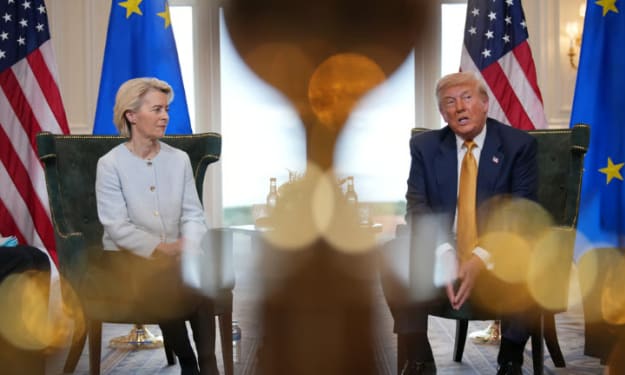
The European Parliament has hit the pause button on a major trade deal with the United States. What was supposed to be a vote this week is now delayed, leaving businesses, investors, and policymakers watching closely. Let’s break down what’s happening, why it matters, and what could come next.
By Aqib Hussain7 days ago in The Swamp
Chris Mason: Both Tories and Labour Feel the Reform Heebie-Jeebies. AI-Generated.
British politics has a habit of reinventing its anxieties, and right now, one name keeps cropping up in whispered briefings and not-so-whispered TV debates: Reform UK. As BBC political editor Chris Mason has repeatedly observed, both the Conservatives and Labour are feeling the “Reform heebie-jeebies” — a nervous unease that this insurgent party could reshape electoral calculations in ways neither side fully controls. At first glance, this might seem odd. Reform UK holds no seats in Westminster and has never formed a government. Yet its influence is less about raw parliamentary power and more about mood, momentum, and messaging. Reform has become a vessel for frustration — with immigration, political elites, economic stagnation, and a sense that the main parties are offering variations of the same cautious script. Why the Conservatives Are Looking Over Their Shoulder For the Conservatives, the threat from Reform is existential in a very practical sense. Reform’s appeal overlaps heavily with the Tory base: older voters, Brexit supporters, and those instinctively suspicious of large government and cultural change. When Reform polls at 10–15 percent, it doesn’t need to win seats to cause damage. It only needs to split the vote. Chris Mason has highlighted how this fear quietly shapes Conservative strategy. Tougher rhetoric on immigration, symbolic battles over culture wars, and repeated promises to “stop the boats” are not just policy choices — they are defensive moves. Reform’s presence makes it harder for Tory leaders to pivot toward the political centre, even when that might be electorally sensible. There’s also a psychological component. Reform represents a reminder of unfinished business from Brexit. Many voters who backed leaving the EU feel that the promises of sovereignty and control were diluted or betrayed. Reform taps into that grievance, framing the Conservatives as managers of decline rather than agents of transformation. For a governing party already bruised by years of internal division, that narrative stings. Labour’s Discomfort Runs Deeper Than It Admits Labour, on paper, should feel more relaxed. Reform draws more directly from Conservative support, and any erosion of the Tory vote could ease Labour’s path to power. But Chris Mason notes that Labour’s nerves are real — and growing. Why? Because Reform doesn’t just attack the right. It attacks the system. Its message resonates in post-industrial towns, coastal communities, and places Labour once took for granted. Voters who feel ignored by Westminster don’t always care about left-right labels. They care about whether anyone sounds like they’re listening. Labour’s current strategy is built around discipline, moderation, and reassuring sceptical voters that it is “safe” to govern. Reform’s rise disrupts that framing. It injects volatility into the electorate and reminds Labour that voter loyalty is thinner than it looks. A disengaged Labour voter who stays home — or casts a protest vote — can be just as consequential as a defection to the Conservatives. The Farage Factor Nigel Farage looms large over all of this, whether or not he formally leads Reform at any given moment. Chris Mason has often pointed out Farage’s unique political skill: he is less interested in policy detail than in emotional connection. He speaks fluently the language of resentment, humour, and defiance — and does so without sounding scripted. That scares both major parties. Conservatives remember how UKIP hollowed out their vote in the 2010s. Labour remembers how populist movements elsewhere in Europe have eaten into centre-left support by reframing debates around identity and national belonging. Farage doesn’t need Reform to win power. He needs it to matter. And it already does. A Symptom, Not Just a Threat One of Mason’s more subtle observations is that Reform’s rise says as much about the main parties as it does about Reform itself. Voters turn to insurgents when they feel the political mainstream is closed, managerial, or complacent. Reform thrives on the perception that Westminster operates as a closed shop. That’s why both Labour and the Conservatives struggle to respond. Attack Reform too aggressively, and they risk validating its anti-establishment narrative. Ignore it, and they allow its message to spread unchecked. Co-opt its language, and they risk looking insincere. The Bigger Picture The “Reform heebie-jeebies” aren’t just about one party’s polling numbers. They reflect a deeper anxiety about control — over voters, over narratives, over the political agenda. Chris Mason’s analysis cuts through the noise by showing that this is not a temporary wobble but a structural shift in British politics. As the next general election approaches, Reform UK may not decide who governs. But it could decide how they govern, what they talk about, and how boldly — or nervously — they act. And that, more than seat counts or slogans, is why both Tories and Labour keep glancing sideways, wondering just how loud that knocking at the door might get.
By Aqib Hussain7 days ago in The Swamp
Saudi Arabia’s Futuristic Megacity Runs Into Dilemma. AI-Generated.
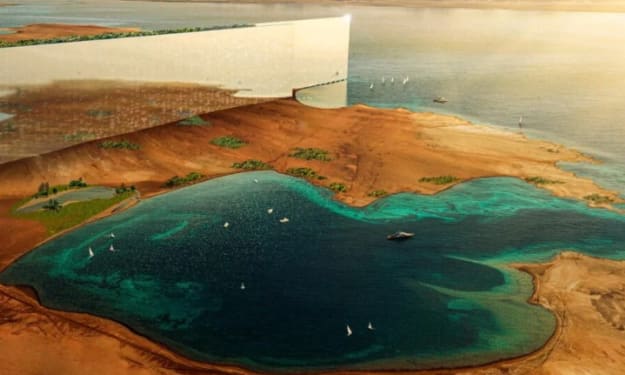
Saudi Arabia’s dream of building the world’s most futuristic megacity is hitting an unexpected crossroads. What was once imagined as a revolutionary place for millions of people to live, work, and thrive is now being quietly re-evaluated. Instead of glass-clad homes, walkable neighborhoods, and car-free living, a new priority is emerging: data centers, artificial intelligence, and digital infrastructure.
By Aqib Hussain7 days ago in The Swamp
Ukrainians Are Sharing Hacks Online on How to Survive Winter Power Cuts. AI-Generated.
When winter arrives in Ukraine, it no longer brings just cold winds and snow-covered streets. For millions of Ukrainians, it also means long and unpredictable power cuts. As energy infrastructure continues to be targeted, electricity outages have become part of daily life—sometimes lasting for hours, sometimes for days. Yet in the middle of these harsh conditions, Ukrainians are doing what they have always done best: adapting, helping one another, and finding creative ways to survive.
By Aqib Hussain7 days ago in Humans
Mexico Shelves Planned Shipment of Oil to Cuba Amid US Tensions. AI-Generated.
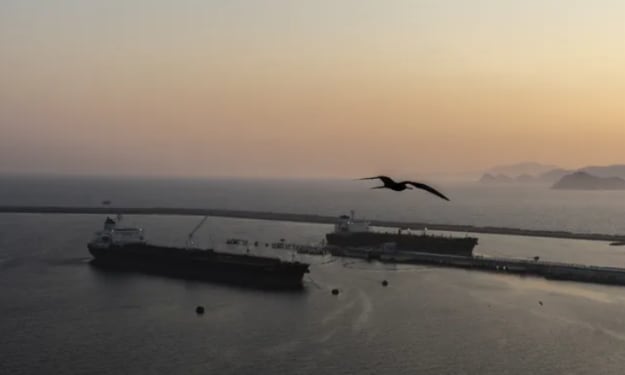
In a move that has caught regional analysts and policymakers by surprise, Mexico has shelved a planned shipment of oil to Cuba, signaling a potential shift in its energy diplomacy as tensions with the United States intensify. The canceled delivery, originally scheduled for mid-January, underscores how energy, politics, and foreign relations are increasingly intertwined in the Western Hemisphere.
By Aqib Hussain7 days ago in The Swamp
Gunmen Kill 11 After Soccer Match in Mexico. AI-Generated.
In a shocking turn of events, 11 people were killed and 12 others injured after gunmen opened fire following a local soccer match in Salamanca, a city in the central Mexican state of Guanajuato, on Sunday, January 25, 2026. Among the victims were women and a child, highlighting the indiscriminate nature of the violence.
By Aqib Hussain7 days ago in The Swamp
Xi’s Purge of Top General Spurs Questions on Taiwan, Succession. AI-Generated.
In one of the most dramatic political moves in recent Chinese history, President Xi Jinping has targeted one of his longest-serving military allies, General Zhang Youxia, vice chairman of China’s Central Military Commission (CMC). The purge has sparked serious questions about Beijing’s plans for Taiwan and the future of political succession in China.
By Aqib Hussain7 days ago in The Swamp
EU Countries Give Final Approval to Russian Gas Ban. AI-Generated.
In a landmark decision, European Union (EU) member states have officially approved a ban on imports of Russian natural gas. This ban, set to be fully enforced by late 2027, is a major step in reducing Europe’s reliance on Moscow for energy. It also reflects the EU’s commitment to reshaping its energy landscape amid ongoing geopolitical tensions. A Long-Awaited Shift in Policy After months of negotiation, EU energy ministers gave their final approval for a regulation that will phase out Russian gas. This includes both pipeline gas and liquefied natural gas (LNG). Here’s what the new rules mean: Russian LNG imports must end by December 31, 2026. Pipeline gas imports will stop by September 30, 2027, with a possible short extension to November 1, 2027 if needed. All new contracts with Russian suppliers are banned immediately. The law balances ambition with practicality. Some countries still heavily depend on Russian energy, and the phased timeline allows them to adjust gradually. Balancing Energy Security and Political Differences The approval was not without disagreement. Hungary and Slovakia voted against the ban, citing concerns about energy shortages, while Bulgaria abstained. Hungary has already announced plans to challenge the ban at the European Court of Justice. Despite these differences, the EU law passed thanks to a reinforced qualified majority, showing the bloc’s growing determination to secure energy independence and reduce Russian influence. It’s worth noting that Russia used to supply over 40% of the EU’s gas, a number that fell to around 13% by 2025 thanks to sanctions, diversification, and changing markets. Some countries like France and Belgium still relied on Russian gas longer, highlighting the uneven transition across Europe. Why This Ban Matters The gas ban is about more than just energy; it’s a strategic and symbolic move. Here’s why: Weakening Russia’s Economic Power Cutting off EU gas imports will further reduce Russia’s revenue, limiting its ability to fund military operations and exert influence abroad. Strengthening EU Energy Sovereignty The ban pushes member states to diversify gas supplies and invest in infrastructure, storage, and interconnectors to ensure reliable energy. National plans must be prepared by March 2026. Accelerating the Green Transition As Europe phases out Russian gas, investment in renewable energy like wind, solar, and hydrogen is expected to increase, helping the bloc reach its climate goals. Economic Challenges Ahead While the ban is historic, it comes with challenges: Rising energy prices in some markets as cheaper Russian gas is replaced. Infrastructure needs, including LNG terminals and interconnectors, to ensure supply resilience. Compliance penalties for companies failing to phase out Russian gas, which could include multi-million-euro fines. Critics also warn that Europe could risk dependence on other external suppliers if diversification efforts are not broad enough. Looking Forward: Europe’s Energy Independence The Russian gas ban is part of REPowerEU, the EU’s strategy to reduce reliance on foreign fossil fuels. Beyond gas, the EU is preparing to phase out Russian oil and nuclear fuel, signaling a long-term shift toward energy sovereignty and sustainability. The final approval of this ban is not just the end of Russian gas imports—it’s the start of a decade-long transformation in European energy, geopolitics, and economic strategy. Final Thoughts The EU’s decision to ban Russian gas is historic. It reduces Moscow’s economic leverage, strengthens European energy security, and encourages investment in green alternatives. While challenges remain, including rising prices and infrastructure needs, the move marks a bold step toward independence and a redefined geopolitical balance in Europe.
By Aqib Hussain7 days ago in The Swamp
Ferry Carrying Over 350 People Sinks in the Philippines, Killing at Least 18. AI-Generated.
A tragic maritime accident unfolded in the southern Philippines on January 26, 2026, when a ferry carrying over 350 people sank off the coast of Basilan province. At least 18 people lost their lives, while dozens remain missing. The incident has once again raised concerns about the safety of passenger ferries in the archipelago.
By Aqib Hussain7 days ago in The Swamp
Tearful Goodbyes as Japan Returns Pandas to China Amid Worsening Ties. AI-Generated.
On a chilly January morning at Ueno Zoological Gardens in Tokyo, crowds gathered for a bittersweet occasion. Xiao Xiao and Lei Lei, the beloved giant pandas who had captured the hearts of Japanese citizens since their birth in 2021, were about to leave Japan and return to their native China. The air was heavy with emotion as visitors, many of whom had grown up visiting these iconic black-and-white bears, lined up for hours just to say their final goodbyes.
By Aqib Hussain7 days ago in The Swamp
Iran Is Selling More Oil but Making Less Money. AI-Generated.
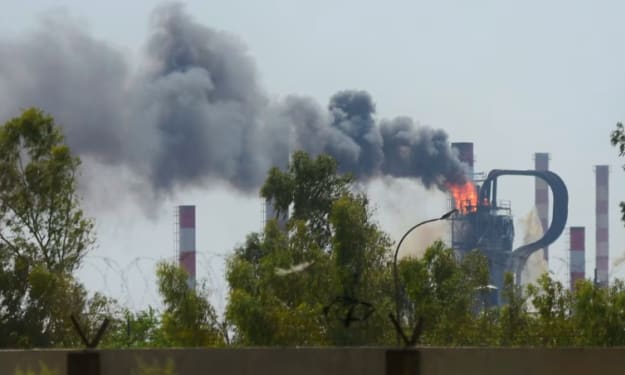
When it comes to oil, Iran should be in the money. After all, the country is selling more barrels than it has in years. But here’s the twist: despite higher sales, Iran is earning less. Yes, you read that right. More oil, but less cash in the bank.
By Aqib Hussain7 days ago in The Swamp
Pentagon Downplays China Threat: What It Means for U.S. Allies. AI-Generated.
For years, China has been framed as the central strategic threat in U.S. defense planning. From military modernization to tensions over Taiwan and the South China Sea, Washington’s messaging consistently placed Beijing at the heart of its global security concerns.
By Aqib Hussain7 days ago in The Swamp