Writing Exercise
OctoPrep Reasoning
Autumn. The leaves change colors. People return to school. Vacations slow down. And every year from 1999 to 2024, writers locked themselves in their rooms and chained themselves to their computers to write the next great novel of at least fifty thousand words.
By Reb Kreyling3 months ago in Writers
Walk with Medo. AI-Generated.
The morning was quiet, and the air smelled fresh after the night’s rain. My dog, Medo, was already waiting by the door, his tail wagging excitedly from side to side. As soon as I picked up the leash, he jumped with joy — he knew our favorite walk was about to begin.
By Tanja Dacovic3 months ago in Writers
Getting To School On Time
Anne Bernays and Pamela Painter — What if? Writing Exercises for Fiction Writers prompts — The Exercise - Write five mini-stories (limit: 200 words each) to account for a single event or set of circumstances, such as a man and woman standing on a city sidewalk, hailing a cab. Each story should be different - in characters, plot, and theme - from the others. The Objective - To loosen the bonds that shackle you to a single, immutable version; to underscore the fact that plot is not preordained but something you can control and manipulate at will, like the strings of a marionette; and to demonstrate once more that there are many ways to skin a cat.
By Denise E Lindquist3 months ago in Writers
Yannick Hanfmann: The Rise of Germany's Tennis Warrior. AI-Generated.
Yannick Hanfmann: The Rise of Germany's Tennis Warrior Discover how Yannick Hanfmann, a German tennis player, emerged from obscurity to be ranked among the world’s top 50 players. Read about his history, the moments that launched him forward, his mentality, and why he is a real warrior on the court.
By Link Logic3 months ago in Writers
Saving The Job
Anne Bernays and Pamela Painter — What if? Writing Exercises for Fiction Writers prompts — The Exercise - On each of five 3x5 index cards, print a vocational label, for example, dentist, truck driver, or fashion model. On each of a second set of index cards, write a mildly strange or unusual behavior. The mistakes here are to be too mundane (brush teeth, clear car) or to be too melodramatic (strangled her lover, drove his flaming truck through the prison walls). Somewhere between lies the quirk of the odd that is interesting: set free the parakeet, pick lose the tennis racket strings, or sew closed his sweater sleeves. Some writers will keep their cards filed for use again and again, and will add to the original pack over time as interesting vocations or actions suggest themselves. Shuffle each pack of cards (not together) and turn over the first pair. The writer may now ask the following question: "Why did Card A do Card B?" Why did the dentist set free the parakeet?" "Why did the fashion model pick loose the tennis racket strings?" The writer may continue flipping cards until a satisfactory pairing is discovered. If no satisfactory pair develops, reshuffle the cards and repeat the procedure. If you have ten cards in each pack you will have 100 possible pairings; twelve cards per pack will yield 144 pairings. Bear in mind that the event suggested by the Story Machine should be thought of as the last scene of a story. Supply motive for the odd behavior. Supply a conflict that might be resolved by this behavior. Imagine a scene prior to the final scene that demonstrates the severity of the conflict. Imagine a scene that demonstrates the initial difficulty. This exercise may easily be adapted for a class. Instead of shuffling, students pass cards one way and then another so that no student is left with any of her original cards. The liberating outcome is that if the new pair lacks all resonance for a student, the student has no emotional investment in the product of the Story Machine. No one has made a mistake or performed badly, just some bad luck has occured. Class discussions of motive and structure can be lively. The Objective - Retrograde plotting is often a revelation to the beginning writer who has again and again found herself staring off into the space above the typewriter and asking, "Now what happens?" Writing toward a conclusion for some writers is easier than exploring the consequences of an imagined premise. One more easily discovers the beginnings of things if one knows the ending. That the Story Machine requires vocational labels gives students insight to the rudiments of characterization, as such labels suggest education levels and socioeconomic status.
By Denise E Lindquist3 months ago in Writers
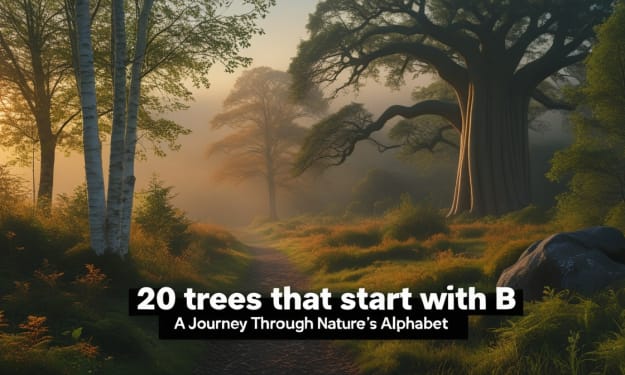
20 Trees That Start with B
Trees do more than mark seasons and shade our spaces. They store stories, ecosystem value and botanical beauty. In this article you’ll encounter 20 trees whose names start with B. Use this list for inspiration, garden planning, blog posts or to deepen your plant-knowledge.
By Ashley Scott3 months ago in Writers
Where Hearts Remember Humanity” - A Poem About the Gentle Power of Love. AI-Generated.
Where Hearts Remember Humanity” - A Poem About the Gentle Power of Love A moving and captivating 800-word poem about love's perpetual bond with humanity. Between love and who we truly are, when we live deeply and allow kindness, compassion, and courage to tame our fears. A faithful ode to the light that lives, even in a broken world and who restores our hope in our human connection and the spirit of our people.
By Hustle Nest3 months ago in Writers
Reworking A Story That Was Submitted To A Challenge
Anne Bernays and Pamela Painter — What if? Writing Exercises for Fiction Writers prompts — The Exercise - Take a story you have completed and go through it and intensify the conflict, magnifying the tension and shrillness at every turn, even to the point of absurdity or hyperbole. Add stress wherever possible, both between characters and within them as individuals. Exaggerate the obstacles they face. Be extreme. The Objective - To create an awareness of the need for a high level of tension while encouraging a healthy regard for how easily it can become excessive. This exercise is not meant to "improve" the story, although it often provokes new and more dynamic descriptions and dialogue. It raises the writer's consciousness about the need for conflict in fiction.
By Denise E Lindquist3 months ago in Writers