
Mark Twain: The Man Who Lived, Laughed, and Witnessed America’s Transformations
From Mississippi River Adventures to Worldly Travels – Discover the Life of the Master Storyteller Who Captured the Heart and Humor of a Changing Nation

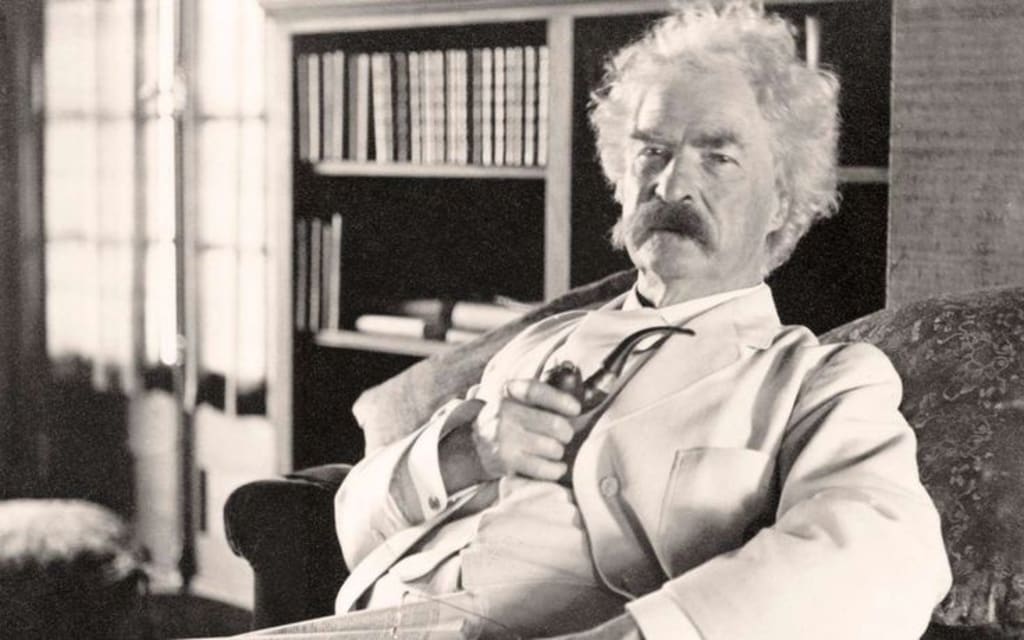
Have you ever wondered what it was like to grow up along the Mississippi River during a time when America was transforming faster than anyone could imagine? Meet Samuel Clemens, better known as Mark Twain—a boy from a small Missouri town who rose from modest beginnings to become one of the greatest storytellers the world has ever known. Twain didn’t just write stories; he captured the soul of a nation, observing both its humor and its heartbreak with a sharp, unforgettable voice.
🌊 From Riverbanks to Adventure
Born on November 30, 1835, in Florida, Missouri, Twain was the sixth of seven children. He spent his early childhood in the frontier town of Hannibal, perched on the banks of the Mississippi River, where life was raw, unpredictable, and full of stories waiting to be told. Hannibal was a place of contrasts—a community where commerce and culture met the harsh realities of slavery and poverty. Twain’s father owned a single enslaved person, while his uncle owned several. Summers were spent on his uncle’s farm, playing near the quarters of enslaved people, listening to their spirituals and tales. These early experiences gave Twain a lifelong understanding of human nature and a deep empathy for the underdog, themes that would permeate his future works.
At age 11, tragedy struck with the death of his father, forcing young Twain to leave school and begin working as a printer’s apprentice. He spent long hours arranging type for a local newspaper, but in those quiet moments, he read everything he could get his hands on. From news stories to poetry, young Sam Clemens soaked it all in, developing a curiosity and a skill with words that would shape his career. By observing the world around him and learning from every story he read, Twain began to understand the power of words—not just to entertain, but to influence thought and provoke change.
✈️ Travels, Tales, and Turning Points
At 18, Twain left Missouri for the bustling cities of New York and Philadelphia, seeking new opportunities in journalism. He worked for several newspapers, honing his craft, learning the importance of observation, and discovering how humor could reveal deeper truths. But the Mississippi River called him home. He returned to become a riverboat pilot, a prestigious position that required precision, courage, and knowledge of every twist and turn of the river. This work gave him not only material for his later writing but also a perspective on human behavior and the intricacies of American life.
The outbreak of the Civil War in 1861 temporarily ended Twain’s river career. He briefly joined a Confederate volunteer unit, the Marion Rangers, but quickly realized that war was not his path. Instead, he headed west to Nevada, chasing the dream of striking it rich in the silver rush. Traveling by stagecoach through a vast and untamed frontier, Twain encountered Native American tribes, eccentric prospectors, and the rugged landscapes of the American West. These adventures would later be immortalized in Roughing It, a work filled with humor, danger, and a vivid portrayal of life on the edge of civilization.
📝 A Literary Giant Emerges
Twain’s first taste of fame came in 1865 with the short story “Jim Smiley and His Jumping Frog,” published in newspapers across the country. His wit and ability to paint pictures with words struck a chord with readers. Soon after, he traveled to Hawaii, Europe, and the Holy Land, writing letters and reports full of vivid imagery and clever observations. These letters became The Innocents Abroad (1869), marking his first major literary success.
Back in the United States, Twain settled in Hartford, Connecticut, with his wife Olivia “Livy” Langdon and their children. Here, in the heart of a literary community known as Nook Farm, Twain’s creativity flourished. During his Hartford years, he wrote some of his most enduring works:
The Adventures of Tom Sawyer (1876) captured the carefree, adventurous spirit of his youth along the Mississippi.
The Prince and the Pauper (1881) explored issues of class, justice, and identity with historical flair.
Adventures of Huckleberry Finn (1884) became his most iconic work, offering a scathing critique of slavery, social inequality, and human hypocrisy.
These novels were more than entertainment—they were a lens through which readers could view the contradictions and injustices of 19th-century America. Twain’s writing combined humor, realism, and social commentary in a way that was revolutionary for his time, allowing ordinary readers to reflect on society while being thoroughly entertained.
💔 Triumphs, Trials, and Travels
Despite literary success, Twain’s life was not without struggle. He made several failed investments, including ventures in publishing and inventions, which eventually led to bankruptcy. Determined to repay his debts, Twain embarked on a worldwide lecture tour, traveling to Europe, Australia, and beyond. These tours allowed him to observe global injustices, colonial exploitation, and the human cost of empire. Twain’s anti-imperialist views grew stronger, and he became an outspoken critic of both European and American expansionism, particularly during the Spanish-American War.
Personal tragedy also marked his later life. His daughter Susy died at 24, his wife Livy passed away in Italy in 1904, and his youngest daughter, Jean, died from an epileptic seizure in 1909. These losses deeply affected Twain, and his later writings reflected a darker, more cynical view of humanity. Yet, through all this, he continued to write, lecture, and observe the world, leaving a record of both the humor and heartbreak of life.
🌟 A Legacy That Inspires
In 1908, Twain moved into his last home, Stormfield, in Redding, Connecticut. He passed away on April 21, 1910, at the age of 74. Today, Mark Twain is remembered as one of America’s greatest authors, a master of storytelling, and a keen observer of society. His words continue to inspire, entertain, and provoke thought. As Twain himself once said:
“Supposing is good, but finding out is better.”
From the riverbanks of Missouri to the global stage, Twain’s life reminds us to explore, question, and laugh along the way. His stories give us a glimpse into a past filled with adventure, hardship, and humanity—lessons that remain timeless.
If Mark Twain’s life and works inspired you:
Say something 💬 – leave a comment about your favorite Twain story or quote!
Share 🔄 – let your friends discover the fascinating life of Mark Twain too!
Subscribe 🛎 – follow for more stories about history’s most intriguing figures!
Tip 💖 – support me to keep bringing these stories to life with passion and detail!
About the Creator
Haroon Pasha
📚 Learn history, literature & knowledge daily
👍 Like | 💬 Comment | 🔔 Subscribe
🔄 Share to support free education
💖 Tip us to help grow this page
Keep reading
More stories from Haroon Pasha and writers in Writers and other communities.
Andrew Carnegie: From Immigrant to Steel Tycoon
Andrew Carnegie was born on November 25, 1835, in Dunfermline, Scotland, a town that had once been wealthy but was declining by the mid-19th century. His father, William Carnegie, was a handloom weaver, a craft that was rapidly disappearing due to the rise of industrialized steam-powered looms. As a result, the family faced severe poverty, forcing Andrew’s mother, Margaret, to work long hours mending shoes and running a small grocery shop to make ends meet. These early experiences instilled in Carnegie a profound awareness of social inequality and a lifelong determination to rise above hardship. Witnessing the struggles of the working class inspired his later belief that wealth should be used to improve society.
By Haroon Pashaabout 12 hours ago in Chapters
A Room of my Own
Four different people have lived in this room since we bought the house, none of which ended well. No good deed goes unpunished for long. I decided after the last round that it was the last round. I no longer have an extra room; I have a writing room.
By Harper Lewis7 days ago in Writers


Comments
There are no comments for this story
Be the first to respond and start the conversation.