
Why Elon Musk Keeps Cutting Tesla Prices And What It Means For The Future Of EVs
The discounts keep coming, the stock keeps shaking, and the EV future suddenly feels a lot less predictable

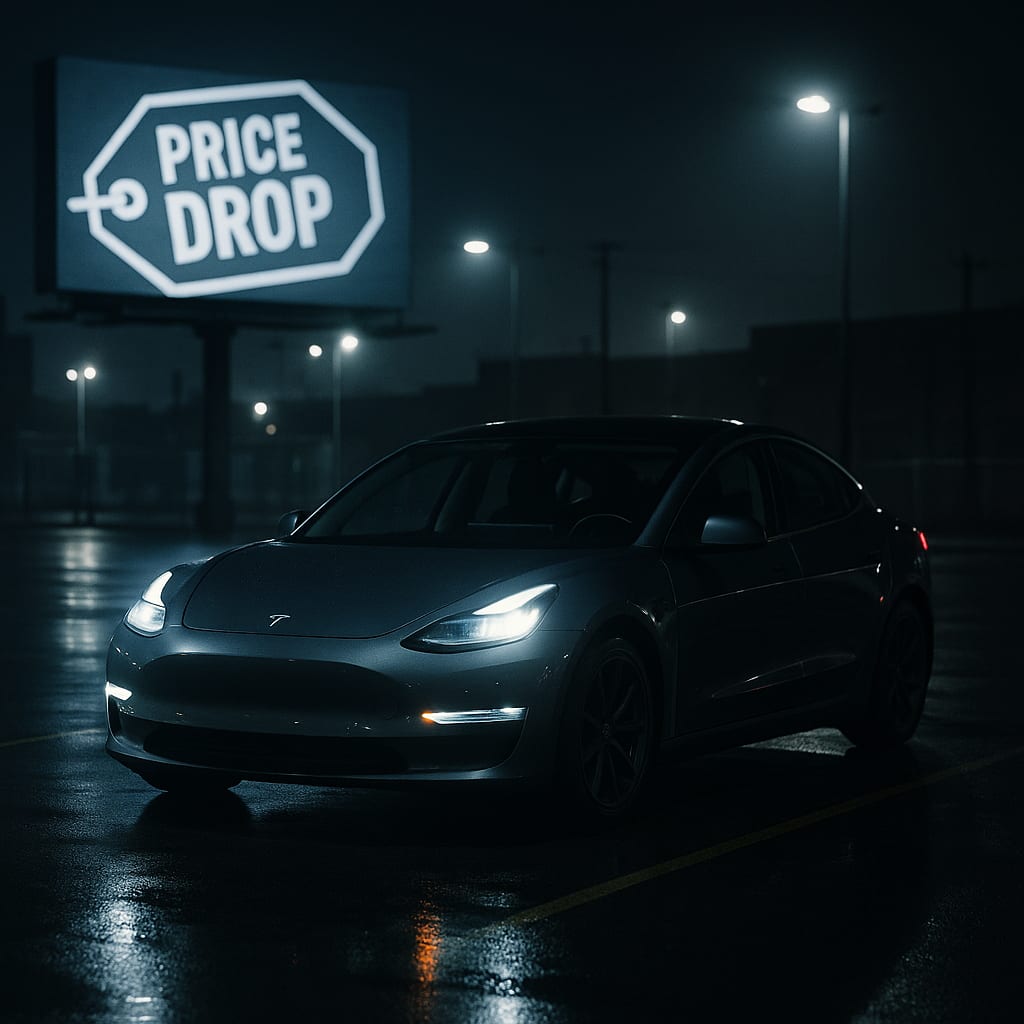
The discounts keep coming, the stock keeps shaking, and the EV future suddenly feels a lot less predictable
I remember the first time I realized Tesla had quietly dropped the price of a car I’d been obsessively speccing out.
It was late at night, one of those doom-scroll sessions where you swear you’re going to bed after “just one more refresh.” I’d been on Tesla’s site almost daily, hovering over the “Order” button for a Model Y that was already stretching my budget.
And then, one random Tuesday night, the price was lower.
Same car. Same options. Thousands of dollars gone from the sticker, like someone had hit backspace on reality.
I didn’t feel excited. I felt… uneasy.
Because if the car I could barely afford yesterday suddenly costs less today, what does that say about the future of this company that’s supposedly worth hundreds of billions? And more importantly, what happens if this becomes the new normal for the entire EV market?
That’s the uncomfortable question sitting inside every Tesla price cut. It’s not just about a discount.
It’s about whether the future of electric cars is being rewritten in real time—by one guy who keeps reaching for the price lever like it’s his favorite toy.
Why Elon Musk keeps slashing Tesla prices, even when it freaks everyone out
On the surface, cutting prices looks simple: demand slows, so you drop the number and hope more people buy. That’s Econ 101.
But with Tesla, the story feels more layered—and more emotional.
Musk has been open about one thing: he’s willing to sacrifice margins to protect volume.
If that sounds abstract, here’s what it means in practice: he’d rather sell a ton of cars at less profit each than a smaller number at luxury-car markups. He’s said this repeatedly on earnings calls—Tesla is “not just a car company,” it’s an AI and robotics company, and cars on the road are the hardware for that software future.
Fewer Teslas on the road means fewer users for Full Self-Driving, fewer data points, fewer chances to turn every car into a subscription machine.
So when interest rates rise and people start hesitating about big purchases, he doesn’t just sit back and watch demand fall.
He cuts.
Sometimes sharply. Sometimes repeatedly. Often without warning.
And every time he does it, something else drops too: investor confidence, competitor comfort, and the illusion that EVs are going to behave like the premium tech products they were sold to us as.
Underneath the price cuts is a specific bet: that the future market belongs to the company that prioritizes scale first, profit later.
If that sounds familiar, it’s because that’s basically the Amazon playbook, rewritten on four wheels.
The promise of “Tesla as iPhone” just collided with “Tesla as Toyota”
For years, the story around Tesla was clean and flattering:
Tesla wasn’t just a carmaker; it was the Apple of EVs. High margins, loyal customers, sleek tech, constant software updates, and a sky-high valuation that traditional automakers could only dream of.
But when you keep cutting prices—sometimes by thousands of dollars in a single quarter—that story shifts.
Suddenly Tesla looks less like Apple and more like… Toyota or Hyundai.
Not in quality or design, but in strategy: big volumes, thinner margins, constant pressure on competitors.
This is the tension Musk seems to be wrestling with in public view:
Is Tesla a luxury technology brand that can charge a premium?
Or is Tesla the first mass-market EV giant that crushes everyone else on cost?
Price cuts are his answer. Over and over again.
Every time a Model 3 or Model Y gets cheaper, Tesla moves a step away from “aspirational tech brand” and a step closer to “default EV for the average buyer.”
And that’s where things get messy.
Because people who paid more—sometimes way more—don’t love watching the price drop right after they buy.
I’ve seen it in forums. Anger. Resentment. “I just bought my car three months ago. I could have saved $5,000 if I’d waited.”
Price cuts help future buyers but sting existing ones.
If you’ve ever bought something big—car, laptop, TV—and watched it get discounted right after, you know the sinking feeling. Now scale that up to many thousands of dollars and a loan you’re locked into for six or seven years.
Your dream EV turned into a quietly bad financial decision overnight.
The ugly side effect: used Teslas getting hammered
The part of the story that doesn’t fit neatly into a press release is what happens to used Teslas every time Musk drops prices on new ones.
If a brand-new Model Y is suddenly cheaper, what does that do to the value of the one you bought last year?
It crushes it.
Used prices have fallen hard in many markets, not because there’s something wrong with the cars, but because the benchmark keeps sliding.
You can find Tesla owners who discovered that their trade-in value dropped by five figures in under a year.
That isn’t just “depreciation.” That’s whiplash.
And it sets up a new kind of anxiety in the EV world:
People hesitate to buy new, afraid a fresh price cut is around the corner.
People hesitate to buy used, worried about further drops.
People hesitate to sell, because it feels like locking in a loss.
The EV revolution was supposed to be about cleaner air and better tech.
No one mentioned the part where you might feel like you bought a stock at the top.
Tesla’s price war is forcing every other carmaker to show who they really are
If you’re an established automaker—Ford, GM, Volkswagen, Hyundai—Tesla’s price cuts are not just annoying. They’re existential.
Most of these companies don’t have Tesla-level margins to begin with.
Their EV divisions are often losing money while they try to scale. Some are subsidized by gasoline truck and SUV profits. They weren’t planning on a knife fight over price this early.
But every time Tesla drops prices, it resets what customers think an EV “should” cost.
A $60,000 electric SUV suddenly looks ridiculous when a Model Y undercuts it by ten grand.
So what do legacy automakers do?
They have three bad choices:
Match the price cuts and hemorrhage money on each EV sold.
Hold prices and watch cars sit on lots, while everyone reads headlines about “EV demand slowing.”
Pull back on EV investments and quietly hope regulators blink and customers keep buying gas.
We’re already seeing some of this play out: EV projects delayed, targets softened, model launches reconsidered. Some companies still talk big about their electric future, but their actions feel cautious, defensive, hesitant.
Tesla’s price moves aren’t just a business strategy; they’re a stress test.
They’re exposing who was serious about competing in EVs and who was treating them like a side hustle until the market was “safe.”
The market isn’t safe anymore. It’s shaped by someone who doesn’t mind detonating the margin structure for the whole industry.
The quiet upside: for some buyers, this is the window they’ve been waiting for
It’s very easy to focus on the chaos, the stock swings, the investor meltdowns on X.
But if you zoom in to the level of a single buyer—a teacher, a nurse, a delivery driver—something more hopeful is happening.
For years, EVs were something you admired from afar. You read the articles. You did the mental math. You told yourself you’d “go electric” when the prices made sense.
Tesla cutting prices keeps pulling that moment forward.
More people who never expected to own a Tesla suddenly find it within reach. In fact, in some regions, a discounted Tesla can be cheaper to own over time than many gas cars once you factor in fuel and maintenance.
There’s a question hiding here that no one on Wall Street likes to ask:
What if this messy, margin-crushing price war is exactly what needed to happen for EVs to actually go mainstream?
Not the “Instagram flex” version of mainstream. The “soccer practice, grocery run, long commute” mainstream.
Cheaper Teslas force everyone else to rethink their pricing, their tech, their timelines.
They expand the pool of people who can participate in this transition.
Yes, it hurts existing owners. Yes, it puts pressure on rivals. Yes, it makes CEOs and CFOs sweat.
But from the perspective of a family trying to save at the pump and breathe slightly cleaner air, lower EV prices are not the villain.
They’re the first time the future doesn’t feel like it belongs exclusively to wealthy early adopters.
Underneath the economics is a bet on data, software, and control
A lot of the price cut conversation gets stuck at “demand” and “inflation” and “interest rates,” and all of that is real.
But there’s another layer to this: Tesla isn’t just selling you a car. It’s trying to pull you into an ecosystem.
Think about it:
Full Self-Driving (FSD) subscriptions or add-ons
Premium connectivity
In-app upgrades and features
Energy products, home charging, solar, Powerwall
The more Teslas are out there, the more potential there is for recurring revenue.
Just like Apple doesn’t only care that you bought the iPhone—it cares that you stay inside iCloud, Apple Music, App Store, AirPods, and on and on—Tesla is thinking in a similar direction.
Cutting prices isn’t just competing with Ford or Toyota.
It’s seeding the world with hardware that Tesla can continue to sell software to for years.
You might finance a Tesla for six or seven years, but Tesla hopes your financial relationship with them lasts much longer.
And it also wants your data: driving behavior, charging patterns, routes, reactions to Autopilot. It all feeds into training the systems Musk believes will define the company’s next act—robotaxis, AI, robotics.
From that angle, price cuts look less like desperate moves and more like aggressive user acquisition.
Get the hardware into as many hands as possible, then build the future on top of it.
Of course, that doesn’t make your monthly payment any smaller. But it explains why Musk keeps ignoring the panic about margins and doubling down on volume.
He isn’t just chasing cars sold.
He’s chasing a kind of control over the EV ecosystem that competitors can’t easily copy if they’re stuck defending their short-term profits.
The emotional whiplash of watching an EV revolution through a stock chart
Somewhere along the way, the story of EVs stopped being about air quality, climate, and technology, and became a reality show about Elon Musk’s decisions.
You can feel it in conversations with people who’d never normally care about automotive earnings reports.
They ask questions like:
“Is Tesla in trouble?”
“Are EVs overhyped?”
“Should I just stick with gas until this all settles down?”
That’s the emotional cost of volatility.
When something is pitched as “the future,” constant price cuts don’t exactly scream stability. They look like a company trying not to lose its footing.
And maybe that’s the most uncomfortable part of all this: the realization that the transition to electric vehicles was never going to be clean or dignified.
It was always going to be messy, political, and driven by people with very different priorities—climate activists, profit-seeking investors, anxious governments, and a CEO who seems to thrive on chaos.
If you own a Tesla, or you’re thinking about buying one, or you just care about this shift away from fossil fuels, you’re stuck in the middle of all of that.
You have to make decisions in the middle of noise.
You have to decide whether you trust a future that is being improvised in public.
What this could do to the EV market in the long run
There’s a version of the future where we look back at this stretch of time and realize it was the pivot point.
The moment when EVs stopped being status symbols and became appliances people buy the way they buy fridges or phones—practical, predictable, normal.
Tesla’s price cuts could push us there faster.
Here’s what that world might look like:
EVs are cheaper than gas cars up front, not just over time.
Used EVs are abundant and cheap enough that a first car for a teenager is electric by default.
Legacy automakers either fully commit to EVs or quietly fade from relevance.
Charging becomes boring infrastructure, not a “cool new thing.”
Tesla is either a dominant giant with Apple-like ecosystem control—or a slightly diminished pioneer, outcompeted by companies that learned from its chaos.
There’s another version of the future too:
Price wars burn out automakers.
Investors sour on EVs as a “hype bubble.”
Governments slow down regulations under pressure.
Progress continues, but limps instead of sprints.
The truth is probably somewhere between those two extremes.
But it’s clear that Musk’s strategy is forcing the issue earlier than anyone expected.
He’s dragging the industry into the uncomfortable part of the transition now, instead of letting everyone ease into it gradually.
If that sounds familiar, it’s because it mirrors his whole career: push too fast, break things, let the aftermath sort itself out.
The takeaway you feel in your gut, not just your wallet
When I think back to that night staring at the newly discounted Model Y on my screen, what stuck with me wasn’t just the money.
It was the feeling that the ground was moving under my feet.
We talk about “the future of transportation” like it’s a neat line on a chart, always going up and to the right. But living through it feels nothing like that.
It feels like checking prices at midnight and wondering if you’re about to make a terrible decision.
It feels like hearing your neighbor whisper that they regret buying too early.
It feels like watching one man’s choices ripple through an entire global industry and realizing you don’t actually get a vote in any of it.
And yet, for all the discomfort, one thing is still true:
EVs are coming. Cheaper, more accessible, more ordinary than any of us expected this soon.
Tesla’s relentless price cutting might break some illusions along the way: the illusion that this shift would be smooth, the illusion that companies would kindly protect our resale values, the illusion that “the future” arrives wrapped in clarity.
But illusions were always going to break.
The real question is simpler, quieter, more personal:
When the dust settles, and electric cars are just cars, will you feel like you were pushed into this future, or like you chose it?
Price cuts are loud. Stock charts are loud. Elon Musk is loud.
Your decision about what to drive—and what kind of world you’re helping to build—won’t be.
It’ll happen in a browser tab, in a dealership lot, in a driveway at dusk when you’re doing the math in your head one more time.
And maybe the strangest part of all of this is that for the first time, because those prices keep sliding down, the choice is actually yours.
Not someday. Not “when the tech matures.”
Now.
About the Creator
abualyaanart
I write thoughtful, experience-driven stories about technology, digital life, and how modern tools quietly shape the way we think, work, and live.
I believe good technology should support life
Abualyaanart
Keep reading
More stories from abualyaanart and writers in Wheel and other communities.
How to Avoid Scams When Selling Your Old Vehicle
Letting go of an old vehicle should be straightforward. You agree on a price, exchange payment, sign the paperwork, and move on. In reality, the process can attract the wrong kind of attention. People looking for quick profit sometimes target private sellers who may not be familiar with common fraud tactics.
By Austin Peck8 days ago in Wheel
United States Electric Car Market Size to Reach USD 262.9 Billion by 2034 | Exhibiting CAGR of 11.02%
Industry Overview Electric cars, commonly referred to as battery electric vehicles (BEVs) and plug-in hybrid electric vehicles (PHEVs), operate either partially or entirely on electric power. Unlike traditional internal combustion engine vehicles, electric cars reduce tailpipe emissions and lower fuel dependency.
By Ashutosh Srivastava3 days ago in Wheel



Comments
There are no comments for this story
Be the first to respond and start the conversation.