
The Mystery Behind the Unclimbed Mount Kailash and Mansarovar
Kailash Mansarovar Mountain Mystery
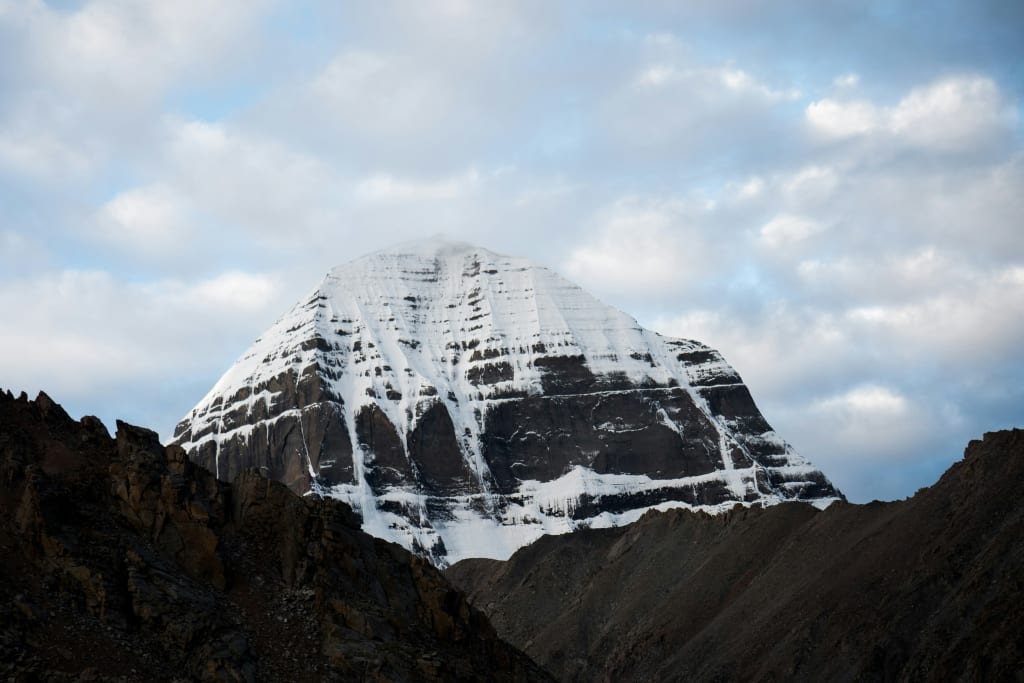
Mount Kailash (6638 m or 21778 ft high) is a jewel in the Tibetan Himalayas. Compared to other famous mountains around the world, Mount Kailash has never been climbed.
While lower in altitude than the Everest peaks, a human has never been reported to live on the sacred hill with the intention of climbing it.
Religious Significance of Mount Kailash
Mount Kailash Kora is a place of pilgrimage to the consciousness of hundreds of millions of people. A holy mountain for Hindus, Buddhists, Jains and Bon (indigenous religion in Tibet).
In the Hindu faith, Kailash is the dwelling of Lord Shiva and his wife Parvati, the consort of Lord Shiva. In Buddhism the point is the source of the cosmic world and in Jainism the pole is the seat of the first Tirthankara in their life achieving the peace and enlightenment.
The sacred value of Kailash is such that it is symbolically forbidden to ascend it. However, on believers' minds, the mountain is not a natural phenomena, but a god to be venerated, for which, it is not possible to reach. Circumambulating the mountain, or Kailash Kora, is a holy task and spiritual acitivity.
The Mystery Surrounding Kailash Mansarovar
Lake Mansarovar, along with Mount Kailash, is one of earth's holiest lakes. Legends portray the lake as the creation of Brahma, and as the image of the sky. Its pure waters are claimed to be medicinal and the soul can be purified by them.
Kailash And Mansarovar, a duet, is magical supernatural wise. It is possible to evoke very profound experiences of, for example, tranquility, mystical union, or ineffable experience when pilgrims visit the landscape.
Why Mount Kailash Remains Unclimbed?
1. Religious Restrictions
In every attempt, Tibetan authorities and local monks have also refused any climbing endeavors and for the sake of the spirit of the tens of millions of believers who figure the mountain.
Reinhold Messner, the famous climber, in 1985, showed an interest in climbing Mount Kailash. However, the Dalai Lama has refused to attempt personally and thus pointed out the spiritual significance that should not be exceeded and the sacredness of the mountain.
However, all climbers in the world have agreed on the condition that Kailash should not suffer any harm, within a couple of years.
2. Geographical Challenges
Although Kailash is not as tall as Mount Everest or K2, its unique morphology creates a big challenge. However, due to the sheer vertical slopes, and the variable weather at a large scale, it can be quite frightening for the individual to make their way up the slope.
The environment is a remote, mountainous terrain that presents logistical issues to any prospective expedition.
3. Legends and Mysticism
Local myths further dissuade climbers. Climbing Kailash in Tibetan myth is alleged to be unlucky. Unsurprisingly, people still believe that supernatural abilities lie right around the corner and the mountain continues to be out of reach of one man's hand.
There are also reports that people die in rapidly aging, if they are not fleeing from the top. These unproven stories are what afford that summit its air of the uncanny and therefore deter all those people who would like to find the courage to scale to its summits.
Scientific and Esoteric Theories
But not just for religious/cultural, Mount Kailash has called scientist and the esotericist. As an isotropic pyramid for the vast majority of researchers, the mountain has been proposed as a pyramid under ecology, which is congruent to the sacred geometry in ancient societies.
Others have suggested that the aura coming from Kailash is unlike anywhere else in the world, that it might be affecting weather, and even human thought.
About the Creator
Keep reading
More stories from writers in Wander and other communities.
Seattle Nightlife Report: Pony
Mid-winter Friday night. Early but already so dark. The days are getting longer but 6 PM is still pitch black. “Firepit!” You declare things after just a few seconds of solemn thought – not a request or suggestion, not a demand. Last week you walked around saying, “Hot tub?” to anyone who would listen. Or one afternoon you pointed at two men holding hands as they crossed 12th Avenue, looked me in the eyes and said, “Boyfriends.”
By Joe Nasta | Seattle foodie poetabout a month ago in Wander
10 Times Tourists Completely Ruined Priceless History
There’s something magnetic about ancient architecture and historic artifacts. Whether it’s a crumbling amphitheater, a sacred temple high in the mountains, or a centuries-old painting in a quiet chapel, we’re drawn to these places. Maybe it’s the mystery. Maybe it’s the legends. Maybe it’s the simple realization that these structures have survived hundreds, sometimes thousands of years.
By Areeba Umair5 days ago in Wander
Goodbye, Mr. Duvall
It is turning out to be an interesting year. I was in the middle of teaching a class when a pop-up appeared on the screen announcing the death of Mr. Robert Seldon Duvall (yes, that was his full name). I was in the middle of a discussion on the obsession we have with winning when it comes to sports (the Winter Olympics was a theme), and I felt as though things were coming full circle. We had already lost Gene Hackman last year, and along with that titan, it feels though one particular golden age has closed off to be replaced by...?
By Kendall Defoe 5 days ago in Geeks

Comments
There are no comments for this story
Be the first to respond and start the conversation.