
The Vulture's Runway
Why your $18,000 designer wrap is a stolen memory with a Parisian label

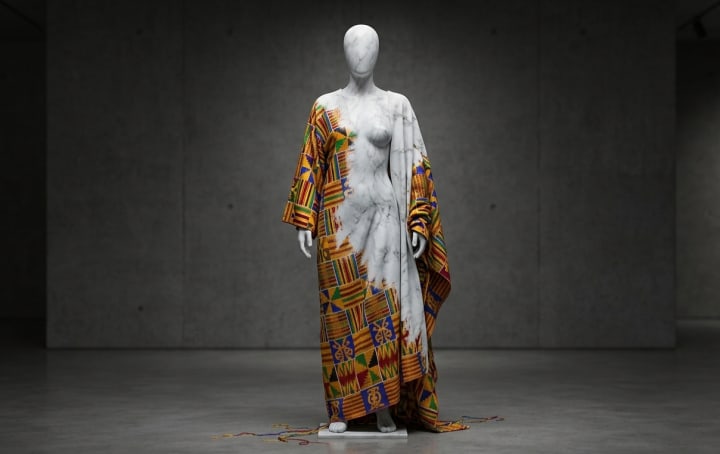
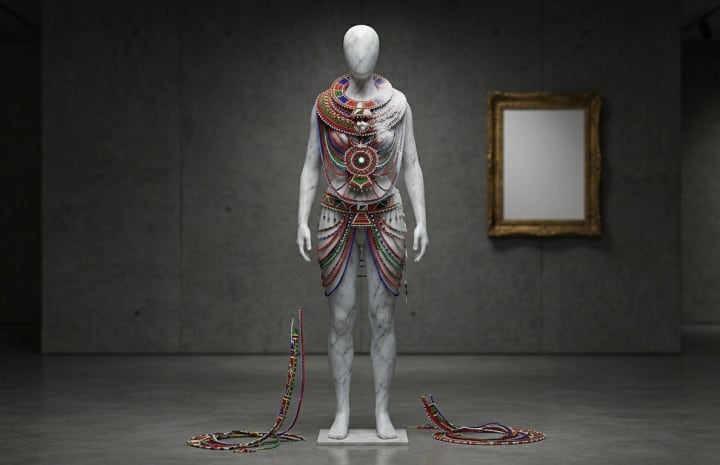
High fashion doesn't discover culture; it bleaches it until the only thing left is the price tag and the name of a man who has never stepped foot in the dust where the pattern was born.
"The clock has struck three, the coffee is cold, and the shadows are beginning to speak. Welcome back to the desk of The Night Writer. Tonight, we’re looking at a heist that didn't happen in a vault, but on the runway, and the loot isn't diamonds—it’s the soul of a continent."
You see it on the cover of the glossies. You see it strutting down the carpet at the Met Gala. A "groundbreaking" spring collection from a fabled Parisian house, featuring vibrant, interlocking geometric shapes, bold concentric circles, and the recognizable rhythm of African textiles. The critics rave about the "fresh," "global" perspective. The price tag on a simple wrap skirt is $18,000.
You are not looking at innovation. You are looking at a masterclass in elegant burglary.
We are currently witnessing the final, most sophisticated stage of colonization: the cannibalization of culture. Europeans and Western brands have stopped merely plundering the soil of Africa for gold and coltan; they are now (and have been for centuries) plundering the very patterns that define its identity. They are stealing the sacred, stripping it of its context, and selling it back to the world as "high fashion." This isn't an "appreciation" of culture. This is a robbery of memory.
Let’s dismantle the biggest lie on the runway: the idea of "inspiration." When a Western designer says they were "inspired" by the textiles of the Akan or the Maasai, they are using a polite euphemism for "uncompensated seizure." "Inspiration" implies a dialogue. It implies that the original artist was aware of, or perhaps even profited from, the transaction. But that is not what is happening. The designers of these global houses aren't sitting down with master weavers in Accra or Nairobi. They are visiting a museum, taking a photo of a century-old kente cloth, digitizing it, and printing it on Italian silk.
A pattern like the Nsataa (the fist) in Kente weaving is not just a cool shape. It’s a visual proverb; it symbolizes unity and strength. The Adinkra symbols of Ghana are an entire philosophical library printed on cloth. When a Western brand slap-dashes these onto a $4,000 jumpsuit without acknowledging the symbol's name, meaning, or origin, they are turning a sacred text into a tablecloth. They are demanding that African culture exist only as an ornament for their vanity, not as a source of intellectual property.
Haute couture is the perfect delivery mechanism for this crime. Its defining characteristic is exclusivity. By its very nature, it separates the "creators" (the Western designers) from the "consumers" (the global elite). When a design house "discovers" a traditional pattern, they are effectively claiming intellectual land. They file the trademark. They patent the "interpretation." And when they do that, they are locking the doors. The very communities that have woven these patterns for generations can no longer legally reproduce their own inheritance for a global market without running afoul of the lawyers protecting the "innovative new design" of a Parisian mogul.
The silence from the fashion industry on this is profound, but the silence from us is what is devastating. We, the consumers, are the enablers. We see the "exotic" pattern and we buy into the narrative of "worldliness" that the brand is selling. We are more comfortable buying a stolen version of African art from a Milanese boutique than we are engaging with the actual African artisans. We are complicit in this erasure every time we praise a Western designer for their "global vision" without asking: "Whose vision are they wearing?"
We have now gone past the point of simply boycotting these heists; we need to do more by refusing to accept the counterfeit. It means demanding a standard of ethical provenance for fashion that matches what we expect from diamonds or lumber. We need international legal frameworks that treat these patterns as community-owned IP, not as open-source data. Support the original weavers directly. If you want Kente, buy it from a Ghanaian cooperative. If you want Shweshwe, support South African textile mills. Stop buying the Italian silk imitation.
When a brand uses African designs, look for the acknowledgement. If the tag doesn't name the ethnic group or the specific textile tradition, it is stolen property. The riot in your mind should stop you from looking at a beautiful pattern and start you looking at a political act. Don't let them convince you that theft is innovation. The Vulture’s Runway is built on the bones of a thousand erased histories. Don't let them walk on your mind without paying the rent.
If a teenager in a basement samples three seconds of a pop song, they’re sued for millions; but when a French billionaire samples three centuries of a tribe’s soul, he’s called a 'visionary.
‐-‐----------------------------------------------------------------------------------------------------
The Ethics of the Aesthetic
In this piece, I wanted to bridge the gap between "fashion" and "theft." Most people don't view a pattern on a dress as a piece of intellectual property, but for many African cultures, these textiles are the equivalent of a national archive or a holy scripture. By using the "Night Writer" persona, I’ve tried to heighten the sense of urgency—making the reader feel like they are discovering a secret that has been hidden in plain sight on every luxury shopping street in the world.
"Daylight is coming to claim the quiet, but these words stay with you. If you enjoyed this journey into the midnight hours, leave a heart or a tip to keep the candles burning. Sleep well—if you can. — The Night Writer."
About the Creator
The Night Writer 🌙
Moonlight is my ink, and the silence of 3 AM is my canvas. As The Night Writer, I turn the world's whispers into stories while you sleep. Dive into the shadows with me on Vocal. 🌙✨
Keep reading
More stories from The Night Writer 🌙 and writers in Viva and other communities.
What Makes Colombo Special?
Wondering what makes Colombo stand out among the capitals in Asia? This stunning city blends colonial heritage, modern attractions, rich culture, and mouthwatering cuisine all within this amazing hotspot. From exploring colourful markets and serene temples and holy sites, to trying out some tasty street food and exquisite rooftop bars, Colombo has something for everyone! Here's how to experience its vibrant spirit and discover what truly makes it special.
By Aurora Gianna3 days ago in Viva
A Historic Decision in Jersey: Choosing Dignity at the End of Life
In February 2026, the island of Jersey made history. Lawmakers voted to allow assisted dying for terminally ill adults. This decision has started important conversations about dignity, suffering, and the right to choose how life ends.
By dua fatimaa day ago in Viva



Comments
There are no comments for this story
Be the first to respond and start the conversation.