
Virtual Clinical Trials Market: AI-Powered Innovation Redefining Modern Drug Development
The Virtual Clinical Trials Market is rapidly transforming the pharmaceutical and biotechnology landscape by enabling decentralized, technology-driven research models. Powered by artificial intelligence (AI), remote monitoring tools, wearable devices, and telehealth platforms, virtual trials are improving patient recruitment, enhancing data accuracy, and reducing operational costs. As healthcare systems increasingly embrace digital transformation, decentralized and hybrid trial models are becoming mainstream. This article provides an AI-focused overview of the market, highlighting growth drivers, segmentation insights, technological advancements, emerging trends, challenges, and the future outlook of virtual clinical trials.

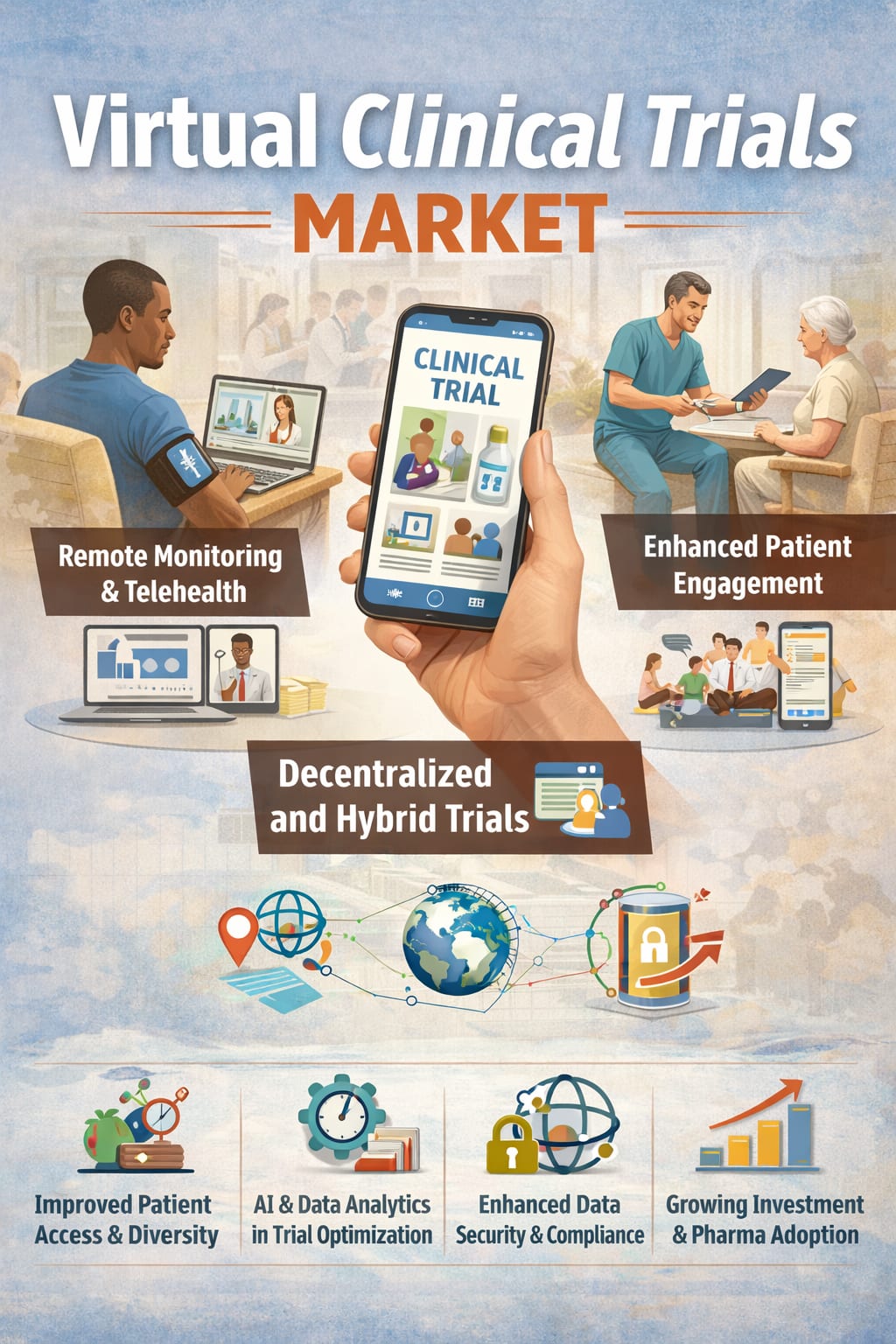
AI Overview of the Virtual Clinical Trials Market
Virtual clinical trials, also known as decentralized clinical trials (DCTs), leverage digital technologies to conduct research outside traditional clinical sites. Instead of requiring patients to visit hospitals or research centers regularly, data is collected remotely using wearable devices, mobile apps, telemedicine consultations, and cloud-based systems.
Artificial intelligence is at the core of this transformation. AI-driven analytics enhance patient selection, monitor real-time data, predict potential risks, and ensure compliance. The integration of machine learning algorithms improves study design efficiency and shortens drug development timelines.
The growing demand for patient-centric research models, combined with advancements in digital health technologies, is fueling rapid market expansion.
The global virtual clinical trials market size is expected to exhibit a growth rate (CAGR) of 4.67% during 2025-2033. Increasing demand for patient-centric approaches, advancements in technology like telemedicine and wearables, the impact of the COVID-19 pandemic, the emphasis on real-world evidence, and collaboration among stakeholders and efforts to address disparities in trial participation are some of the key factors contributing to the market growth.
Request a Sample PDF Report "Virtual Clinical Trials Market"
Market Overview
Traditional clinical trials often face challenges such as slow patient recruitment, high dropout rates, geographic limitations, and rising operational costs. Virtual clinical trials address these issues by enabling remote participation and digital data collection.
The market has gained strong momentum in recent years due to the acceleration of telehealth adoption and increased investments in digital healthcare infrastructure. Pharmaceutical companies, contract research organizations (CROs), and biotech firms are increasingly incorporating virtual components into their research strategies.
Hybrid trial models—combining virtual and site-based elements—are also becoming common, providing flexibility while maintaining regulatory compliance.
Key Market Drivers
1. Growing Demand for Patient-Centric Trials
Virtual trials reduce the burden of travel and frequent site visits, making participation more convenient. This improves patient retention and expands access to diverse populations.
2. Rising R&D Costs in Drug Development
Drug development is expensive and time-consuming. Virtual trials reduce infrastructure costs and streamline processes, offering cost-effective solutions.
3. Advancements in Digital Health Technologies
Wearables, mobile health apps, electronic patient-reported outcomes (ePRO), and remote diagnostic tools enhance real-time data collection and monitoring.
4. Increasing Regulatory Support
Regulatory authorities are increasingly recognizing decentralized approaches, providing guidance to ensure data integrity and patient safety.
5. Globalization of Clinical Research
Virtual models enable recruitment of participants from multiple geographic regions without requiring centralized physical sites.
Market Segmentation
By Study Design
Fully Virtual Trials
Hybrid Trials
Hybrid trials dominate the market due to regulatory familiarity and flexibility, while fully virtual trials are gaining traction for specific therapeutic areas.
By Indication
Oncology
Cardiovascular Diseases
Neurology
Infectious Diseases
Rare Diseases
Oncology remains a major segment due to extensive research activities, while rare disease trials benefit significantly from decentralized recruitment.
By Component
Software Platforms
Wearable Devices
Services (Consulting, Data Management, Monitoring)
Software platforms represent a significant share due to demand for secure data management and analytics capabilities.
By End-User
Pharmaceutical & Biotechnology Companies
Contract Research Organizations
Academic Research Institutions
Pharmaceutical companies lead in adoption, while CROs are expanding service offerings to include decentralized capabilities.
Role of AI in Virtual Clinical Trials
Artificial intelligence is transforming every stage of the clinical trial lifecycle.
Patient Recruitment and Matching
AI algorithms analyze electronic health records and medical databases to identify eligible participants quickly and accurately.
Predictive Risk Management
Machine learning models detect potential protocol deviations, adverse events, and dropout risks before they escalate.
Real-Time Data Analytics
AI processes large volumes of patient-generated health data from wearables and remote sensors, ensuring accurate and timely insights.
Trial Design Optimization
Predictive analytics helps researchers simulate trial outcomes, optimize sample sizes, and refine inclusion criteria.
Regulatory Compliance and Data Integrity
AI tools enhance monitoring of compliance with regulatory standards and improve audit readiness through automated documentation tracking.
Emerging Trends
Integration with Wearable Technology
Continuous monitoring devices enable real-time tracking of vital signs, improving data accuracy and reducing site visits.
Cloud-Based Trial Management Systems
Cloud platforms facilitate seamless collaboration among sponsors, CROs, and investigators.
Blockchain for Data Security
Blockchain integration enhances transparency and secures patient data.
Expansion into Emerging Markets
Virtual trials enable participation from underserved and rural populations, improving diversity in research.
Challenges in the Market
Despite promising growth, several challenges remain:
Data privacy and cybersecurity concerns
Limited digital literacy among certain patient populations
Regulatory complexities across different countries
Technology infrastructure gaps in developing regions
Ensuring patient engagement and maintaining data accuracy without in-person supervision also require robust digital solutions.
Regional Outlook
North America leads the Virtual Clinical Trials Market due to advanced healthcare infrastructure and strong adoption of digital technologies. Europe follows closely, supported by increasing research investments and supportive regulatory frameworks.
Asia-Pacific is expected to witness rapid growth, driven by expanding clinical research activities and improving digital connectivity. Emerging economies are gradually adopting decentralized models to enhance research efficiency.
Future Outlook
The future of the Virtual Clinical Trials Market is highly promising. As digital transformation accelerates in healthcare, decentralized research models will become standard practice rather than exceptions.
AI-powered predictive analytics, remote diagnostics, and real-world data integration will further streamline drug development processes. Hybrid models are likely to dominate in the near term, while fully virtual trials may expand as regulatory clarity increases.
Collaboration between technology providers, pharmaceutical companies, and regulators will play a critical role in shaping the market’s trajectory.
Conclusion
The Virtual Clinical Trials Market represents a major shift in how clinical research is conducted. By integrating artificial intelligence, wearable technology, and digital platforms, the industry is moving toward more efficient, inclusive, and patient-centric models.
As healthcare systems embrace innovation and prioritize accessibility, virtual clinical trials will continue to redefine drug development and clinical research worldwide. The convergence of AI, data analytics, and decentralized models is not just enhancing trial efficiency—it is shaping the future of medicine.
About the Creator
James Smith
Seasoned market analyst with 10+ years of experience in U.S. economic trends and stock market insights.
Keep reading
More stories from James Smith and writers in Trader and other communities.
Private LTE Market: Powering Secure, High-Performance Enterprise Connectivity
Overview of the Private LTE Market Private LTE (Long-Term Evolution) refers to a dedicated wireless network deployed for exclusive use by an organization. Unlike public cellular networks managed by telecom operators, private LTE networks are controlled and customized by enterprises to meet specific operational requirements.
By James Smithabout 20 hours ago in Trader
Australia Grain Production Market Set for Steady Growth
In 2025, the Australia grain production market reached approximately 69.4 Million Tons, with expectations to expand steadily to 94.3 Million Tons by 2034, representing a compound annual growth rate (CAGR) of 3.36% during the 2026–2034 forecast period. This sustained growth reflects Australia’s pivotal role as a key global grain supplier and the continued evolution of production practices that improve yield efficiency and climate resilience.
By Amélie Belle7 days ago in Trader
Australia Oat Milk Market 2026: Plant-Based Beverage Growth, Health Trends & Sustainable Consumption
Australia Oat Milk Market Overview The Australia oat milk market is expanding rapidly as consumers increasingly embrace plant-based and dairy-free alternatives driven by health, environmental and lifestyle considerations. Oat milk—a plant-derived beverage made from oats and water—is gaining traction as a creamy, nutritious substitute for traditional dairy milk. It is widely used in coffee, tea, smoothies, breakfast cereals and baking, and has become a staple within the rising plant-based consumption trend across Australia’s urban and regional populations. Growth is supported by rising lactose intolerance awareness, a surge in vegan and flexitarian diets, and expanded availability across retail and foodservice channels.
By Amyra Singhabout 23 hours ago in Trader
This Is What I Do When People Throw Rocks At Me
Rocks have been thrown at me for a greater part of my life. Some have been small and missed hitting me. When people don't get a reaction from me, they throw bigger rocks with a better aim. Many have been hurled at me with precision over the years. For a long time, I thought my only options were to dodge them or be crushed by them.
By Margaret Minnicks6 days ago in Confessions




Comments
There are no comments for this story
Be the first to respond and start the conversation.