
South East Asia Building Management System Market Size & Forecast 2026–2034
Smart Infrastructure Momentum to Drive Market from US$ 6.51 Billion to US$ 17.64 Billion

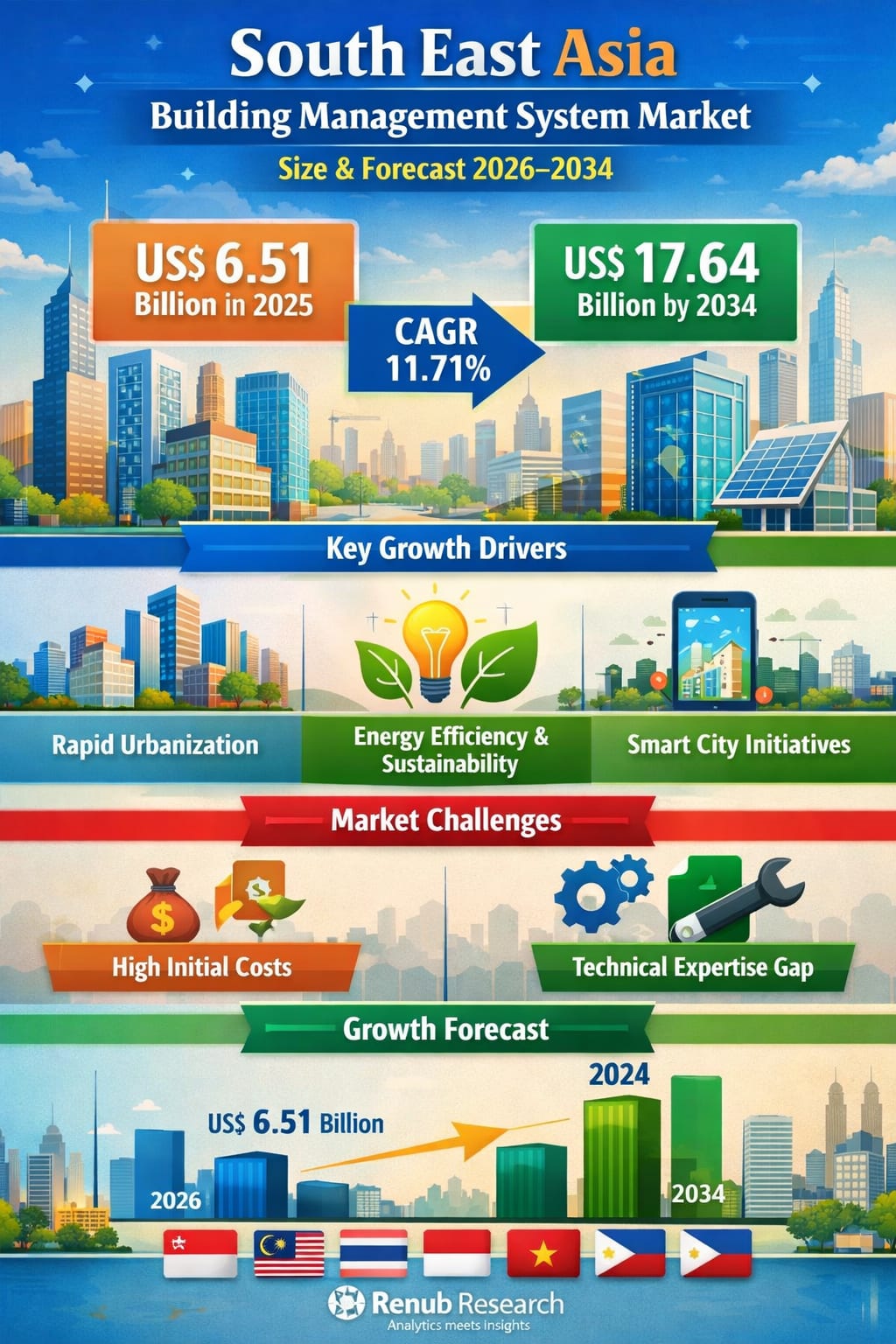
The South East Asia Building Management System (BMS) market is poised for strong and sustained expansion over the coming decade. According to Renub Research, the market is projected to grow from US$ 6.51 Billion in 2025 to US$ 17.64 Billion by 2034, registering a robust CAGR of 11.71% during 2026–2034.
This growth reflects a larger transformation underway across Southeast Asia—where rapid urbanization, expanding commercial real estate, and government-backed sustainability initiatives are reshaping the region’s built environment. As cities become denser and buildings more complex, automated and intelligent control systems are no longer optional—they are essential.
South East Asia Building Management System Market Outlook
A Building Management System (BMS) refers to the integrated application of digital technologies for centralized control and monitoring of building operations. These include HVAC (heating, ventilation, and air conditioning), lighting, energy usage, fire safety, security systems, and access control.
Through sensors, controllers, networking infrastructure, and advanced software platforms, BMS solutions enable real-time monitoring and automation. This integration delivers operational efficiency, lower energy costs, enhanced safety, and improved sustainability performance.
Across Southeast Asia—including Singapore, Indonesia, Thailand, Malaysia, Vietnam, and the Philippines—BMS adoption is accelerating due to:
Rapid commercial construction
Expansion of airports, malls, hospitals, and office towers
Growing energy costs
Rising environmental awareness
Government sustainability mandates
As developers increasingly design smart and green buildings, BMS is becoming a foundational component rather than a premium add-on.
Key Growth Drivers
1. Rapid Urbanization and Infrastructure Development
Urbanization remains one of the most powerful catalysts for BMS growth in Southeast Asia. Currently, around half of ASEAN’s population lives in urban areas, but the pace varies significantly. Singapore is nearly 100% urbanized, while countries like Cambodia are still in earlier stages of transition.
Cities such as Jakarta, Manila, Bangkok, and Ho Chi Minh City are expanding rapidly. By 2030, a significant share of Asia’s population will reside in urban environments, intensifying demand for commercial complexes, mixed-use developments, airports, and high-rise residential buildings.
Modern infrastructure projects across Indonesia, Vietnam, Thailand, and the Philippines are increasing building size and complexity. Manual management of HVAC, lighting, and security in such facilities is inefficient and costly. BMS solutions enable centralized oversight, automated optimization, and data-driven decision-making—dramatically improving operational efficiency.
New developments increasingly integrate BMS during the design stage, further accelerating adoption.
2. Rising Demand for Energy Efficiency and Sustainability
Energy consumption in commercial buildings represents a substantial portion of overall electricity demand. As power tariffs rise across Southeast Asia, building owners are prioritizing energy optimization.
BMS platforms provide:
Real-time energy monitoring
Load optimization
Automated lighting control
Smart HVAC scheduling
Predictive maintenance
Governments across the region are promoting green building certifications and stricter energy codes. In tropical climates, efficient HVAC management is particularly critical due to high cooling loads.
In February 2025, Singapore-based G Element Pte Ltd signed an MOU with Daikin Airconditioning (Singapore) Pte. Ltd., highlighting the growing emphasis on digital twin technology and intelligent cooling solutions. Such collaborations reinforce how sustainability and digital innovation are converging in the BMS ecosystem.
3. Smart City Initiatives and Digital Transformation
Smart city programs across Southeast Asia are reinforcing BMS deployment. Governments are investing in connected infrastructure, IoT ecosystems, and digital governance frameworks.
Vietnam’s National Digital Transformation Programme through 2025 (with orientation toward 2030) is accelerating enterprise digitization and smart infrastructure implementation. BMS integrates seamlessly into smart city frameworks by enabling:
Connected building ecosystems
Cloud-based remote management
AI-driven performance analytics
Predictive asset maintenance
As digital transformation deepens, BMS is becoming a core pillar of intelligent urban infrastructure.
Market Challenges
High Initial Investment and Cost Sensitivity
One of the key barriers in the Southeast Asia BMS market is the relatively high upfront cost of system installation. Hardware components such as sensors, controllers, networking devices, and integration software require substantial investment.
Retrofitting older buildings is even more complex and expensive than installing BMS in new constructions. In emerging economies within the region, cost-sensitive developers may prioritize short-term savings over long-term lifecycle benefits.
While BMS delivers strong ROI over time, educating stakeholders about total cost of ownership remains crucial.
Limited Technical Expertise and Integration Complexities
BMS implementation requires specialized knowledge across multiple subsystems, including HVAC, security, lighting, and fire safety. Integration challenges arise when systems from multiple vendors must work seamlessly together.
A shortage of skilled professionals in certain Southeast Asian markets can lead to underutilization or suboptimal system performance. Addressing this talent gap through training and technical partnerships will be vital for sustained market expansion.
Adjacent Market Opportunities
Southeast Asia Building HVAC Market
The HVAC segment is one of the most dynamic components of the BMS ecosystem. Southeast Asia’s tropical climate creates persistent demand for cooling systems in offices, malls, airports, and hospitals.
Smart HVAC systems integrated with BMS enable automated temperature control, occupancy-based cooling, and predictive maintenance. Energy-efficient HVAC adoption is rising as governments tighten energy efficiency standards.
Southeast Asia Building Security and Access Control Market
Security concerns and regulatory compliance are boosting demand for advanced access control technologies. Biometric systems, RFID, smart cards, and mobile authentication are increasingly integrated into centralized BMS platforms.
Centralized monitoring enhances real-time alerts and rapid threat response—critical in densely populated urban environments.
Southeast Asia BMS Software Market
Cloud-based and AI-enabled BMS software solutions are gaining strong traction. These platforms allow remote building monitoring, data analytics, and operational optimization.
Cloud deployment reduces infrastructure costs while enhancing scalability. As digital transformation accelerates, BMS software will remain a high-growth segment.
Southeast Asia Building Activated Carbon Market
Indoor air quality is becoming a major concern across Southeast Asia due to urban pollution and industrial emissions. Activated carbon filters are widely used in HVAC and air purification systems for odor and pollutant removal.
As health-focused building standards gain prominence, demand for advanced air filtration solutions is expected to increase.
Commercial and Online BMS Market Trends
Commercial buildings dominate BMS adoption due to their scale and operational complexity. Office towers, hotels, hospitals, and shopping centers require centralized control to reduce operating costs and enhance occupant comfort.
Meanwhile, the online BMS market is expanding rapidly. Cloud-based solutions allow facility managers to monitor buildings remotely, improving responsiveness and reducing onsite infrastructure costs. Multi-site operators particularly benefit from centralized dashboards and analytics.
Country-Level Insights
Singapore
Singapore remains the most advanced BMS market in Southeast Asia. Strong government support, smart city initiatives, and strict energy efficiency regulations drive widespread adoption.
In July 2023, Honeywell International Inc. partnered with Resorts World Sentosa to implement Singapore’s first large-scale cloud-based BMS for a major integrated resort. This reflects Singapore’s leadership in decarbonization and intelligent building operations.
Malaysia
Malaysia’s BMS market is expanding steadily, particularly in Kuala Lumpur, Penang, and Johor Bahru. Green building initiatives and energy efficiency certifications are supporting adoption.
In March 2023, Delta Controls introduced its Red5 series of BACnet controllers with scalable IoT connectivity, improving integration and reducing costs.
Indonesia
Indonesia’s large population and rapid infrastructure development make it a high-potential BMS market. Urbanization and rising electricity costs are key drivers.
In October 2025, ABB Ltd. partnered with the Government of Indonesia to improve electrical safety nationwide—reinforcing the importance of intelligent building and power management solutions.
Competitive Landscape
The Southeast Asia BMS market features global technology leaders and regional specialists. Major players include:
Cisco Systems Inc.
Hitachi Ltd.
Mitsubishi Electric Corporation
Honeywell International Inc.
Emerson Electric Co.
United Technologies Corporation
Trane Technologies
Huawei Technologies Corporation
Hubbell Inc.
Companies are evaluated across five viewpoints: Overview, Key Person, Recent Developments, SWOT Analysis, and Revenue Analysis.
Strategic partnerships, cloud innovation, AI integration, and IoT expansion remain key competitive strategies.
Market Segmentation
By System Type:
HVAC System | Fire & Safety | Energy Management | Security & Access Control | Smart Building Integration | Facility Management | Emergency Management | Others
By Component:
Hardware | Software | Services
By Technology:
Activated Carbon | Electrostatic Precipitators | HEPA | Ion & Ozone Generators | Others
By Application:
Commercial | Industrial | Residential
By End User:
Offline | Online
By Country:
Singapore | Malaysia | Thailand | Indonesia | Vietnam | Philippines | Rest of Southeast Asia
Final Thoughts
The South East Asia Building Management System market is entering a decisive growth phase. With the market projected to expand from US$ 6.51 Billion in 2025 to US$ 17.64 Billion by 2034, at a CAGR of 11.71%, BMS solutions are becoming central to the region’s infrastructure transformation.
Urbanization, sustainability mandates, rising energy costs, and digital transformation initiatives are converging to create powerful momentum. While challenges such as high initial investment and limited technical expertise remain, the long-term benefits of operational efficiency, energy savings, and intelligent automation outweigh short-term barriers.
About the Creator
Keep reading
More stories from shibansh kumar and writers in Trader and other communities.
United States Procurement Software Market Size and Forecast 2026–2034
United States Procurement Software Market Overview The United States Procurement Software Market is entering a decisive growth phase as enterprises accelerate their shift toward digital, data-driven purchasing operations. The market is expected to reach US$ 6.22 billion by 2034, up from US$ 2.9 billion in 2025, expanding at a compound annual growth rate (CAGR) of 8.82% from 2026 to 2034. This strong upward trajectory reflects how procurement is no longer viewed as a purely administrative function, but as a strategic lever for cost optimization, risk management, compliance, and long-term value creation.
By shibansh kumarabout 16 hours ago in Trader
Australia Online Travel Bookings Market Steadies Toward USD 15.9 Billion by 2034
In 2025, the Australia online travel bookings market was valued at USD 11.4 billion and is forecast to reach USD 15.9 billion by 2034, growing at a compound annual growth rate (CAGR) of 3.76% from 2026 to 2034. Online travel bookings encompass reservations for flights, accommodation, transport and bundled vacation packages via digital platforms including mobile apps, desktop websites and third-party OTAs (online travel agencies). This expansion reflects broader digital trends in travel planning and the resurgence of both domestic and international tourism demand in Australia’s evolving travel sector.
By Amélie Bellea day ago in Trader
When the Shelter Closes
Across the street from my house, a man slept under a tree, his dog by his side. My first, naive thought: he must be traveling through. But he kept coming back, often sleeping there during the day. Then it hit me—that person might not have a home.
By Bride of Sounda day ago in Humans


Comments
There are no comments for this story
Be the first to respond and start the conversation.