
Kitchenware Market Size and Forecast 2025–2033
From Smart Cookware to Sustainable Utensils: How Changing Lifestyles Are Reshaping the Global Kitchenware Industry

Introduction: The Modern Kitchen Is Getting Smarter, Greener, and More Stylish
The global kitchen is no longer just a place to cook—it has become a center for creativity, wellness, technology, and lifestyle expression. From compact apartments in megacities to spacious suburban homes, consumers are rethinking how they cook, eat, and entertain. This shift is transforming the kitchenware industry into one of the most dynamic segments of the consumer goods market.
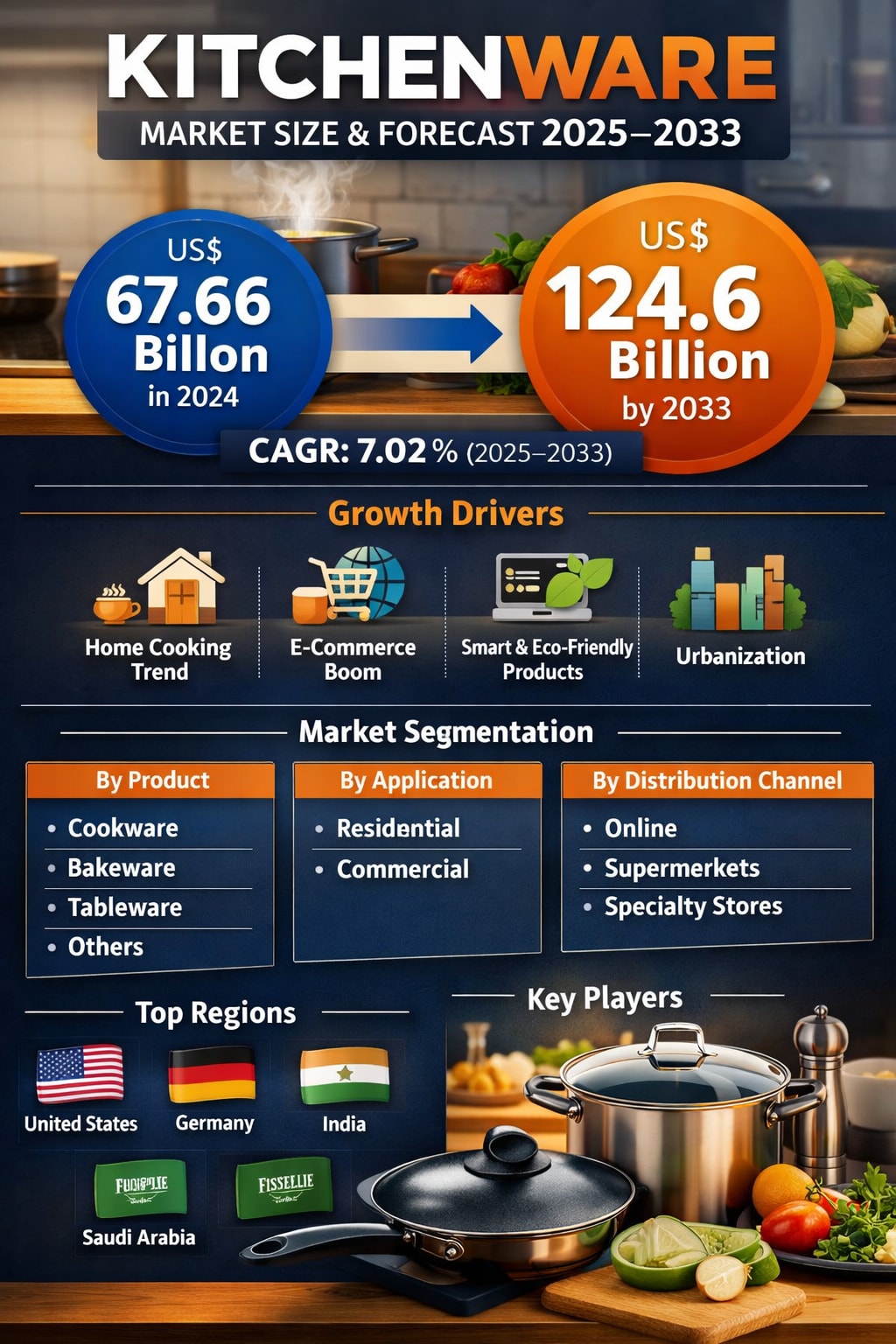
According to Renub Research, the Kitchenware Market is expected to reach US$ 124.6 billion by 2033, up from US$ 67.66 billion in 2024, growing at a compound annual growth rate (CAGR) of 7.02% from 2025 to 2033. This impressive expansion is being driven by several converging trends: the rising popularity of home cooking, increasing disposable incomes, the rapid growth of e-commerce, continuous product innovation, accelerating urbanization, and a global shift toward healthier and more sustainable lifestyles.
Kitchenware today includes far more than just pots and pans. It covers a wide range of products such as cookware, bakeware, tableware, utensils, storage containers, and increasingly, smart and multifunctional kitchen tools designed to improve efficiency and convenience. Materials like stainless steel, glass, silicone, ceramics, and eco-friendly composites are being used to meet rising expectations around durability, safety, and environmental responsibility.
As consumers become more design-conscious, health-aware, and time-sensitive, the kitchenware market is evolving into a space where functionality, aesthetics, and technology intersect—setting the stage for strong long-term growth worldwide.
Global Kitchenware Industry Overview
Kitchenware refers to the extensive range of appliances, utensils, equipment, and tools used in the preparation, cooking, and serving of food. Common products include pots, pans, knives, cutting boards, spatulas, mixing bowls, baking trays, and food storage containers. Over time, the industry has expanded to include advanced and smart kitchen tools that enhance precision, safety, and convenience.
Material choice plays a crucial role in product development. Stainless steel is favored for its durability and hygiene, glass and ceramics for their safety and aesthetic appeal, and silicone for flexibility and heat resistance. At the same time, growing awareness about food safety and sustainability is pushing manufacturers to reduce harmful coatings and introduce eco-friendly alternatives.
The COVID-era cooking boom permanently changed consumer behavior. Even after restaurants reopened, many consumers continued cooking at home, experimenting with new recipes, and investing in better kitchen tools. This long-term behavioral shift, combined with rising incomes and digital shopping habits, has created a strong foundation for sustained market growth.
Another important factor is the influence of social media and food content. Cooking shows, recipe reels, and influencer-led kitchen setups have made kitchenware more aspirational, encouraging consumers to upgrade their tools not just for function, but also for style and social sharing.
Key Growth Drivers of the Kitchenware Market
1. Rising Demand for Multifunctional and Space-Saving Products
One of the strongest drivers of market growth is the increasing preference for multifunctional and space-saving kitchenware. As urban living spaces become smaller, especially in major cities, consumers are looking for compact products that can perform multiple tasks while minimizing clutter.
Stackable cookware, foldable utensils, and multi-use appliances are gaining popularity among young professionals, renters, and small families. These products not only save space but also offer better value for money by combining several functions into one tool.
In 2023, for example, Cuisinart introduced an outdoor wok station aimed at consumers seeking performance-driven and versatile cooking solutions, highlighting the industry’s move toward specialized yet flexible products. This trend toward practical innovation is expected to continue, especially in densely populated urban markets.
2. Innovation and Technology Integration in Kitchenware
Technology is playing a growing role in shaping the future of kitchenware. Today’s consumers want products that offer greater safety, precision, and ease of use. Smart kitchenware with features such as temperature control, improved non-stick coatings, ergonomic designs, and even app connectivity is gaining traction.
In 2023, All-Clad Metalcrafters launched a new stainless steel cookware line with a PFOA-free nonstick coating, responding directly to consumer concerns about health and chemical safety. Innovations like these not only improve cooking performance but also align with the rising demand for healthier and more sustainable products.
Beyond coatings and materials, design improvements—such as heat-resistant handles, scratch-resistant surfaces, and lightweight construction—are encouraging consumers to replace older products more frequently, supporting steady market growth.
3. Growing Urbanization and Changing Lifestyles
Urbanization is another powerful engine behind the kitchenware market. As more people move to cities, living spaces are becoming more compact, and lifestyles more fast-paced. This has increased demand for efficient, easy-to-use, and space-conscious kitchen tools.
Busy urban consumers often look for products that reduce cooking time, simplify food preparation, and are easy to clean and store. Manufacturers are responding by introducing innovative designs that combine convenience with modern aesthetics, making kitchenware more appealing to younger, design-savvy buyers.
At the same time, the rise of dual-income households and health-conscious consumers is driving interest in home-cooked meals, further boosting demand for high-quality and user-friendly kitchen products.
Challenges Facing the Kitchenware Market
1. Saturation in Developed Markets
In many developed regions, especially North America and Western Europe, the kitchenware market is relatively mature. Most households already own essential kitchen tools, which limits the scope for volume-driven growth. As a result, companies must rely more on replacement demand, premiumization, and innovation to sustain sales.
This puts pressure on brands to continuously launch new designs, materials, and features that can persuade consumers to upgrade, even when their existing products are still functional.
2. High Competition and Price Pressure
The kitchenware industry is highly competitive, with a mix of global brands, regional players, and low-cost manufacturers. This intense competition often leads to price wars, squeezing profit margins for both manufacturers and retailers.
To stand out, companies must invest heavily in branding, product design, marketing, and research and development. At the same time, low-cost producers—particularly from emerging markets—continue to challenge established brands by offering cheaper alternatives, making customer loyalty harder to maintain.
Regional Market Insights
United States Kitchenware Market
The U.S. kitchenware market is experiencing steady growth, driven by changing consumer preferences and technological advancements. The rising popularity of smart and eco-friendly kitchen products is a key trend, as consumers become more health- and sustainability-conscious.
E-commerce has also played a major role in expanding product accessibility, allowing consumers to compare brands, read reviews, and discover new products more easily than ever before. As a result, the U.S. market is increasingly focused on innovative designs that combine functionality, sustainability, and modern aesthetics.
Germany Kitchenware Market
Germany’s kitchenware market is known for its emphasis on quality, durability, and precision engineering. Sustainability is a major purchasing factor, with growing demand for recyclable materials and environmentally friendly coatings.
Well-known premium brands such as WMF, Zwilling, and Fissler continue to dominate, while innovative newcomers focus on modern designs and eco-conscious manufacturing. The trend toward smaller urban homes is also boosting demand for space-saving and multifunctional kitchenware, supporting steady market growth.
India Kitchenware Market
India is one of the fastest-growing kitchenware markets, driven by rapid urbanization, rising disposable incomes, and a renewed interest in home cooking. Consumers are increasingly adopting health-conscious and sustainable cooking products, including traditional materials like brass and copper.
In January 2025, Artarium launched its first Kitchenware & Cookware collection, blending traditional Indian craftsmanship with modern, wellness-focused design. This reflects a broader trend in India, where young consumers are experimenting with new cooking styles while also embracing cultural heritage.
The rapid expansion of e-commerce platforms is further accelerating market growth by making a wide range of products accessible across urban and semi-urban areas.
Saudi Arabia Kitchenware Market
Saudi Arabia’s kitchenware market is growing quickly as consumer preferences evolve and interest in home cooking increases. There is rising demand for products that combine traditional aesthetics with modern functionality.
Sustainability and smart kitchen appliances are gaining popularity, and the expansion of online retail platforms has significantly improved product availability. Both local and international brands are competing to cater to diverse consumer tastes, making kitchenware an increasingly important category in Saudi households.
Recent Developments in the Kitchenware and Related Markets
In 2023, the Malaysian Ministry of Health (KKM) sought public feedback on revising regulations to ensure the safety of milk products, reflecting broader concerns about food safety and product quality that also influence kitchenware standards.
In May 2022, Arla Foods invested around USD 213 million to expand its dairy facility in Pronsfeld, Germany, showcasing the scale of investment in food processing infrastructure—an ecosystem that closely links with kitchenware usage and standards in both commercial and residential kitchens.
Kitchenware Market Segmentation
By Product:
Cookware
Bakeware
Tableware
Others
By Application:
Residential
Commercial
By Distribution Channel:
Hypermarkets/Supermarkets
Specialty Stores
Online
Others
Country-Level Coverage (25 Markets)
North America:
United States, Canada
Europe:
France, Germany, Italy, Spain, United Kingdom, Belgium, Netherlands, Turkey
Asia Pacific:
China, Japan, India, Australia, South Korea, Thailand, Malaysia, Indonesia, New Zealand
Latin America:
Brazil, Mexico, Argentina
Middle East & Africa:
South Africa, United Arab Emirates, Saudi Arabia
Competitive Landscape and Key Players
The market analysis covers companies from five perspectives:
Company Overview
Key Persons
Recent Developments & Strategies
SWOT Analysis
Sales Analysis
Key Players Include:
GROUPE SEB
TTK Prestige Ltd.
The Vollrath Company, LLC
Wilh. Werhahn KG
Target Brands, Inc.
Newell Brands
Fissler
Tramontina
These companies are focusing on innovation, sustainability, premiumization, and digital channels to strengthen their market positions.
Final Thoughts: A Market Built for the Modern Lifestyle
The global kitchenware market is entering a golden era of transformation. With the market projected to grow from US$ 67.66 billion in 2024 to US$ 124.6 billion by 2033, the industry is clearly benefiting from powerful lifestyle, technological, and economic shifts.
As consumers cook more at home, care more about health and sustainability, and demand smarter, more efficient tools, kitchenware is evolving from a basic household necessity into a lifestyle-driven, design-focused, and innovation-led industry.
For manufacturers, retailers, and investors alike, the message is clear: the future of kitchenware will be shaped by smart design, eco-conscious materials, multifunctionality, and digital-first retail strategies. Those who adapt fastest to these trends will be best positioned to win in this rapidly expanding global market.


Comments
There are no comments for this story
Be the first to respond and start the conversation.