
Procurement Software Market Size and Forecast 2026–2034
AI-Driven Automation, Digital Transformation, and Spend Intelligence Reshape the Future of Enterprise Procurement

Procurement Software Market Outlook
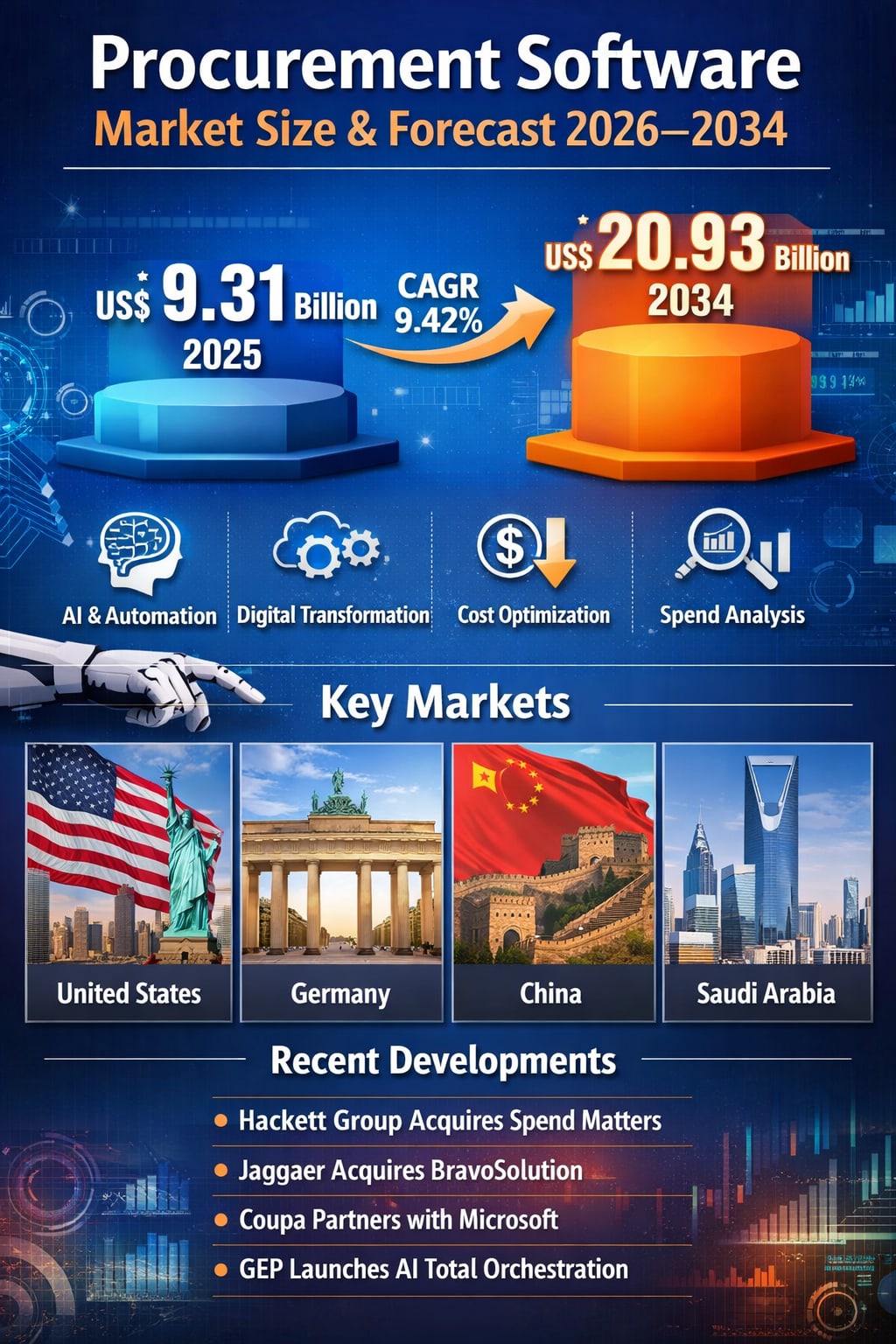
The global procurement software market is entering a phase of accelerated transformation as organizations across industries seek to modernize purchasing operations, enhance transparency, and strengthen cost control. According to industry estimates, the Procurement Software Market is expected to reach US$ 20.93 billion by 2034, up from US$ 9.31 billion in 2025, growing at a compound annual growth rate (CAGR) of 9.42% from 2026 to 2034.
This strong growth trajectory reflects a broader shift toward digital business models, data-driven decision-making, and automation-first enterprise strategies. Procurement, once considered a largely operational function, is now recognized as a strategic pillar influencing profitability, resilience, and competitive advantage. As global supply chains become more complex and cost pressures intensify, organizations are increasingly turning to advanced procurement platforms to gain real-time visibility, reduce risks, and optimize spending.
Modern procurement software goes far beyond simple purchase order management. Today’s solutions integrate artificial intelligence (AI), advanced analytics, cloud computing, and workflow automation to deliver end-to-end visibility across sourcing, contracting, purchasing, invoicing, and supplier management. This evolution is transforming procurement from a back-office process into a strategic, value-creating function within enterprises worldwide.
Procurement Software Industry Overview
Procurement software is a digital solution designed to automate and streamline an organization’s purchasing lifecycle, from requisition and sourcing to payment and supplier performance management. These platforms enable businesses to manage supplier relationships, compare vendor quotations, negotiate contracts, track orders, and monitor spending in real time. Core functionalities typically include sourcing and tender management, purchase order creation, invoice processing, contract lifecycle management, and spend analytics.
With the integration of AI, cloud infrastructure, and data analytics, modern procurement tools deliver far greater visibility, accuracy, and control than traditional systems. By centralizing procurement activities within a single platform, organizations can reduce manual errors, accelerate approval workflows, ensure compliance with internal policies and external regulations, and make data-driven purchasing decisions.
As enterprises operate in increasingly volatile and interconnected supply chains, procurement software has become essential for improving operational efficiency, strengthening supplier collaboration, and supporting long-term financial performance. The market’s rapid expansion reflects the growing recognition that digital procurement is no longer optional—it is a strategic necessity.
Key Growth Drivers Shaping the Market
AI-Driven Optimization and Smart Procurement Platforms
Artificial intelligence is rapidly reshaping how organizations approach procurement. AI-powered platforms enable predictive analytics, automated decision-making, and more sophisticated supplier evaluation. These systems can analyze historical spending patterns, assess supplier performance, detect anomalies, and forecast demand with far greater accuracy than manual methods.
In October 2023, Olive Technologies partnered with Procurify to integrate AI-driven vendor sourcing and selection capabilities, highlighting how intelligent tools are becoming central to modern procurement strategies. AI-based solutions also automate repetitive tasks such as purchase order processing, invoice matching, and compliance checks, allowing procurement teams to focus on higher-value strategic activities like supplier negotiations and risk management.
As enterprises prioritize agility, transparency, and data-driven insights, AI-enabled procurement platforms are increasingly seen as essential infrastructure. This shift is a major contributor to the sustained growth of the global procurement software market.
Digital Transformation and Low-Code Procurement Ecosystems
The broader wave of digital transformation across enterprises is another powerful driver of procurement software adoption. Organizations are moving away from fragmented, manual processes toward integrated digital ecosystems that support faster decision-making and greater operational resilience.
Low-code and no-code platforms are playing a particularly important role in this transition. In October 2023, GEP launched GEP Quantum, an AI-driven, low-code procurement and supply chain platform designed to support tools such as GEP Smart and GEP Nexxe. These solutions allow non-technical users to configure workflows, build applications, and adapt processes with minimal IT dependency.
By reducing implementation time and increasing flexibility, low-code procurement platforms make digital transformation more accessible, especially for organizations that need to respond quickly to changing market conditions. This trend is significantly accelerating adoption across both large enterprises and mid-sized organizations.
Rising Focus on Efficiency and Spend Control
In an environment of economic uncertainty, inflationary pressures, and intense competition, organizations are placing greater emphasis on efficiency, cost savings, and return on investment. Procurement software plays a critical role in supporting these goals by providing real-time visibility into spending, supplier performance, and compliance risks.
In October 2023, Atamis partnered with Maximus UK to deliver advanced procurement tools aimed at improving sourcing efficiency and operational transparency. This reflects a broader market trend: enterprises are moving away from disconnected, manual systems toward centralized platforms that enable smarter purchasing decisions.
By offering detailed spend analytics, automated approval workflows, and stronger governance controls, procurement software helps organizations identify savings opportunities, reduce maverick spending, and improve overall financial discipline. As cost optimization remains a top priority for businesses worldwide, demand for advanced procurement solutions continues to rise.
Challenges Facing the Procurement Software Market
Integration Complexity and Legacy System Constraints
Despite strong growth prospects, the procurement software market faces notable challenges—chief among them is integration with legacy systems. Many organizations still rely on outdated ERP platforms, region-specific tools, or even paper-based workflows. Introducing modern procurement software often requires extensive customization, data migration, and process reengineering.
These integration efforts can increase implementation costs, extend deployment timelines, and create temporary operational disruptions. In some cases, poor integration can lead to data inconsistencies, user frustration, and lower adoption rates. Small and mid-sized enterprises, in particular, may struggle with limited IT resources and complex system landscapes, slowing the pace of digital procurement adoption.
Cybersecurity Risks and Data Privacy Concerns
Procurement platforms handle highly sensitive information, including supplier contracts, pricing structures, financial transactions, and compliance documentation. As more organizations move these processes to the cloud, concerns about cybersecurity and data privacy become increasingly critical.
Risks such as data breaches, ransomware attacks, and unauthorized access can have serious consequences, including financial losses, reputational damage, and disrupted supply chains. Additionally, compliance with global data protection regulations, such as GDPR, adds further complexity to system design and deployment.
These concerns make some organizations cautious about fully digitizing procurement, particularly in highly regulated industries. Addressing security and privacy risks effectively will remain a key requirement for vendors seeking to build trust and expand market adoption.
Regional Market Insights
United States Procurement Software Market
The United States represents one of the largest and most mature markets for procurement software. Strong digital transformation initiatives, widespread cloud adoption, and the presence of leading technology vendors have created a highly dynamic ecosystem.
Enterprises across manufacturing, healthcare, retail, and the public sector are increasingly investing in AI-enabled procurement platforms to improve efficiency, reduce costs, and strengthen supply chain visibility. U.S. organizations place strong emphasis on automation, analytics, and integrated procure-to-pay systems, driving continuous demand for innovative solutions. The focus on compliance, risk management, and sustainability further supports long-term market growth.
Germany Procurement Software Market
Germany’s procurement software market is shaped by its powerful industrial base, particularly in automotive, chemicals, and advanced manufacturing. German enterprises value precision, transparency, and compliance, making digital procurement tools an essential part of their operational strategy.
The country’s strong push toward Industry 4.0 and automation is accelerating the adoption of AI-driven and cloud-based procurement platforms. Additionally, strict sustainability regulations and quality standards are encouraging organizations to adopt solutions that can track supplier certifications, environmental performance, and regulatory compliance. As German companies strengthen supply chain resilience, demand for advanced procurement software continues to grow steadily.
China Procurement Software Market
China’s procurement software market is expanding rapidly, driven by large-scale manufacturing activity, fast-paced digital transformation, and increasing emphasis on automation. Enterprises are adopting procurement platforms to manage complex supplier networks, improve spend visibility, and enhance sourcing efficiency.
Government initiatives supporting digital ecosystems and smart supply chains further stimulate adoption across industries. Cloud-based solutions are particularly popular due to their scalability and cost efficiency, appealing to both large enterprises and SMEs. As Chinese companies integrate AI and analytics into procurement operations, demand for intelligent software platforms is expected to remain strong.
Saudi Arabia Procurement Software Market
Saudi Arabia’s procurement software market is gaining momentum as part of the country’s broader Vision 2030 agenda, which emphasizes digitization, transparency, and economic diversification. Both public and private sector organizations are investing in procurement platforms to modernize operations, reduce manual processes, and strengthen governance.
Large-scale infrastructure, energy, and construction projects are driving demand for centralized sourcing and vendor management systems capable of handling complex supplier ecosystems. With accelerating cloud adoption and a growing focus on cost optimization and strategic sourcing, Saudi Arabia is emerging as an important growth market for advanced procurement technologies.
Recent Developments in the Procurement Software Market
The market has seen significant strategic activity and innovation in recent years:
May 2025: The Hackett Group acquired Spend Matters, strengthening its AI-driven procurement advisory and digital intelligence capabilities.
March 2025: Beroe acquired nnamu, expanding its procurement intelligence suite with deeper market research and category insights.
January 2025: Unimarket and VendorPanel merged to form a broader source-to-pay platform aimed at mid-market organizations.
January 2025: GEP launched its AI-powered Total Orchestration Solution, simplifying guided buying and enhancing decision support.
May 2025: Jaggaer finalized its acquisition of BravoSolution, significantly strengthening its Source-to-Pay portfolio and global presence.
March 2024: Coupa Software partnered with Microsoft to integrate its spend management capabilities with Microsoft Dynamics 365.
January 2024: Icertis introduced a new Procurement Module within its Contract Intelligence platform.
September 2023: Coupa launched Supply Chain Collaboration to improve buyer-supplier coordination and risk mitigation.
August 2023: Ivalua released version 178 of its platform, adding advanced features for analytics, compliance, and digital adoption.
Market Segmentation Overview
By Deployment:
Cloud-based
On-premises
By Organization Size:
Small and Medium-sized Enterprises
Large Enterprises
By End Use:
Retail & E-Commerce
Healthcare and Pharmaceutical
Manufacturing & Automotive
BFSI
IT & Telecom
Oil & Gas, Energy & Utilities
Others
By Region:
North America (United States, Canada)
Europe (France, Germany, Italy, Spain, United Kingdom, Belgium, Netherlands, Turkey)
Asia Pacific (China, Japan, India, South Korea, Thailand, Malaysia, Indonesia, Australia, New Zealand)
Latin America (Brazil, Mexico, Argentina)
Middle East & Africa (Saudi Arabia, UAE, South Africa)
Competitive Landscape
The procurement software market is highly competitive, with major players focusing on innovation, acquisitions, and platform expansion. Key companies include:
Coupa Software Inc.
SAP SE
Zycus Inc.
GT Nexus (Infor Inc.)
Microsoft Corporation
Oracle Corporation
GEP Corporation
Jaggaer Inc.
These companies are evaluated across multiple dimensions, including company overviews, leadership, recent developments, SWOT analysis, and revenue performance, reflecting a dynamic and rapidly evolving competitive environment.
Final Thoughts
The global procurement software market is undergoing a fundamental transformation, driven by digitalization, AI adoption, and the growing strategic importance of procurement within enterprises. With the market projected to grow from US$ 9.31 billion in 2025 to US$ 20.93 billion by 2034 at a CAGR of 9.42%, the long-term outlook remains highly positive.
As organizations seek greater efficiency, transparency, and resilience in their supply chains, procurement software will continue to evolve from a transactional tool into a strategic intelligence platform. Vendors that successfully combine AI, analytics, security, and user-friendly design will be best positioned to capture the next phase of growth in this rapidly expanding global market.
About the Creator
Keep reading
More stories from shibansh kumar and writers in Trader and other communities.
AI in Education Market Size and Forecast 2026–2034: Transforming Global Learning Through Intelligent Technologies
AI in Education Market: A Rapidly Expanding Global Industry The global AI in Education Market is entering a phase of remarkable expansion as digital transformation reshapes how knowledge is delivered, consumed, and managed. According to Renub Research, the market is expected to grow from US$ 5.21 billion in 2025 to US$ 61.34 billion by 2034, registering a robust compound annual growth rate (CAGR) of 31.52% from 2026 to 2034. This extraordinary growth reflects the rising role of artificial intelligence in making education more personalized, scalable, and efficient across the world.
By shibansh kumara day ago in Trader
The Paradox of Tokenization: How a Technology of Freedom Can Become a System of Control
Blockchain was once introduced as a technology of liberation. A currency free from central authority, transactions resistant to censorship, and a system where trust is replaced by code. These ideas positioned it as an alternative to traditional financial structures and inspired many to imagine a more open economic order. Yet technology itself is neutral, while the structures that design and deploy it are not. Today, blockchain is no longer just a tool of freedom. It is also becoming a new arena where power is reorganized.
By crypto genie5 days ago in Trader
1.15M Pre-Market at 1973.T NEC Networks & Sys JPX Feb 2026: Monitor Momentum
NEC Networks & Systems, listed under the ticker 1973.T on the Japan Exchange Group, is attracting attention in pre-market trading with 1.15 million shares changing hands in late February 2026. This elevated pre-market volume suggests active participation from investors monitoring momentum and positions the stock for potential directional moves once regular trading begins.
By Hammad Nawazabout 4 hours ago in Trader



Comments
There are no comments for this story
Be the first to respond and start the conversation.