
AI in Education Market Size and Forecast 2026–2034: Transforming Global Learning Through Intelligent Technologies
How Artificial Intelligence Is Redefining Teaching, Learning, and Educational Management Worldwide

AI in Education Market: A Rapidly Expanding Global Industry
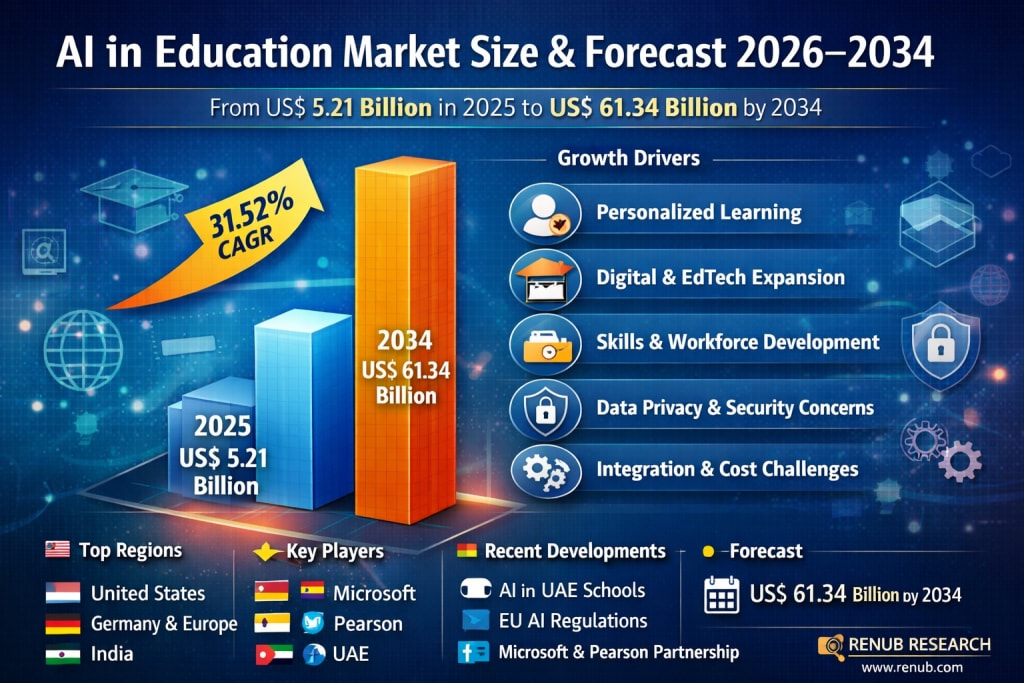
The global AI in Education Market is entering a phase of remarkable expansion as digital transformation reshapes how knowledge is delivered, consumed, and managed. According to Renub Research, the market is expected to grow from US$ 5.21 billion in 2025 to US$ 61.34 billion by 2034, registering a robust compound annual growth rate (CAGR) of 31.52% from 2026 to 2034. This extraordinary growth reflects the rising role of artificial intelligence in making education more personalized, scalable, and efficient across the world.
Artificial Intelligence (AI) is no longer a futuristic concept in classrooms. It is already being used to personalize learning paths, automate administrative work, improve student engagement, and support teachers with data-driven insights. From intelligent tutoring systems and adaptive learning platforms to AI-powered analytics and virtual assistants, educational institutions are increasingly embracing these technologies to enhance both teaching quality and learning outcomes.
Several powerful forces are driving this market forward, including the growing availability of digital devices, the increasing need for individualized learning experiences, the pressure to reduce administrative workloads, the expansion of online and blended learning models, and the rapid advancement of AI technologies such as machine learning and natural language processing. Together, these trends are shaping a more flexible, inclusive, and performance-oriented global education ecosystem.
AI in Education Industry Overview
Artificial Intelligence is transforming the education sector by fundamentally changing how students learn and how institutions operate. At the heart of this transformation is personalized learning. AI-powered systems analyze student data—such as learning pace, performance patterns, strengths, and weaknesses—to tailor content, exercises, and assessments to individual needs. This helps students grasp concepts more effectively while reducing frustration and learning gaps.
Adaptive learning platforms and intelligent tutoring systems are among the most widely adopted AI applications in education today. These tools provide real-time feedback, adjust difficulty levels based on learner progress, and recommend targeted resources to improve understanding and retention. For educators, AI offers powerful support by automating routine tasks such as grading, attendance tracking, scheduling, and content management. This allows teachers to focus more on instruction quality, mentorship, and student engagement.
Beyond the classroom, AI is playing a crucial role in improving accessibility and inclusivity. Technologies such as speech-to-text, text-to-speech, real-time translation, and AI-driven assistive tools are helping students with disabilities or language barriers participate more fully in learning environments. Virtual classrooms and AI-enabled chatbots now provide 24/7 academic support, answering questions, guiding students through coursework, and offering reminders and study tips.
In higher education and professional training, AI-driven simulations, virtual labs, and immersive learning environments are helping learners develop practical, job-ready skills in a scalable and cost-effective way. From an institutional perspective, AI supports data-driven decision-making by analyzing enrollment trends, student retention, and academic performance. Predictive analytics helps identify at-risk students early, enabling timely interventions to improve outcomes and reduce dropout rates.
While challenges such as data privacy, ethical use, and algorithmic bias remain, the continued integration of AI is expected to create more efficient, responsive, and learner-centric education systems worldwide.
Growth Drivers for the AI in Education Market
Rising Demand for Personalized and Adaptive Learning
One of the most important growth drivers of the AI in education market is the increasing demand for personalized and adaptive learning experiences. Traditional education models often rely on standardized curricula that do not account for individual differences in learning speed, style, or prior knowledge. As a result, many students struggle to keep up, while others are not sufficiently challenged.
AI-powered platforms address this problem by analyzing student behavior, performance, and engagement data to create customized learning paths. Adaptive assessments dynamically adjust their difficulty level based on learner responses, ensuring that students are neither overwhelmed nor under-stimulated. This personalized approach improves comprehension, boosts motivation, and enhances long-term learning outcomes.
Educational institutions and corporate training providers are increasingly adopting AI-driven learning management systems to support diverse learner populations at scale. As digital learning continues to expand across K–12 education, higher education, and professional training, the demand for learner-centric, data-driven solutions is expected to accelerate the adoption of AI technologies even further.
Increasing Adoption of Digital Learning and EdTech Platforms
The rapid expansion of digital learning and EdTech platforms is another major driver fueling the AI in education market. The growing use of online courses, virtual classrooms, mobile learning apps, and blended learning models has generated massive volumes of educational data. AI systems are uniquely suited to analyze this data and transform it into actionable insights.
AI enhances digital learning platforms through features such as intelligent content recommendations, automated grading, virtual tutors, and AI-powered chatbots that provide round-the-clock student support. Governments and educational institutions around the world are investing heavily in digital infrastructure to improve access to quality education, especially in remote and underserved regions.
The shift toward remote and hybrid learning models has further accelerated the integration of AI, as institutions seek tools that can maintain engagement, ensure assessment accuracy, and support large numbers of learners simultaneously. As EdTech ecosystems mature, AI is increasingly becoming a core component of scalable, interactive, and outcome-focused education delivery.
Growing Focus on Skills Development and Workforce Readiness
The global job market is evolving rapidly due to technological change, automation, and digital transformation. This has created a strong emphasis on skills development, upskilling, and reskilling, which is driving the adoption of AI in education.
AI-powered learning platforms help align educational content with industry needs by analyzing labor market trends, skill gaps, and employer requirements. These platforms offer targeted training programs, competency-based assessments, and personalized career pathways. In corporate learning and higher education, AI-driven analytics track learner progress and predict skill proficiency, enabling more effective and measurable training outcomes.
Governments, employers, and educational institutions are increasingly using AI to build agile learning ecosystems that support lifelong learning. As the demand for future-ready skills continues to rise, AI-enabled education solutions are becoming essential tools for improving employability and workforce competitiveness.
Challenges in the AI in Education Market
Data Privacy, Security, and Ethical Concerns
Despite its strong growth potential, the AI in education market faces significant challenges related to data privacy, security, and ethical use. AI-driven education platforms rely heavily on sensitive data, including personal information, academic records, behavioral patterns, and sometimes biometric data. Managing this information responsibly is complex, especially across regions with different data protection regulations.
Risks such as data breaches, unauthorized access, and misuse of student data can undermine trust among learners, parents, and institutions. In addition, concerns about algorithmic bias and lack of transparency present serious ethical challenges. If AI models are trained on biased or incomplete datasets, they may reinforce existing inequalities or produce unfair outcomes.
Addressing these issues requires strong data governance frameworks, transparent and explainable AI models, strict regulatory compliance, and continuous monitoring to ensure fairness, accountability, and security.
High Implementation Costs and Integration Complexity
Another major challenge is the high cost of implementation and the complexity of integrating AI solutions into existing education systems. Many institutions, particularly in developing regions, face budget constraints that limit their ability to invest in advanced technologies, digital infrastructure, and skilled personnel.
Implementing AI often requires upgrading IT systems, training teachers and administrators, and providing ongoing technical support. Integrating AI tools with legacy learning management systems and institutional databases can also be technically challenging and time-consuming. Resistance to change among educators and administrators can further slow adoption, especially if there is insufficient training or clarity about the benefits.
Overcoming these barriers will require strategic planning, scalable and cost-effective solutions, supportive public policies, and close collaboration between technology providers and educational institutions.
Regional Market Insights
United States AI in Education Market
The United States AI in Education market is one of the most advanced and dynamic in the world, supported by strong digital infrastructure, high technology adoption, and a mature EdTech ecosystem. Institutions across K–12, higher education, and corporate learning are increasingly using AI to improve teaching effectiveness, personalize learning, and streamline administrative operations.
AI-powered tools such as adaptive learning platforms, intelligent tutoring systems, automated grading solutions, and virtual assistants are gaining widespread adoption. The market also benefits from strong collaboration between universities, technology companies, and startups developing innovative AI-driven education solutions. Government support for digital learning and rising investment in EdTech continue to accelerate market growth. With its focus on skills development, lifelong learning, and data-driven education, the United States is expected to remain a global leader in this space.
Germany and the European AI in Education Landscape
In Europe, the regulatory environment plays a central role in shaping AI adoption in education. The EU AI Act classifies education as a high-risk sector, requiring AI vendors to build transparent, auditable systems that comply with strict data protection standards such as GDPR. This places strong emphasis on ethical AI use, data security, and accountability.
Public investments are also supporting steady growth. Germany’s DigitalPakt Schule program and initiatives such as Estonia’s AI Leap highlight regional efforts to modernize digital infrastructure and integrate AI into education. Programs like Erasmus+ projects focused on AI skills and teacher readiness further strengthen implementation. This policy-driven, carefully managed approach is fostering sustainable and responsible expansion of AI in education across Europe.
India AI in Education Market
The India AI in Education market is growing rapidly, driven by rising digital adoption, supportive government initiatives, and strong demand for personalized learning solutions. AI applications such as adaptive learning platforms, intelligent tutoring systems, automated grading, and virtual assistants are being deployed across schools, universities, and corporate training programs.
Public-private partnerships are playing a crucial role in accelerating adoption. Large-scale skilling initiatives, including collaborations with global technology companies, are helping build AI-ready talent and improve digital infrastructure. With its large student population, vibrant EdTech startup ecosystem, and strong focus on digital skills, India is emerging as a key growth engine in the Asia-Pacific AI in education market.
United Arab Emirates AI in Education Market
The United Arab Emirates is positioning itself as a regional leader in AI-enabled education. The country has integrated AI as a core subject in government schools from kindergarten to Grade 12, covering topics such as algorithms, data analysis, ethics, and practical applications. This forward-looking approach aims to prepare students for a technology-driven future and build a knowledge-based economy.
Government-led programs, strategic partnerships with global technology providers, and comprehensive teacher training initiatives are supporting market growth. AI tools are being used to enhance personalized learning, improve administrative efficiency, and boost student engagement. With strong digital infrastructure and a clear policy vision, the UAE is becoming a hub for innovation in AI-driven education in the Middle East.
Recent Developments in the AI in Education Market
May 2025: The UAE Ministry of Education mandated AI education for all public-school students starting from the 2025–2026 academic year.
April 2025: The European Commission published the AI Continent Action Plan, including data-access reforms and the launch of an AI Skills Academy.
January 2025: Microsoft and Pearson announced a multi-year partnership to develop AI-powered learning tools and assessment solutions.
September 2024: PowerSchool launched two new PowerBuddy AI solutions focused on college, career readiness, and custom AI use in K–12 education.
July 2024: Pearson introduced new generative AI tools through Pearson+ Channels, enabling personalized learning experiences and AI-assisted assessments.
Market Segmentation
By Component:
Solutions
Services
By Deployment Mode:
On-Premises
Cloud-Based
By Technology:
Machine and Deep Learning
Natural Language Processing (NLP)
By Application:
Learning Platforms & Virtual Facilitators
Intelligent Tutoring Systems (ITS)
Smart Content
Fraud and Risk Management
Others
By End User:
K–12 Education
Higher Education
Corporate Training & Learning
By Geography:
North America (United States, Canada)
Europe (France, Germany, Italy, Spain, United Kingdom, Belgium, Netherlands, Turkey)
Asia Pacific (China, Japan, India, Australia, South Korea, Thailand, Malaysia, Indonesia, New Zealand)
Latin America (Brazil, Mexico, Argentina)
Middle East & Africa (South Africa, Saudi Arabia, United Arab Emirates)
Key Players Analysis
Major companies operating in the AI in education market include:
IBM Corporation
Microsoft Corporation
Cognizant Technology Solutions Corporation
Alphabet Inc.
Pearson Plc
Coursera Inc.
DreamBox Learning, Inc.
Carnegie Learning, Inc.
These companies are analyzed across five viewpoints: Overview, Key Persons, Recent Developments, SWOT Analysis, and Revenue, reflecting their strategic positioning in this fast-growing market.
Final Thoughts
The global AI in Education Market is on a powerful growth trajectory, driven by the need for personalized learning, digital transformation, and future-ready skills development. With the market projected to surge from US$ 5.21 billion in 2025 to US$ 61.34 billion by 2034 at a CAGR of 31.52%, AI is set to become a foundational pillar of modern education systems worldwide.
While challenges related to data privacy, ethics, and implementation costs remain, ongoing innovation, supportive policies, and increasing collaboration between educators and technology providers are paving the way for more inclusive, efficient, and outcome-driven learning environments. In the years ahead, AI will not just support education—it will fundamentally reshape how knowledge is created, shared, and experienced across the globe.
About the Creator
Keep reading
More stories from shibansh kumar and writers in Trader and other communities.
Flame Retardants Market Size and Forecast 2026–2034
Introduction The global flame retardants market is entering a phase of steady and strategic expansion, driven by rising safety awareness, stricter regulations, and the growing use of advanced materials across multiple industries. According to Renub Research, the Flame Retardants Market is expected to grow from US$ 11.34 billion in 2025 to US$ 18.87 billion by 2034, registering a CAGR of 5.82% from 2026 to 2034. This growth reflects not only increasing industrial activity but also a deeper global commitment to fire safety in construction, electronics, automotive, textiles, and infrastructure development.
By shibansh kumarabout 17 hours ago in Trader
Taiwan Drones Market Size, Industry Trends, Share, Growth and Forecast to 2033
Market Overview The Taiwan drones market has witnessed notable development in recent years, driven by advancements in technology, growing industrial applications, and increasing interest in unmanned aerial systems (UAS). Drones are becoming essential tools across various sectors, including agriculture, infrastructure inspection, logistics, public safety, and aerial photography.
By Jackson Watson2 days ago in Trader
Stanislav Kondrashov on Nvidia and the Expansion of Global AI Infrastructure
Artificial intelligence is often described as a software breakthrough. Yet the real shift is happening in server halls, semiconductor plants and energy-intensive data centres. Stanislav Kondrashov, founder of TELF AG, argues that the current phase of AI development is defined less by code and more by capacity.
By Stanislav Kondrashovabout 20 hours ago in Trader




Comments
There are no comments for this story
Be the first to respond and start the conversation.