
Middle East and Africa CGM Market Size & Forecast 2026–2034
Rising Diabetes Burden and Digital Health Adoption Drive a New Era of Continuous Glucose Monitoring

Middle East and Africa Continuous Glucose Monitoring Market Outlook
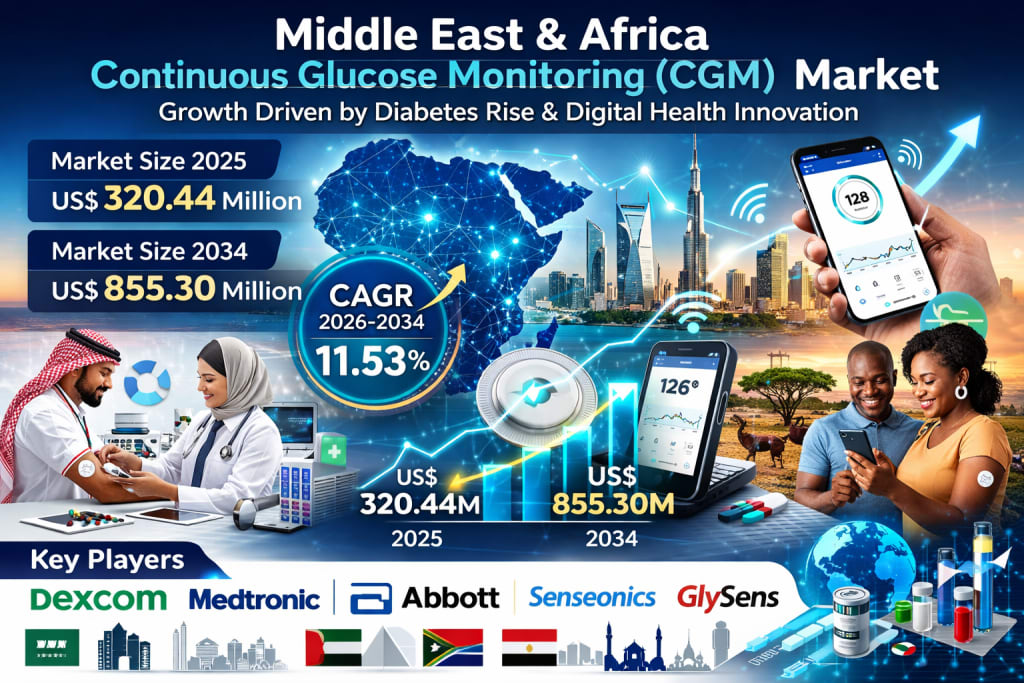
The Middle East and Africa (MEA) continuous glucose monitoring (CGM) market is entering a phase of sustained and meaningful expansion, driven by the rising prevalence of diabetes, increasing awareness of preventive healthcare, and the growing availability of advanced medical technologies. According to Renub Research, the market is forecasted to expand from US$ 320.44 million in 2025 to US$ 855.30 million by 2034, registering a compound annual growth rate (CAGR) of 11.53% from 2026 to 2034.
This growth trajectory reflects more than just improving sales figures—it signals a broader transformation in how diabetes is managed across the Middle East and Africa. As healthcare systems in the region modernize and patients become more informed, continuous glucose monitoring is steadily moving from a niche technology to a mainstream tool in diabetes care.
Continuous glucose monitoring is an advanced medical technology designed to track glucose levels in real time, both day and night. A typical CGM system consists of a small sensor inserted under the skin, a transmitter that sends data, and a receiver or smartphone application that displays glucose readings. Unlike traditional finger-stick testing, CGM provides continuous data, trend analysis, and alerts for high or low glucose levels. This real-time insight empowers both patients and healthcare professionals to make more informed decisions about insulin dosing, diet, physical activity, and overall lifestyle management—ultimately reducing the risk of long-term complications.
Across the MEA region, adoption of CGM solutions is accelerating, particularly in countries such as Saudi Arabia, the United Arab Emirates, South Africa, and Egypt. The combination of rising diabetes prevalence, improving healthcare infrastructure, expanding smartphone usage, and the growing need for remote patient monitoring solutions is creating a favorable environment for CGM technologies to thrive.
Rising Prevalence of Diabetes and Lifestyle-Related Diseases
One of the most powerful growth drivers for the Middle East and Africa CGM market is the escalating burden of diabetes and lifestyle-related diseases. Rapid urbanization, economic development, and changing dietary patterns have significantly altered lifestyles across the region. Sedentary habits, increased consumption of processed foods, and rising obesity rates have all contributed to a sharp increase in both Type 1 and Type 2 diabetes cases.
Data from the International Diabetes Federation (IDF) has consistently shown that the Middle East and North Africa region records some of the highest diabetes prevalence rates globally. In 2021, the region was estimated to have a prevalence rate of around 12.2%, with projections indicating a dramatic increase in the coming decades. Some Gulf Cooperation Council (GCC) countries are already among the world’s highest in terms of diabetes prevalence, making advanced glucose monitoring not just a convenience, but a necessity.
Countries like Qatar, Saudi Arabia, and the UAE are witnessing particularly high rates of Type 2 diabetes, often linked to obesity and lifestyle factors. As healthcare systems grapple with the long-term costs and complications associated with diabetes—such as cardiovascular disease, kidney failure, and vision loss—there is a growing emphasis on early detection, continuous monitoring, and better disease management. CGM systems, by offering real-time and trend-based glucose insights, are increasingly seen as a critical tool in achieving these goals.
Advancements in Healthcare Infrastructure and Digital Health Adoption
Another major catalyst for market growth is the steady improvement in healthcare infrastructure and the rapid adoption of digital health technologies across the MEA region. Governments are investing heavily in modernizing hospitals, expanding access to care, and integrating digital solutions such as telemedicine, electronic health records, and remote patient monitoring platforms.
CGM technology fits naturally into this digital healthcare ecosystem. The integration of smartphones, cloud-based data platforms, and even artificial intelligence features has made CGM systems more user-friendly and more clinically valuable. Patients can now share glucose data with their physicians remotely, enabling more proactive and personalized treatment plans.
In Saudi Arabia, for example, the broader Vision 2030 initiative has placed strong emphasis on healthcare transformation and digital innovation. In June 2023, SANTECHTURE unveiled new AI-driven revenue cycle management offerings in Riyadh, highlighting the country’s push toward technologically advanced healthcare systems. While not directly related to CGM, such developments reflect a broader readiness of the healthcare ecosystem to adopt sophisticated digital tools—including advanced diabetes monitoring solutions.
As awareness grows about the benefits of continuous monitoring, both clinicians and patients are increasingly recognizing that CGM can reduce hospital visits, improve glycemic control, and enhance overall quality of life. This shift in mindset is playing a crucial role in accelerating market adoption across the region.
Government Initiatives and Growing Focus on Preventive Care
Government-led healthcare initiatives are also contributing significantly to the expansion of the CGM market in the Middle East and Africa. Many countries in the region have launched national programs focused on diabetes screening, early diagnosis, and public awareness. These efforts are part of a broader move toward preventive healthcare, aimed at reducing the long-term burden of chronic diseases on healthcare systems.
Reimbursement policies and insurance coverage for advanced diabetes management technologies are still evolving, but progress is being made—particularly in wealthier Middle Eastern countries with more developed healthcare systems. As coverage improves, CGM devices become more accessible to a wider patient population, further supporting market growth.
Educational campaigns by healthcare organizations and device manufacturers are also increasing patient awareness about the benefits of CGM. Patients are learning that continuous monitoring can help prevent dangerous hypoglycemic and hyperglycemic episodes, improve day-to-day disease management, and reduce the risk of long-term complications.
In February 2025, the UAE Ministry of Health and Prevention introduced the National Unified Licensing Platform, integrating various licensing services for healthcare professionals. While this initiative is more focused on regulation and workforce management, it underscores the region’s broader commitment to modernizing healthcare systems—creating a more supportive environment for advanced medical technologies like CGM.
Challenges: High Costs and Limited Reimbursement
Despite its strong growth outlook, the Middle East and Africa CGM market faces several challenges. One of the most significant barriers is the high cost of CGM devices and related components, including sensors, transmitters, and software subscriptions. Compared to traditional finger-stick glucose monitoring methods, CGM systems represent a considerably higher upfront and ongoing expense.
In many African countries and parts of the Middle East, inconsistent or limited reimbursement coverage further restricts access to these technologies. As a result, CGM adoption tends to be higher in more affluent GCC countries, while remaining relatively limited in lower-income or under-resourced healthcare markets.
Limited Awareness and Access in Rural and Underserved Areas
Another key challenge is the uneven distribution of healthcare infrastructure and awareness across the region. In many rural or underserved areas—particularly in parts of Africa—access to specialized diabetes care and advanced medical devices remains limited. A shortage of trained healthcare professionals, lower levels of patient education, and limited digital connectivity all contribute to slower adoption of CGM technologies.
Many patients in these regions still rely on traditional glucose monitoring methods, often due to cost constraints or lack of awareness about more advanced options. Bridging this gap will require sustained investment in healthcare infrastructure, education, and affordability initiatives.
Middle East and Africa CGM Sensors Market
CGM sensors form the core of any continuous glucose monitoring system and represent a major revenue-generating segment of the market. These sensors are responsible for measuring glucose levels in interstitial fluid and transmitting that data for analysis and display.
The sensor segment benefits from recurring demand, as sensors need to be replaced regularly. Rising numbers of diabetic patients and increasing adoption of CGM systems are driving strong growth in this segment. Technological advancements are also improving sensor accuracy, comfort, and lifespan, making them more appealing to both patients and clinicians.
In the Middle East, strong healthcare systems, higher disposable incomes, and better insurance coverage support the adoption of advanced CGM components. In Africa, growing awareness and increasing use of medical technologies in urban centers are gradually boosting sensor demand. Continued innovation aimed at reducing costs and extending sensor life is expected to further accelerate adoption across the region.
Middle East and Africa CGM Receivers Market
CGM receivers play a crucial role in making glucose data accessible and easy to interpret for both patients and healthcare providers. Advances in display technology, battery life, and wireless connectivity are making these devices more user-friendly and reliable.
In regions with varying levels of smartphone penetration, dedicated receivers still hold significant value, especially in hospital settings or among patients who prefer a standalone device. As healthcare providers increasingly recommend CGM systems, the demand for reliable and easy-to-use receivers is expected to grow steadily across the Middle East and Africa.
Middle East and Africa CGM Hospitals Market
Hospitals represent one of the most important end-user segments for CGM systems in the MEA region. CGM is increasingly used in intensive care units, maternity wards, and post-surgical care settings, where tight glycemic control is critical for patient outcomes.
In the Middle East, strong government investment in advanced hospital infrastructure is supporting the wider adoption of CGM technologies. In Africa, private and tertiary hospitals are gradually incorporating CGM into their diabetes management protocols. The growing focus on digital health and remote patient monitoring is further reinforcing the role of CGM in hospital environments.
Middle East and Africa CGM Homecare Settings Market
Homecare settings are emerging as a high-growth area for CGM adoption. As more patients seek convenient, self-managed solutions for chronic disease care, CGM systems offer real-time alerts, continuous data tracking, and greater independence from frequent clinic visits.
In the Middle East, better access to healthcare, higher smartphone usage, and expanding insurance coverage are supporting the growth of home-based CGM use. In Africa, adoption is increasing more gradually, but rising awareness and improving affordability are expected to drive long-term growth. Home-based CGM is likely to play an increasingly important role in long-term diabetes management across the region.
Saudi Arabia CGM Market
Saudi Arabia represents one of the most important markets for CGM in the region, driven by a high prevalence of diabetes and strong government support for healthcare modernization. Improved hospital infrastructure, widespread smartphone usage, and expanding insurance coverage are making CGM systems more accessible to patients.
Hospitals and endocrinologists are increasingly prescribing CGM for both Type 1 diabetes patients and insulin-dependent Type 2 patients. In November 2025, Roche announced the launch of the Accu-Chek SmartGuide CGM system in the Middle East, starting with Kuwait, Qatar, and Saudi Arabia, with further rollout planned for the UAE. This launch brings AI-powered predictive capabilities to the region, marking an important step forward in advanced diabetes care.
South Africa CGM Market
South Africa’s CGM market is growing steadily, supported by rising diabetes prevalence and increasing acceptance of advanced diabetes management technologies. Adoption is currently strongest in private healthcare and urban hospital networks, particularly for patients with Type 1 diabetes or those on intensive insulin therapy.
In November 2025, Roche announced the availability of its Accu-Chek SmartGuide CGM system in South Africa, expanding access to advanced glucose monitoring with AI-driven features. However, high costs and limited reimbursement in the public healthcare system remain significant barriers to wider adoption.
United Arab Emirates CGM Market
The UAE CGM market benefits from high healthcare spending, advanced medical infrastructure, and a strong national focus on preventive care and digital health. High diabetes prevalence and widespread smartphone usage further support the adoption of CGM systems in both hospital and homecare settings.
In July 2024, Sibionics received product marketing approval from the UAE Ministry of Health & Prevention for its GS1 CGM system, highlighting the country’s openness to innovative diabetes management technologies. Continued investment in smart healthcare solutions is expected to further boost CGM adoption in the UAE.
Market Segmentation
By Component:
Sensors
Transmitters
Receivers
By End User:
Hospitals
Homecare Settings
Others
By Country:
Saudi Arabia
UAE
Qatar
Bahrain
Iran
Egypt
Oman
South Africa
Rest of the Middle East and Africa
Company Analysis (5 Viewpoints):
Overview
Key Person
Recent Developments
SWOT Analysis
Revenue Analysis
Key Companies:
Dexcom
Medtronic
Senseonics
Abbott Diabetes Care
GlySens
Final Thoughts
The Middle East and Africa continuous glucose monitoring market is on a strong and sustainable growth path, underpinned by rising diabetes prevalence, improving healthcare infrastructure, and accelerating digital health adoption. With the market expected to grow from US$ 320.44 million in 2025 to US$ 855.30 million by 2034 at a CAGR of 11.53%, CGM is set to become a cornerstone of modern diabetes care in the region.
While challenges such as high costs and uneven access remain, ongoing technological innovation, supportive government initiatives, and growing patient awareness are steadily reshaping the landscape. Over the coming decade, continuous glucose monitoring is likely to move from being an advanced option for a few to a standard of care for many—helping millions of patients across the Middle East and Africa live healthier, safer, and more informed lives with diabetes.
About the Creator
Mobile Application Market Size and Forecast 2025–2033
Mobile Application Market Overview The global mobile application market has become one of the most dynamic and influential segments of the digital economy. What began as simple tools for communication and basic utilities has evolved into a vast ecosystem powering entertainment, finance, education, healthcare, retail, and enterprise productivity. Today, mobile applications are not just software products; they are the primary interface between businesses and consumers in an increasingly mobile-first world.
By shibansh kumar4 days ago in Trader
Vacuum Insulation Panel Market Size and Forecast 2026–2034
Introduction: A New Era of High-Performance Insulation The global push toward energy efficiency, sustainability, and smarter infrastructure is reshaping how industries think about insulation. From residential towers and commercial complexes to cold storage facilities and high-performance appliances, the need for advanced thermal solutions has never been more critical. Against this backdrop, the Vacuum Insulation Panel (VIP) market is emerging as one of the most promising segments within the broader insulation industry.
By Sakshi Sharmaa day ago in Trader


Comments
There are no comments for this story
Be the first to respond and start the conversation.