
Saudi Arabia Hotel Market Size, Growth, and Forecast 2026–2034: Vision 2030 Fuels a New Hospitality Era
Driven by religious tourism, mega-events, and Vision 2030 investments, Saudi Arabia’s hotel industry is entering a decade of unprecedented expansion.

Introduction: A Transformational Decade for Saudi Hospitality
Saudi Arabia’s hospitality sector is undergoing one of the most ambitious transformations in the global tourism industry. Long known primarily for religious tourism centered in Makkah and Madinah, the Kingdom is now rapidly diversifying its tourism and leisure offerings under the Vision 2030 economic reform program. This shift is reshaping the hotel industry, attracting global brands, unlocking massive investments, and creating a more balanced mix of religious, business, and leisure travel demand.
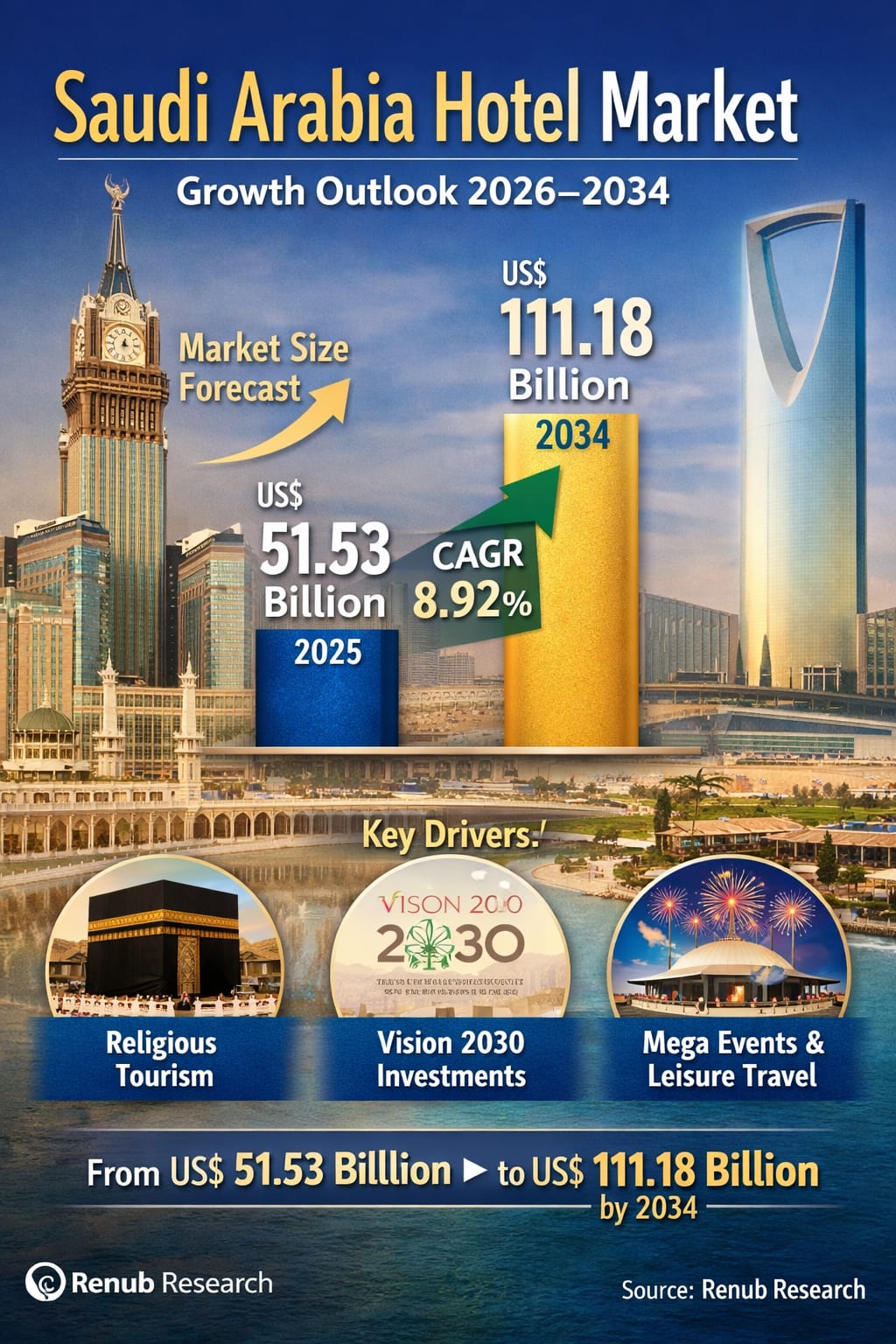
According to Renub Research, the Saudi Arabia Hotel Market is expected to reach US$ 111.18 billion by 2034, up from US$ 51.53 billion in 2025, growing at a CAGR of 8.92% from 2026 to 2034. This robust growth reflects not only rising visitor numbers but also the rapid expansion of hotel capacity, the entry of international chains, and the development of mega tourism projects across the Kingdom.
From luxury resorts on the Red Sea coast to budget and midscale hotels in pilgrimage cities, Saudi Arabia’s hotel landscape is becoming broader, more competitive, and more globally aligned. The coming decade will likely define the country’s position as a major tourism and hospitality hub in the Middle East and beyond.
Saudi Arabia Hotel Market: Industry Overview
The Saudi Arabia hotel market comprises a wide range of lodging options, including budget hotels, midscale properties, luxury hotels, serviced apartments, resorts, and boutique accommodations. Historically, the market has been heavily influenced by religious tourism, with Makkah and Madinah acting as the primary demand centers due to Hajj and Umrah pilgrimages.
However, the scope of the industry has expanded significantly in recent years. Riyadh has emerged as a major business and events destination, Jeddah is strengthening its role as a commercial and leisure gateway, and new destinations such as Al-Ula, NEOM, and the Red Sea coast are positioning Saudi Arabia as a high-end leisure tourism market.
Hotels today are increasingly focused on modern guest expectations. Digital booking platforms, smart room technologies, loyalty programs, and personalized services are becoming standard. At the same time, large-scale infrastructure investments—airports, high-speed rail, urban transport, and entertainment districts—are improving accessibility and supporting higher visitor volumes.
With strong government backing, increasing private investment, and the entry of major international hotel brands, the Saudi hotel industry is shifting from a volume-driven pilgrimage market to a diversified, experience-oriented hospitality ecosystem.
Market Size and Growth Outlook
Renub Research projects a strong and sustained growth trajectory for the Saudi Arabia hotel market. The industry is forecast to expand from US$ 51.53 billion in 2025 to US$ 111.18 billion by 2034, registering a CAGR of 8.92% between 2026 and 2034.
This growth is being driven by several structural factors: rising international and domestic tourist arrivals, large-scale government investment in tourism infrastructure, the hosting of mega-events, and the rapid development of new leisure destinations. Additionally, increasing disposable incomes and a growing culture of domestic travel are supporting demand for both midscale and premium accommodations.
The expansion is not limited to room numbers alone. Average room rates, ancillary services, food and beverage offerings, and integrated entertainment and retail experiences are also contributing to higher overall market value.
Key Growth Drivers of the Saudi Arabia Hotel Market
1. Religious Tourism in Makkah and Madinah
Religious tourism remains the backbone of Saudi Arabia’s hotel industry. Every year, millions of pilgrims travel to Makkah and Madinah for Hajj and Umrah, creating consistently high demand for hotel rooms across all categories—luxury, midscale, and budget.
During peak pilgrimage seasons, especially Hajj and Ramadan, hotel occupancy rates in these cities often reach near-full capacity. This has encouraged continuous investment in new hotel developments, renovations, and capacity expansions. The government has also invested heavily in supporting infrastructure, including airport expansions, high-speed rail links, and crowd management systems, which further strengthen the hospitality ecosystem.
Hotels serving pilgrims increasingly offer specialized services such as multilingual staff, shuttle transportation to holy sites, guided religious tours, and customized meal options. Digital booking platforms and international travel agencies have also made it easier for pilgrims from around the world to plan and book their stays. This steady and predictable flow of visitors ensures a strong baseline demand for the hotel market year after year.
2. Vision 2030 and Government Tourism Initiatives
Vision 2030 is the single most important catalyst for the transformation of Saudi Arabia’s tourism and hospitality sector. The strategy aims to diversify the economy, reduce reliance on oil revenues, and position tourism as a key pillar of economic growth.
Under this vision, the government is developing mega-projects such as NEOM, the Red Sea Project, Al-Ula, and Qiddiya, all of which include large-scale hospitality components. These destinations are designed to attract high-spending international tourists, create new leisure and entertainment hubs, and extend average visitor stays.
In parallel, policy reforms such as easier visa procedures, international tourism marketing campaigns, and incentives for foreign investment are making the Kingdom more accessible and attractive to global travelers. Public-private partnerships are encouraging international hotel chains to enter or expand in the market, raising service standards and increasing overall capacity.
Vision 2030 also emphasizes sustainability, workforce development, and quality standards in hospitality, ensuring that growth is not only rapid but also structurally sound over the long term.
3. Mega-Events and the Rise of Business and Leisure Travel
Saudi Arabia has become an increasingly active host of international events, sports competitions, cultural festivals, and business exhibitions. Events such as Riyadh Season, Formula E, major boxing matches, global conferences, and the upcoming Expo 2030 are generating significant short-term and long-term demand for hotel accommodations.
Business travel is also growing steadily, driven by expanding corporate activity, foreign investment, and the development of Riyadh, Jeddah, and Dammam as regional business hubs. Hotels in these cities are investing in conference facilities, meeting spaces, and business-oriented services to cater to this segment.
At the same time, leisure tourism is rising, particularly along the Red Sea coast and in heritage destinations like Al-Ula. This is creating new opportunities for resort-style properties, luxury hotels, and experience-driven hospitality concepts. The combination of business and leisure demand is helping to stabilize occupancy rates throughout the year and across different regions.
Challenges in the Saudi Arabia Hotel Market
Seasonal Fluctuations and Capacity Management
One of the key challenges for the Saudi hotel industry is the highly seasonal nature of demand, particularly in pilgrimage cities. While Makkah and Madinah experience extremely high occupancy during Hajj and peak Umrah seasons, there are off-peak periods when room utilization drops significantly.
Managing this fluctuation requires dynamic pricing strategies, flexible staffing models, and diversified demand sources such as conferences, domestic tourism, and group travel. Overcapacity during peak periods and underutilization during off-peak seasons remain operational and financial challenges for many hotel operators.
Intensifying Competition and Regulatory Compliance
The rapid entry of international hotel chains has increased competition across all segments of the market. Operators must differentiate themselves through service quality, brand positioning, technology adoption, and guest experience.
At the same time, hotels must comply with local regulations related to labor, safety, environmental standards, and cultural norms. Adapting to these requirements while maintaining international service standards adds complexity, particularly for smaller domestic operators. Compliance costs, staff training, and continuous investment in facilities and systems are becoming increasingly important for long-term competitiveness.
Regional Market Insights
Makkah Hotel Market
Makkah is the epicenter of religious tourism in Saudi Arabia and the most important city for hotel demand. Millions of pilgrims visit each year, and during Hajj season, hotels operate at near full capacity. The city has a wide range of accommodations, from budget hotels to luxury international brands located near the Grand Mosque.
Government investments in transportation and infrastructure continue to support the growth of the hotel sector in Makkah. While seasonal demand fluctuations remain a challenge, the city offers one of the most stable long-term demand profiles in the entire Saudi hospitality market.
Riyadh Hotel Market
Riyadh, as the political and economic capital, is the center of business travel, conferences, and government-related visits. Mega-events like Riyadh Season and international exhibitions further boost hotel occupancy.
The city’s hotel market is characterized by strong demand for luxury and upper-midscale properties, as well as growing interest in lifestyle and business-focused hotels. Intense competition is pushing operators to invest in technology, service quality, and integrated guest experiences.
Madinah Hotel Market
Madinah’s hotel market is also driven primarily by religious tourism, particularly visits to the Prophet’s Mosque. Demand peaks during Hajj and Ramadan, with a strong focus on midscale and budget accommodations catering to large volumes of pilgrims.
Infrastructure upgrades and improved connectivity are enhancing the city’s attractiveness. Although seasonality affects occupancy, long-term demand remains strong due to the city’s religious significance.
Jeddah Hotel Market
Jeddah serves as a major gateway for pilgrims, business travelers, and leisure tourists. Its strategic location on the Red Sea coast and its role as a commercial hub make it one of the most diverse hotel markets in the Kingdom.
Luxury hotels, beach resorts, and business-oriented properties all coexist in Jeddah. Growing leisure tourism and waterfront developments are further strengthening the city’s position as a key hospitality destination.
Recent Developments in the Saudi Arabia Hotel Market
The pace of investment and expansion in the Saudi hospitality sector remains strong:
August 2025: The Hospitality Network (THN) announced its expansion into Saudi Arabia with a new Riyadh hub to support collaboration in hospitality and real estate.
July 2025: Hilton signed its first Tapestry Collection by Hilton property in Saudi Arabia, the 221-room Diyar Ajwa in Madinah, scheduled to open in late 2025.
July 2025: IDS Next completed over 50 hotel installations in Saudi Arabia, providing customized ERP solutions for multi-property management and regulatory compliance.
May 2025: IHG partnered with Ashaad Company to develop three properties in Jeddah and Al Khobar, adding over 1,700 rooms, with completions expected between 2028 and 2030.
May 2025: Wyndham and Le Park Concord unveiled a plan to develop 100 Super 8 hotels over the next decade, with the first properties expected in 2026.
April 2025: HMH announced expansions in Al Khobar and Makkah, including a flagship 460-room project in the holy city.
October 2024: The New Murabba Development Company confirmed major plans for a 27 million sqm development including 9,000 hotel rooms as part of a landmark urban project.
Market Segmentation Overview
By Hotel Type:
High-End Hotel
Mid-Scale Hotel
Budget Hotel
By Ordering Platform:
Online
Offline
By Region:
Makkah
Riyadh
Madinah
Jeddah
Al Khobar
Dammam
Competitive Landscape
The Saudi hotel market features a mix of global and regional players, including:
Dur Group, IHG Group, Marriott International, Accor, Hilton Hotels, Al Hokair Group, and Altyaar Group.
Each company is typically analyzed across five key viewpoints: Overview, Key Person, Recent Development, SWOT Analysis, and Revenue Analysis, reflecting the increasingly professional and data-driven nature of competition in the market.
Final Thoughts: A Market Entering Its Golden Decade
Saudi Arabia’s hotel industry is no longer just a supporting pillar for religious tourism—it is becoming a diversified, globally competitive hospitality market. With strong backing from Vision 2030, massive infrastructure investments, and a growing calendar of international events, the sector is poised for sustained expansion.
With the market expected to grow from US$ 51.53 billion in 2025 to US$ 111.18 billion by 2034 at a CAGR of 8.92%, the coming years will likely define Saudi Arabia’s position as one of the most important hospitality growth stories in the world. For investors, operators, and travelers alike, the Kingdom’s hotel market is entering a transformative and opportunity-rich era.
About the Creator
United States Online Food Delivery Market 2026 : Industry Size to Reach USD 75.4 Billion by 2034, At a CAGR of 8.94%
Market Overview The United States online food delivery market has experienced remarkable growth over the past decade, driven by evolving consumer lifestyles, increased smartphone penetration, and rapid digital transformation in the food service industry. Online food delivery refers to the process of ordering meals through mobile applications or websites, where restaurants prepare the food and deliver it directly to customers.
By Jackson Watson2 days ago in Trader
Microsoft Corporation: Why This Stock Defines the Future of Enterprise Technology
Microsoft Corporation is often described as a “quiet compounder” in the stock market—a company that grows steadily, adapts intelligently, and rewards patient investors over time. While some tech giants rely heavily on consumer trends, Microsoft has positioned itself at the core of global business infrastructure. From operating systems to cloud computing and artificial intelligence, Microsoft plays a critical role in how modern organizations function.
By Hammad Nawaza day ago in Trader



Comments
There are no comments for this story
Be the first to respond and start the conversation.