
Intraocular Lens Market Size and Forecast 2026–2034
Aging Populations, Rising Cataract Surgeries, and Premium Lens Adoption Propel Global Growth

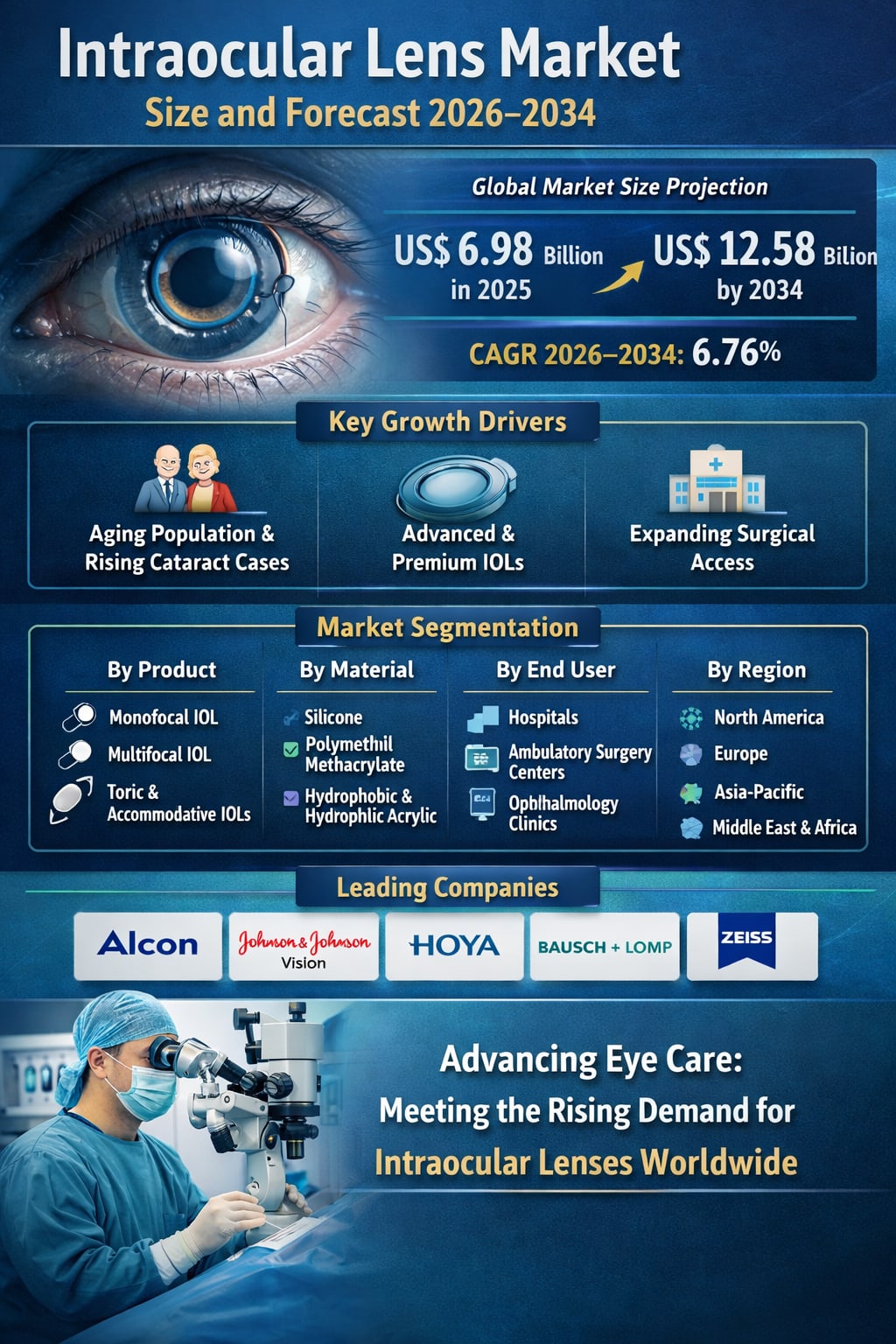
The global Intraocular Lens (IOL) Market is entering a transformative growth phase, driven by demographic shifts, surgical innovation, and rising patient awareness. According to Renub Research, the Intraocular Lens Market was valued at US$ 6.98 billion in 2025 and is projected to reach US$ 12.58 billion by 2034, expanding at a Compound Annual Growth Rate (CAGR) of 6.76% from 2026 to 2034.
The steady rise in cataract prevalence, an expanding elderly population, and increasing demand for advanced and premium intraocular lenses are reshaping the competitive and technological landscape of this sector. With surgical outcomes improving and accessibility widening across emerging markets, intraocular lenses are becoming central to global eye health strategies.
Intraocular Lens Market Outlook
An intraocular lens (IOL) is a small, artificial lens surgically implanted in the eye to replace the natural lens when it becomes clouded due to cataracts. Cataract surgery involves removing the opaque natural lens and replacing it with an IOL to restore vision by properly refracting light onto the retina.
While cataract surgery remains the primary application, intraocular lenses are also used in refractive lens exchange procedures to correct vision disorders such as myopia, hyperopia, and presbyopia. IOLs are available in multiple designs, including:
Monofocal IOLs
Multifocal IOLs
Toric IOLs
Accommodative IOLs
Each type addresses specific visual needs and varying levels of dependence on glasses or contact lenses.
Globally, the market has witnessed significant momentum due to technological advancements, increased awareness about eye care, and improvements in surgical infrastructure—particularly in emerging economies. Premium and advanced lenses offering enhanced visual performance are rapidly gaining traction among patients seeking long-term, high-quality visual outcomes.
Growth Drivers of the Intraocular Lens Market
Rising Prevalence of Cataracts and Aging Population
Cataracts remain the leading cause of blindness worldwide, and their incidence increases significantly with age. With global life expectancy rising, the demand for cataract surgery continues to expand.
It is estimated that at least 2.2 billion people worldwide experience some form of vision impairment. Of these, approximately 1 billion cases could have been prevented or remain unaddressed. Cataracts account for nearly 45% of global blindness and represent a significant share of moderate to severe visual impairment cases.
Prevalence rates rise sharply with age—from about 3.9% among individuals aged 55–64 to more than 90% among those aged 80 and above. This demographic shift directly fuels the need for surgical intervention and, consequently, intraocular lens implantation.
Governments and healthcare systems across developing countries are investing heavily in blindness prevention programs, expanding access to cataract surgeries through public initiatives and charitable partnerships. This widespread push to reduce avoidable blindness strongly supports sustained IOL demand.
Technological Advancements and Premium IOL Adoption
Technological innovation remains a cornerstone of market expansion. Modern intraocular lenses now include multifocal, toric, extended depth-of-focus (EDOF), and accommodative designs, offering improved visual acuity and reducing dependence on spectacles.
In February 2025, Johnson & Johnson introduced the TECNIS PureSee™ purely refractive IOL in India. Designed to treat presbyopia, the lens combines monofocal-like clarity with improved refractive performance, highlighting the industry's shift toward refined premium solutions.
Advanced materials enhance biocompatibility, durability, and predictability of outcomes. Surgeons increasingly prefer premium lenses for their reliability and reduced complication rates, while patients are more informed and willing to invest in superior vision correction.
The premium segment, though higher priced, is gaining steady adoption in urban centers worldwide.
Expanding Access to Ophthalmic Surgical Care
Another crucial growth driver is improved access to ophthalmic surgical infrastructure. Governments in emerging markets are strengthening healthcare systems, expanding surgical facilities, and training ophthalmologists.
In October 2024, Carl Zeiss Meditec AG showcased digital surgical innovations at the American Academy of Ophthalmology (AAO) conference. These advancements aim to streamline workflows across cataract and refractive procedures, enabling more personalized and efficient patient care.
Ambulatory surgical centers (ASCs) are also playing a pivotal role in expanding procedural capacity by offering cost-effective, high-volume cataract surgeries with modern IOL implantation techniques.
Market Challenges
High Cost of Premium Intraocular Lenses
Despite their advantages, premium IOLs often face reimbursement limitations. In many healthcare systems, standard monofocal lenses are covered, while multifocal and toric lenses require partial or full out-of-pocket payments.
In price-sensitive regions, this cost differential limits premium lens penetration. While awareness is growing, affordability remains a barrier in several emerging economies.
Post-Surgical Complications and Regulatory Requirements
Complications such as lens dislocation, glare, halos, or posterior capsule opacification may impact patient satisfaction. These risks require skilled surgical practices and thorough patient education.
Additionally, regulatory approvals for IOLs are stringent, requiring extensive clinical validation to ensure safety and efficacy. Compliance with global standards can increase development timelines and costs for manufacturers.
Segment Analysis
Monofocal Intraocular Lens Market
Monofocal lenses dominate the market due to affordability, predictable outcomes, and strong insurance coverage. They offer clear vision at a fixed distance—typically for distance vision—and are widely used in both developed and developing countries.
Hospitals and public eye care centers primarily rely on monofocal lenses, especially in high-volume cataract surgery programs.
Multifocal Intraocular Lens Market
The multifocal segment is growing rapidly, fueled by demand for reduced spectacle dependence. These lenses provide improved near and distance vision, making them attractive for lifestyle-oriented patients.
Although higher costs restrict universal adoption, increasing willingness to invest in premium eye care supports steady growth.
Silicone Material Intraocular Lens Market
Silicone IOLs are valued for flexibility and biocompatibility. Their foldable nature allows small-incision surgeries, enabling quicker recovery. While occasionally contraindicated in specific retinal procedures, they remain widely used in cataract and refractive lens exchange surgeries.
Polymethyl Methacrylate (PMMA) Intraocular Lens Market
PMMA lenses represent a traditional and cost-effective option. Though rigid and requiring larger incisions, they are widely adopted in emerging markets and government-sponsored cataract programs due to affordability and durability.
Ambulatory Surgery Centers Market
Ambulatory Surgery Centers are gaining prominence as preferred venues for cataract surgeries. Their efficiency, lower costs, and high surgical volumes contribute significantly to IOL demand. Advanced anesthetic techniques and minimally invasive procedures further support ASC growth.
Regional Insights
United States Intraocular Lens Market
The United States represents one of the most advanced and lucrative IOL markets globally. High cataract surgery volumes and strong premium lens adoption characterize this region.
In October 2025, the FDA approved BVI’s FineVision HP trifocal IOL, expanding premium options available to U.S. surgeons. The presence of major manufacturers such as Alcon Inc. and Bausch Health Companies Inc. strengthens competitive intensity and innovation.
Favorable reimbursement for standard lenses and rising out-of-pocket spending for premium solutions further enhance market growth.
United Kingdom Intraocular Lens Market
The UK market is supported by a structured public healthcare system. However, National Health Service (NHS) budget constraints limit premium lens usage. Private healthcare providers, on the other hand, offer advanced options.
In August 2024, Rayner introduced the RayOne Galaxy, the world’s first spiral-shaped IOL incorporating AI technology—highlighting continued innovation in the region.
India Intraocular Lens Market
India is witnessing rapid growth due to its large aging population and high cataract burden. Government blindness prevention programs significantly boost surgical volumes.
Cost-effective monofocal and PMMA lenses dominate public facilities, while premium lenses are gaining traction in urban private hospitals. In March 2024, Novartis AG subsidiary Alcon launched the Clareon IOL family in India, enhancing premium offerings.
Saudi Arabia Intraocular Lens Market
Saudi Arabia’s healthcare modernization initiatives and strong public investment support steady IOL demand. Modern hospitals equipped with advanced surgical systems facilitate adoption of foldable and premium lenses. Improved public healthcare access continues to drive cataract surgeries across the region.
Competitive Landscape
Key companies operating in the Intraocular Lens Market include:
Alcon Inc.
Bausch Health Companies Inc.
Hoya Corporation
Johnson & Johnson
STAAR Surgical Company
Carl Zeiss Meditec AG
Novartis AG
These companies compete on innovation, premium product portfolios, strategic partnerships, and geographic expansion. Many are focusing on digital surgical integration, AI-driven lens customization, and next-generation refractive technologies.
Market Segmentation
By Product:
Monofocal IOL
Multifocal IOL
Toric IOL
Accommodative IOL
By Material:
Polymethyl Methacrylate
Silicone
Hydrophobic & Hydrophilic Acrylic
Other Materials
By End User:
Hospitals
Ambulatory Surgery Centers
Ophthalmology Clinics
Eye Research Institutes
By Region:
North America, Europe, Asia-Pacific, Latin America, and Middle East & Africa, covering major countries such as the United States, Germany, France, China, Japan, India, Brazil, Saudi Arabia, and others.
Final Thoughts
The Intraocular Lens Market is on a clear upward trajectory, underpinned by demographic realities, technological breakthroughs, and expanding global access to cataract surgery. With the market projected to grow from US$ 6.98 billion in 2025 to US$ 12.58 billion by 2034, the sector reflects both medical necessity and technological advancement.
As healthcare systems prioritize vision restoration and patients increasingly seek premium visual outcomes, intraocular lenses will remain central to ophthalmic innovation. Companies that balance affordability with cutting-edge technology are best positioned to capture the expanding global opportunity.
About the Creator
Keep reading
More stories from shibansh kumar and writers in Trader and other communities.
School Bags Market Size & Forecast 2026–2034
The global School Bags Market is on a steady upward trajectory, projected to grow from USD 25.22 billion in 2025 to USD 41.64 billion by 2034, registering a CAGR of 5.73% between 2026 and 2034. The expansion reflects not only rising global student enrollment but also growing awareness of ergonomics, product innovation, organized retail penetration, and the increasing integration of technology in education.
By shibansh kumara day ago in Trader
Philippines Coffee & Tea Capsules Market 2026: Premium Beverage Surge, Smart Brewing Adoption and Retail Expansion
Philippines Coffee & Tea Capsules Market Overview The Philippines coffee and tea capsules market is witnessing rapid expansion as consumers increasingly embrace premium, convenient and technology-enabled beverage formats. Coffee and tea capsules — designed for single-serve brewing machines — deliver consistent quality, portion control and café-style experiences at home and in offices. As urbanisation rises and middle-class spending strengthens, Filipino consumers are shifting toward specialty beverage consumption supported by modern retail and e-commerce penetration.
By Manisha Dixita day ago in Trader
A Historic Declaration
We the People of the Husbands of the United States of America, in Order to form a more perfect Union, and I mean you...with me...establish Justice, insure domestic Tranquility, provide for the common defence, promote the general Welfare, and secure the Blessings of Liberty to ourselves, after Puberty, do ordain and establish this Declaration of Co-Dependence.
By Gerard DiLeo5 days ago in Humans



Comments
There are no comments for this story
Be the first to respond and start the conversation.