
School Bags Market Size & Forecast 2026–2034
Rising Enrollment, Ergonomic Awareness, and Digital Learning to Propel Global Demand

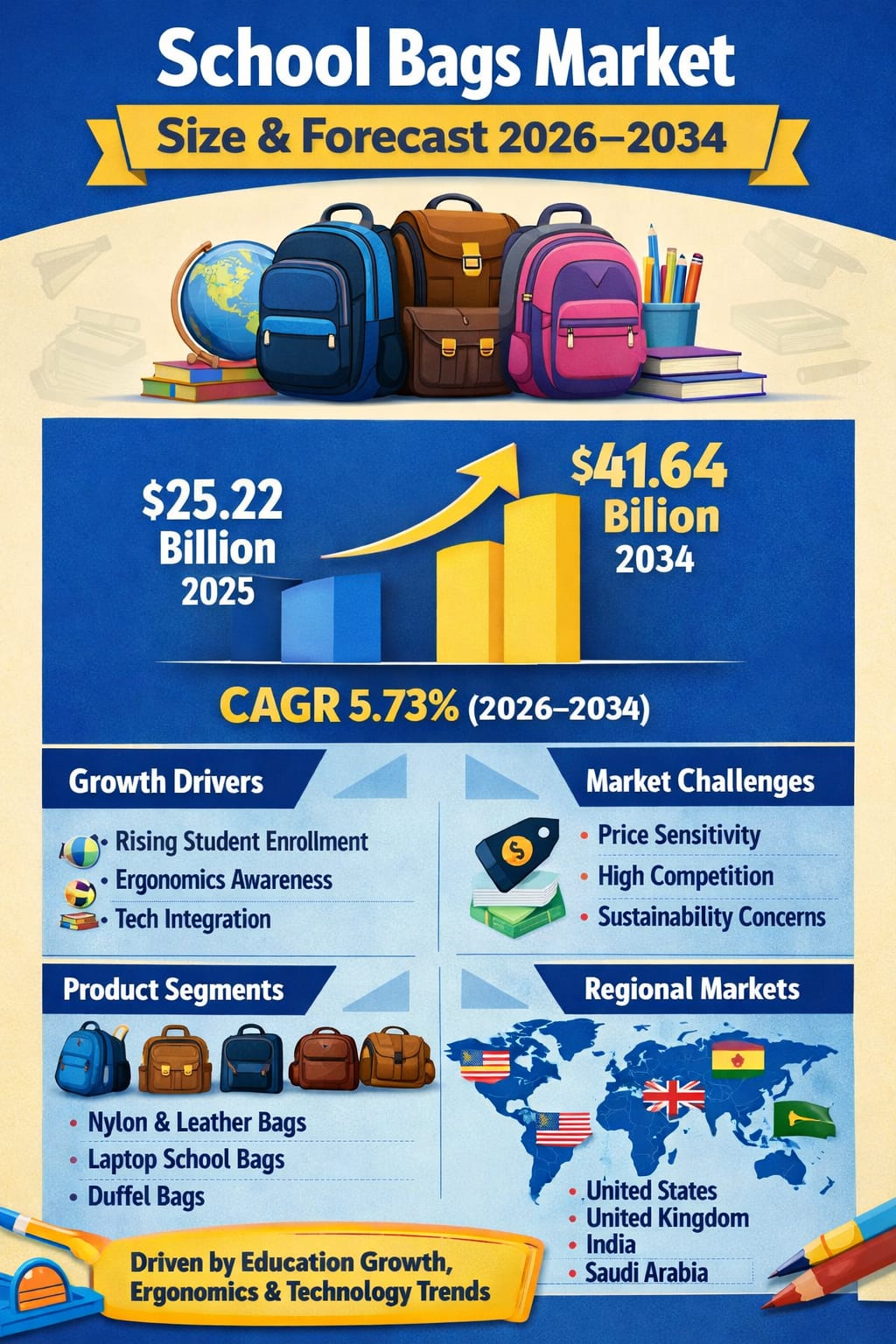
The global School Bags Market is on a steady upward trajectory, projected to grow from USD 25.22 billion in 2025 to USD 41.64 billion by 2034, registering a CAGR of 5.73% between 2026 and 2034. The expansion reflects not only rising global student enrollment but also growing awareness of ergonomics, product innovation, organized retail penetration, and the increasing integration of technology in education.
According to Renub Research, structural shifts in education systems, rising disposable incomes, and heightened focus on child health are reshaping purchasing decisions in this traditionally seasonal yet resilient market.
School Bags Market Outlook
A school bag is a purpose-designed carrying accessory used by students to transport textbooks, notebooks, stationery, lunch boxes, and increasingly, electronic devices such as tablets and laptops. Popular designs include backpacks, messenger bags, satchels, trolley bags, and duffel bags. Among these, backpacks dominate globally due to their ergonomic comfort and versatility.
Modern school bags are engineered with padded shoulder straps, breathable back panels, weight-distribution systems, and lightweight materials to reduce strain on children's shoulders and spines. Beyond functionality, school bags now reflect personal style, brand preference, and lifestyle identity.
Globally, demand remains consistent due to rising school enrollments and recurring replacement cycles. However, the market is evolving from being purely necessity-driven to experience-driven, influenced by branding, sustainability, and digital compatibility.
Growth Drivers for the School Bags Market
Rising Global Student Enrollment and Education Spending
The expansion of global education access remains the core growth pillar. Governments across developing and developed economies are strengthening policies to improve literacy and higher education participation.
In November 2024, the NAFSA: Association of International Educators reported that 1.1 million international students enrolled in U.S. higher education institutions during the 2023–2024 academic year contributed $43.8 billion to the U.S. economy and supported over 378,000 jobs. Although growth rates moderated compared to previous years, the total economic contribution surpassed pre-pandemic levels.
Each enrolled student represents recurring demand for school accessories, including backpacks and laptop bags. As household incomes rise in Asia-Pacific, Latin America, and parts of Africa, families increasingly opt for durable, high-quality products rather than low-cost, short-life alternatives.
Growing Awareness of Ergonomics and Child Health
Medical professionals and schools have raised concerns about the long-term impact of heavy school bags on children's posture and spinal health. Conditions such as back pain, muscle strain, and improper posture are driving demand for ergonomically designed bags.
Major brands have responded with innovations. In July 2022, Nike Inc. launched back-to-school backpacks engineered for improved weight distribution and comfort. Features such as cushioned straps, breathable mesh panels, and reinforced stitching now define premium offerings.
Some schools have even issued guidelines recommending ergonomic backpacks, further institutionalizing demand for high-quality designs.
Influence of Fashion, Branding, and Product Innovation
School bags have transformed into lifestyle accessories. Character-themed designs, brand logos, customization options, and bold color palettes significantly influence purchasing decisions, especially among younger students.
In March 2024, DOMS Industries entered the school bags segment, leveraging its strong brand presence in the stationery market. This strategic diversification highlights how established education-related brands are expanding portfolios to capture adjacent revenue streams.
Technological innovation is also reshaping the category. Features such as USB charging ports, anti-theft compartments, RFID-tagged sections, and water-resistant coatings are increasingly common, particularly in middle and high school segments.
Challenges in the School Bags Market
Price Sensitivity and Intense Competition
In emerging markets, consumers remain highly price-sensitive. Local, unorganized manufacturers offer low-cost alternatives, creating pricing pressure for branded players. The back-to-school season intensifies competition, often resulting in heavy discounting.
Profit margins are challenged by the need to balance affordability with quality. Additionally, brand differentiation requires sustained marketing investment, particularly for new entrants seeking market share.
Durability Expectations and Sustainability Concerns
Consumers increasingly expect long-lasting products. Poor durability leads to dissatisfaction and brand switching. Simultaneously, sustainability has emerged as a decisive factor in purchasing behavior.
Eco-friendly materials, recycled fabrics, and ethical sourcing practices are gaining traction. However, sustainable production often increases manufacturing costs, posing challenges for companies competing in price-sensitive regions.
Product Segment Insights
Nylon School Bags Market
Nylon school bags dominate due to their lightweight, tear resistance, water resistance, and affordability. Manufacturers prefer nylon for its flexibility and ability to incorporate ergonomic features such as ventilated back panels and adjustable straps.
Parents favor nylon bags for durability and low maintenance, ensuring continued dominance in both developed and developing markets.
Leather School Bags Market
Leather school bags cater to consumers seeking premium quality and timeless design. Though heavier and more expensive than synthetic alternatives, leather appeals to older students and fashion-conscious buyers.
Faux leather options are gaining traction amid environmental concerns, offering aesthetic appeal without ethical drawbacks.
Laptop School Bags Market
Digital learning has fueled rapid growth in laptop-compatible school bags. These products feature padded compartments, shock resistance, cable organizers, and USB charging ports.
With hybrid education models becoming mainstream, laptop bags represent one of the fastest-growing segments.
Duffel School Bags Market
Duffel school bags cater to students involved in sports and extracurricular activities. Their spacious interiors and versatility make them ideal for carrying sports gear. Though a niche category, demand is supported by growing participation in school sports programs.
Age-Based Market Segmentation
Preschool Bags Market
Preschool bags emphasize lightweight construction, vibrant colors, and cartoon themes. Safety, durability, and washability are critical factors influencing parental decisions.
High School Bags Market
High school students require larger capacity bags capable of carrying textbooks, electronics, and sports equipment. Style and brand appeal significantly influence this segment, alongside ergonomic features.
Distribution Channel Insights
Supermarkets and Hypermarkets
Organized retail plays a vital role in driving affordability and accessibility. Seasonal promotions and private-label offerings increase sales volumes during peak back-to-school periods.
Online Retail Market
The online channel continues to expand rapidly. Consumers benefit from product comparison, reviews, customization options, and doorstep delivery. Rising smartphone penetration supports this digital shift, particularly in Asia-Pacific markets.
Regional Insights
United States School Bags Market
The U.S. market is mature yet innovation-driven. High back-to-school expenditure, brand loyalty, and technological integration support growth. Sustainability trends are rising, with recycled materials gaining popularity.
According to the U.S. Consumer Product Safety Commission, 38% of new school bags in 2025 include smart capabilities such as charging ports and RFID compartments.
Major global players active in this region include Adidas AG, Puma SE, and Samsonite International S.A..
United Kingdom School Bags Market
The UK market emphasizes durability and uniform compliance. Sustainability and minimalist design trends are shaping purchasing decisions. E-commerce penetration continues to rise, especially among secondary school students.
India School Bags Market
India represents one of the fastest-growing markets due to its vast student population and expanding urban middle class. Brands such as VIP Industries Limited and Wildcraft are expanding aggressively across Tier II and Tier III cities.
Price sensitivity remains strong, but ergonomic awareness is increasing. Cartoon-printed preschool bags and laptop-compatible high school backpacks are particularly popular.
Saudi Arabia School Bags Market
In Saudi Arabia, demand is shaped by digital education initiatives and rising awareness of ergonomic health standards. In October 2023, KSrelief distributed 3,600 school bags to children in Somali districts, highlighting institutional involvement in education support.
Market Segmentation Overview
By Fabric: Canvas, Polyester, Nylon, Leather, Others
By Type: Messenger Bag, Backpack, Laptop Bag, Duffel Bag, Clutch Bag
By Age: Preschool, Elementary, Middle School, High School
By Distribution Channel: Supermarkets, Hypermarkets, Online Retail, Others
By Region: North America, Europe, Asia Pacific, Latin America, Middle East & Africa
Competitive Landscape
Leading companies covered under five key viewpoints (Overview, Key Persons, Recent Developments & Strategies, Product Portfolio, Financial Insights) include:
Adidas AG
Nike Inc.
Puma SE
Samsonite International S.A.
Sumdex Group
VIP Industries Limited
Wildcraft
These companies are focusing on ergonomic innovation, sustainability, digital compatibility, and brand collaborations to maintain competitive advantage.
Final Thoughts
The global School Bags Market is transitioning from a necessity-driven industry to a value-added, innovation-focused segment. With projected growth from USD 25.22 billion in 2025 to USD 41.64 billion by 2034, the market reflects structural growth rooted in education expansion, rising health awareness, and technological integration.
While price sensitivity and sustainability costs present challenges, opportunities abound in ergonomic innovation, eco-friendly materials, and smart bag technology. As education systems continue to modernize globally, school bags will remain a fundamental yet evolving component of the academic ecosystem.
About the Creator
Keep reading
More stories from shibansh kumar and writers in Trader and other communities.
Global Semiconductor Market Size & Forecast 2026–2034
The global semiconductor industry is entering a transformative decade. According to Renub Research, the Semiconductor Market is projected to increase from US$ 702.43 billion in 2025 to US$ 1,273.04 billion by 2034, expanding at a CAGR of 6.83% during 2026–2034.
By shibansh kumarabout 20 hours ago in Trader
Petroleum Coke Market 2026: Trends, Applications, and Technological Innovations
Petroleum Coke Market Overview: Petroleum coke (petcoke) is a carbon-rich solid material derived from oil refining. It is primarily used as a fuel in power plants, cement kilns, and steel production due to its high calorific value and cost-effectiveness compared to coal. The market growth is closely tied to the global energy sector, industrialization, and infrastructure development. Geographically, North America and Asia-Pacific are major markets, while emerging economies in Latin America and the Middle East are showing increasing demand.
By James Smithabout 18 hours ago in Trader
IT Training Market Accelerates as Digital Transformation and AI Adoption Reshape Global Workforce Development
IT Training Market Overview The global IT Training Market has emerged as a critical component of the modern digital economy. As enterprises adopt advanced technologies such as cloud computing, big data analytics, artificial intelligence (AI), blockchain, and cybersecurity frameworks, the need for skilled IT professionals continues to intensify.
By James Smith5 days ago in Trader
When the Shelter Closes
Across the street from my house, a man slept under a tree, his dog by his side. My first, naive thought: he must be traveling through. But he kept coming back, often sleeping there during the day. Then it hit me—that person might not have a home.
By Bride of Sound5 days ago in Humans




Comments
There are no comments for this story
Be the first to respond and start the conversation.