
Industrial Automation And Control Systems Market Size and Forecast 2026–2034
Industrial Automation And Control Systems Market to Reach US$ 466.29 Billion by 2034, Fueled by AI, Smart Factories, and Industry 4.0 Transformation

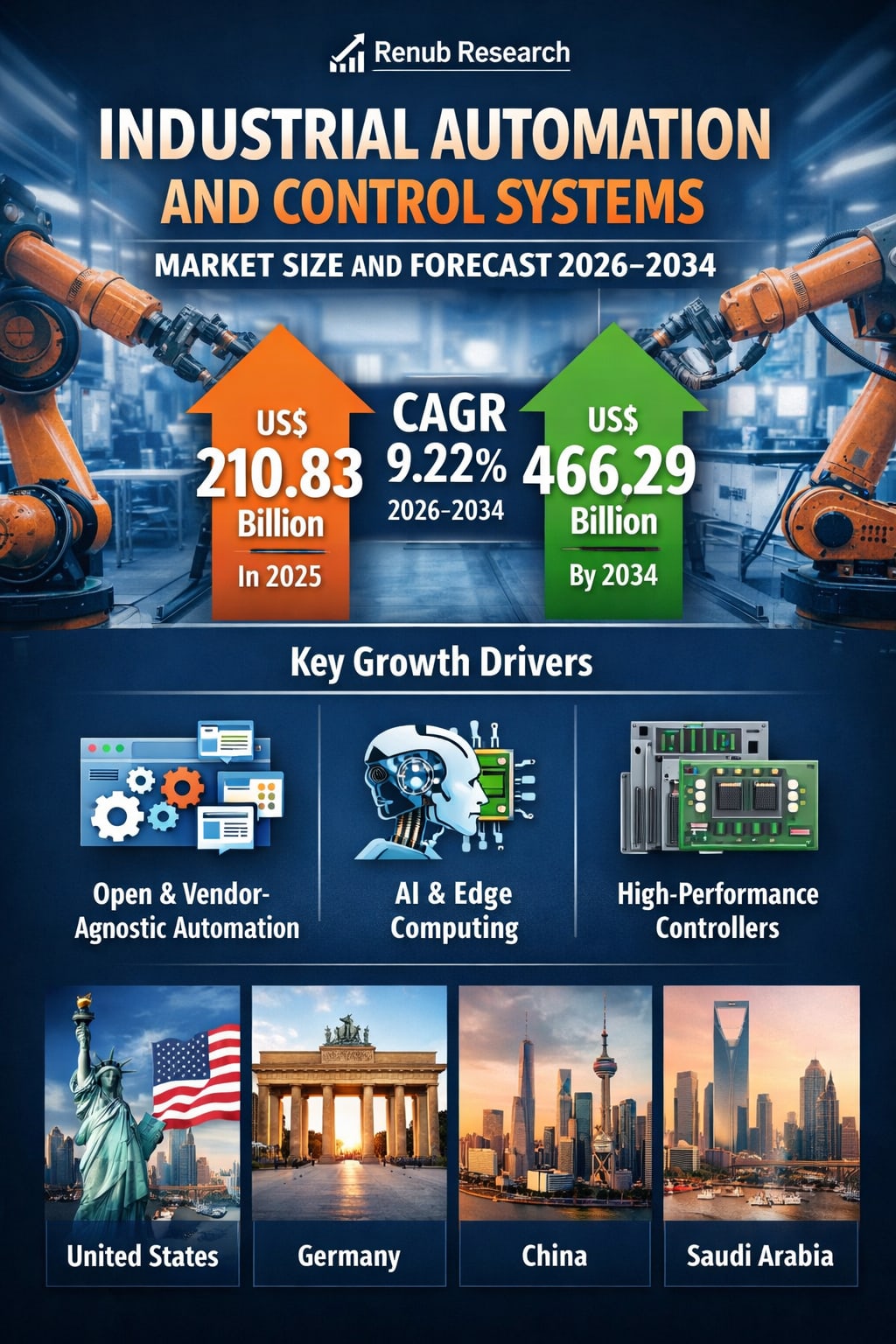
The global Industrial Automation and Control Systems (IACS) Market is entering a transformative decade. According to Renub Research, the market is projected to grow from US$ 210.83 billion in 2025 to US$ 466.29 billion by 2034, expanding at a CAGR of 9.22% from 2026 to 2034.
This remarkable growth trajectory is driven by rapid digital transformation, increased adoption of artificial intelligence (AI), the proliferation of Industrial Internet of Things (IIoT), and the global shift toward smart factories. Industries worldwide are reengineering their operations to achieve higher efficiency, predictive maintenance capabilities, reduced downtime, and real-time decision-making—placing automation and control systems at the heart of industrial evolution.
Industrial Automation and Control Systems Industry Overview
Industrial Automation and Control Systems (IACS) refer to integrated hardware and software frameworks that automate, monitor, and control industrial processes with minimal human intervention. These systems include:
Programmable Logic Controllers (PLCs)
Distributed Control Systems (DCS)
Supervisory Control and Data Acquisition (SCADA)
Human Machine Interfaces (HMI)
Industrial sensors and actuators
Industrial communication networks
Intelligent controllers and edge computing systems
IACS enables real-time data processing, advanced analytics, and automated control execution. It ensures precision, repeatability, and operational consistency across industries such as manufacturing, oil & gas, automotive, pharmaceuticals, chemicals, utilities, aerospace, and energy.
As enterprises integrate robotics, AI-driven analytics, digital twins, and IIoT platforms, IACS functions as the backbone of smart factory ecosystems. It supports predictive maintenance, remote operations, and seamless coordination between machines and enterprise systems.
The accelerating shift toward data-driven manufacturing and operational intelligence is significantly strengthening the market’s growth momentum.
Key Growth Drivers of the Industrial Automation and Control Systems Market
1. Expansion of Open, Software-Defined, and Vendor-Agnostic Automation
Industries are increasingly transitioning from rigid proprietary architectures to open, software-defined automation systems that offer scalability and interoperability. Vendor-neutral ecosystems enable seamless integration between devices, platforms, and applications across multi-vendor environments.
In April 2025, Schneider Electric introduced its Open Automation Movement initiative. The movement promotes democratized access to automation technologies through software-driven and interoperable systems. By enabling plug-and-play flexibility and third-party integration, open frameworks reduce engineering complexity and lifecycle costs.
This approach aligns strongly with Industry 4.0 strategies, encouraging agile production systems that can adapt to dynamic market demands. As industries seek cyber-secure, scalable automation solutions, open ecosystems are becoming essential to future-ready manufacturing.
2. Adoption of AI, Edge Computing, and Intelligent Mobility Automation
Artificial intelligence is transforming industrial automation from rule-based control to predictive and autonomous systems. AI-powered analytics support anomaly detection, predictive maintenance, quality optimization, and real-time decision-making.
In March 2025, autonomous vehicle software company Oxa partnered with NVIDIA to enhance industrial mobility automation using physical AI and photoreal digital simulations. This collaboration allows highly accurate virtual training environments, improving machine reliability and reducing development costs.
Edge AI solutions are particularly impactful. Processing data closer to the source reduces latency and supports autonomous robotics, smart PLCs, automated guided vehicles (AGVs), and predictive analytics in real time.
As AI becomes embedded in production environments, industries increasingly demand intelligent automation platforms capable of continuous optimization and adaptive control.
3. Rising Demand for High-Performance Controllers and Advanced Industrial Networking
Modern manufacturing environments require high-speed controllers capable of handling complex motion control, precision robotics, and synchronized communication across networks.
In November 2024, semiconductor supplier GigaDevice introduced the GD32H75E EtherCAT SubDevice Controller—an ultra-high-performance MCU designed for industrial PLCs, servo drives, and communication modules. Such innovations support low-latency communication, enhanced synchronization, and real-time industrial networking.
Similarly, in October 2024, Siemens AG launched the SIRIUS 3RC7 intelligent link module integrated with its Totally Integrated Automation (TIA) platform. This solution provides improved data transparency and seamless integration into existing automation environments.
High-speed industrial Ethernet, 5G integration, and Time-Sensitive Networking (TSN) are further accelerating adoption of next-generation automation architectures.
Market Challenges
High Initial Investment and Integration Complexity
Despite clear benefits, deploying advanced IACS solutions involves significant capital expenditure. Implementation of PLCs, SCADA systems, robotics, AI analytics, and industrial sensors requires substantial upfront investment.
Integration with legacy infrastructure presents additional challenges. Many traditional facilities operate on outdated control systems lacking compatibility with modern communication protocols. Upgrading infrastructure while maintaining operational continuity demands skilled engineering and phased implementation strategies.
Small and mid-sized enterprises often face financial and technical barriers, slowing the pace of large-scale adoption.
Cybersecurity Risks in Highly Connected Ecosystems
As industrial networks become interconnected through IIoT and cloud platforms, cybersecurity risks intensify. Industrial control systems are attractive targets for ransomware, espionage, and sabotage.
Legacy PLCs and SCADA systems were not originally designed with modern cybersecurity standards. Securing Operational Technology (OT) environments now requires multi-layered defenses, encrypted communication protocols, real-time monitoring, and embedded threat detection.
In July 2024, Nozomi Networks introduced Arc Embedded security sensors integrated within Mitsubishi Electric PLCs, enhancing process-level threat visibility. Such solutions demonstrate the growing focus on secure automation frameworks.
Cyber resilience will remain a top priority as digitalization accelerates.
Regional Market Insights
United States
The United States is among the most advanced automation markets globally. Rapid adoption of robotics, AI, and IIoT across automotive, aerospace, electronics, energy, and food processing sectors drives demand for sophisticated automation platforms.
Government-backed reshoring initiatives and modernization of production facilities further boost automation investments. Strong R&D capabilities and the presence of global technology leaders support continuous innovation in edge AI and intelligent control systems.
Germany
Germany, the birthplace of Industry 4.0, continues to lead in precision engineering and automation excellence. Its automotive, chemical, and machinery sectors rely heavily on intelligent PLCs, DCS, robotics, and industrial networking.
Leading automation firms such as Siemens AG, Bosch Rexroth AG, and Beckhoff Automation drive technological advancements. Sustainability initiatives and electrification trends further stimulate automation deployment across manufacturing ecosystems.
China
China represents the fastest-growing industrial automation market globally. The “Made in China 2025” initiative encourages investments in robotics, AI-enabled control systems, and advanced manufacturing technologies.
Rising labor costs and the push toward high-value manufacturing are accelerating automation adoption across electronics, automotive, renewable energy, and heavy machinery sectors. Both domestic suppliers and international players are expanding their footprint in the Chinese market.
Saudi Arabia
Saudi Arabia’s Vision 2030 strategy is reshaping its industrial landscape. Investments in oil & gas modernization, petrochemicals, mining, water treatment, and smart city projects such as NEOM are driving automation demand.
The country is adopting advanced PLCs, SCADA systems, robotics, and IIoT platforms to enhance operational efficiency and safety standards. Strategic partnerships with global automation leaders are strengthening its position as a growing Middle Eastern automation hub.
Recent Developments in the IACS Market
April 2025: Schneider Electric launched the Open Automation Movement to promote vendor-agnostic automation.
March 2025: Oxa partnered with NVIDIA to accelerate industrial mobility automation using physical AI.
November 2024: GigaDevice introduced the GD32H75E EtherCAT SubDevice Controller.
October 2024: Siemens launched the SIRIUS 3RC7 intelligent link module integrated with TIA.
July 2024: Nozomi Networks released Arc Embedded OT security sensor.
February 2023: ABB Ltd upgraded its ABB Ability™ Symphony® Plus DCS, enabling secure OPC UA connectivity to edge and cloud platforms.
These advancements highlight the increasing convergence of automation, cybersecurity, AI, and cloud connectivity.
Market Segmentation
By System
Distributed Control System (DCS)
Programmable Logic Controller (PLC)
Supervisory Control and Data Acquisition (SCADA)
Others
By Component Type
HMI
Industrial Robots
Control Valves
Sensors
Others
By End Use
Manufacturing
Food & Beverage
Healthcare
Automotive
Oil & Gas
Chemical
Energy & Utilities
Mining & Metal
Aerospace & Defense
Others
By Region
North America (United States, Canada)
Europe (Germany, France, Italy, Spain, UK, Belgium, Netherlands, Turkey)
Asia Pacific (China, Japan, India, South Korea, Thailand, Malaysia, Indonesia, Australia, New Zealand)
Latin America (Brazil, Mexico, Argentina)
Middle East & Africa (Saudi Arabia, UAE, South Africa)
Competitive Landscape
Leading companies covered with five viewpoints (Overview, Key Persons, Recent Developments, SWOT Analysis, Revenue Analysis, Company Analysis) include:
Siemens AG
Honeywell International Inc.
General Electric Company
Mitsubishi Electric Corporation
Rockwell Automation, Inc.
Johnson Controls International plc
Schneider Electric
Yokogawa Electric Corporation
OMRON Corporation
Danaher Corporation
These companies are investing heavily in AI-driven automation, cybersecurity integration, open platforms, and edge-enabled architectures to maintain competitive advantage.
Final Thoughts
The Industrial Automation and Control Systems Market is at the center of the global industrial transformation. With Renub Research forecasting growth from US$ 210.83 billion in 2025 to US$ 466.29 billion by 2034, the industry is poised for sustained expansion driven by AI integration, smart manufacturing, and digital transformation initiatives.
Open automation frameworks, high-performance controllers, cybersecurity innovations, and edge intelligence are reshaping how industries operate. While high initial investments and cybersecurity risks pose challenges, the long-term benefits of efficiency, cost optimization, and operational resilience far outweigh these barriers.
About the Creator
NVIDIA Corporation: The Stock Powering the Global Artificial Intelligence Boom
NVIDIA Corporation has emerged as one of the most influential companies of the modern technology era. While it was once known primarily for gaming graphics cards, NVIDIA has transformed into the backbone of artificial intelligence, high-performance computing, and data-center innovation. For investors, this shift has turned NVIDIA stock into a symbol of the AI revolution itself.
By Hammad Nawaz5 days ago in Trader
Flower Bloom 369
FLOWER Bloom 2/25/26 Wednesday By Mariann Carroll Karen had been with Tony for 7 years. Tony started acting strangely after her surgery. He would mow the lawn in the rain and be on his cellphone. He started pushing Karen away. Tony came clean about seeing someone. Karen moved out two months later. Karen moved in with a friend. She felt betrayed.
By Mariann Carroll4 days ago in Fiction


Comments
There are no comments for this story
Be the first to respond and start the conversation.