
India Industrial Automation Market Size and Forecast 2026–2034
Rapid Digitalization, Semiconductor Expansion, and Industry 4.0 Adoption to Propel Market to US$ 13.65 Billion by 2034

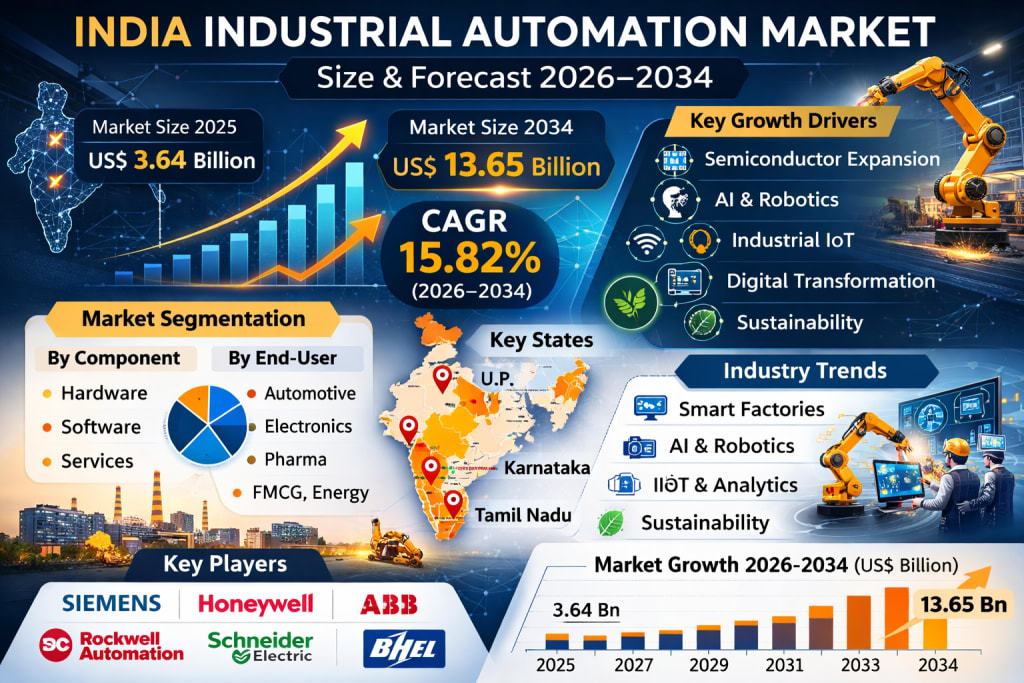
India Industrial Automation Market is expected to reach US$ 13.65 billion by 2034 from US$ 3.64 billion in 2025, expanding at a remarkable CAGR of 15.82% from 2026 to 2034. The rapid transformation of India’s manufacturing landscape—driven by digitalization, policy support, rising global competitiveness, and integration of AI, robotics, and IoT—is reshaping the country’s industrial ecosystem.
Automation is no longer a futuristic ambition for Indian industries; it is fast becoming a strategic necessity. From automotive assembly lines in Pune to semiconductor fabs near Jewar, companies are investing heavily in intelligent systems that improve productivity, minimize downtime, and deliver consistent quality at scale.
India Industrial Automation Industry Overview
Industrial automation in India refers to the integration of advanced technologies such as robotics, industrial IoT (IIoT), AI-driven control systems, smart sensors, and cloud-connected software into manufacturing and operational processes. These technologies reduce manual intervention, enhance efficiency, and improve production reliability.
Automation systems are widely deployed across:
Automotive
Pharmaceuticals
FMCG
Chemicals
Electronics
Heavy engineering
Oil & gas
Aerospace
As India accelerates toward Industry 4.0, factories are transitioning into smart manufacturing hubs powered by digital twins, predictive maintenance tools, and real-time data monitoring systems. Government initiatives such as “Make in India,” Production Linked Incentive (PLI) schemes, and digital infrastructure expansion are providing additional momentum.
The convergence of digital infrastructure, policy backing, and sectoral expansion is positioning India as a competitive global manufacturing destination.
Key Growth Drivers of the India Industrial Automation Market
1. Expansion of India’s Semiconductor & Electronics Manufacturing
India’s increasing focus on semiconductor fabrication and electronics manufacturing is a major catalyst for automation demand. Semiconductor production requires extreme precision, contamination-free environments, and advanced process control systems.
In May 2025, the Union Cabinet approved a sixth semiconductor facility under the India Semiconductor Mission, a joint venture between HCL and Foxconn near Jewar airport. The plant is designed to manufacture display driver chips with a monthly capacity of 36 million units and 20,000 wafers, supported by an investment of INR 3,700 crore.
Such mega projects depend on:
Robotics for cleanroom handling
Advanced process control systems
AI-based inspection systems
Intelligent traceability tools
Automated material transport systems
As India builds its semiconductor ecosystem, automation adoption will surge across upstream suppliers and downstream electronics manufacturers.
2. Shift Toward Open, Interoperable, and Software-Led Automation
Traditional automation systems often operate on proprietary platforms, limiting scalability and integration. Indian manufacturers are now transitioning toward open, vendor-neutral, and software-defined automation architectures.
In May 2025, Schneider Electric introduced the Open Automation Movement in India, promoting plug-and-play connectivity and interoperability across multi-vendor environments.
Open automation offers:
Modular scalability
Lower integration costs
Faster upgrades
Real-time analytics
Enhanced cybersecurity
This transformation enables automotive, FMCG, chemical, and heavy engineering companies to optimize lifecycle costs and accelerate digital maturity.
3. Growing Emphasis on Digital Transformation & Sustainability
Sustainability is becoming central to India’s manufacturing growth. Companies are integrating automation to monitor energy usage, reduce emissions, optimize asset utilization, and comply with ESG frameworks.
In December 2024, ABB Ltd India partnered with PwC to support digital transformation and ESG integration for manufacturers. Automation now supports:
Energy monitoring
Emission tracking
AI-driven predictive maintenance
Digital twin simulations
Smart grid integration
Global value chains demand transparency and greener operations. Automation technologies enable Indian firms to align with international sustainability standards, improving export competitiveness.
Challenges in the India Industrial Automation Market
High Investment Costs and Slow SME Adoption
Although large enterprises are investing aggressively, small and medium enterprises (SMEs) face financial constraints. High upfront costs for robotics, control systems, and cybersecurity infrastructure can deter adoption.
Integration, maintenance, and workforce training add to the financial burden. Many SMEs lack clarity on long-term ROI, which slows the pace of digital transformation.
Affordable modular automation models and financial incentives will be crucial to bridging this gap.
Workforce Skill Shortages and Training Gaps
India faces a shortage of professionals skilled in robotics programming, AI-based analytics, and industrial IoT integration. While India has strong IT capabilities, hands-on experience with industrial control systems remains limited.
Gaps in industry–academia collaboration and limited specialized training infrastructure slow adoption. Companies often struggle to hire engineers capable of managing programmable logic controllers (PLCs), SCADA systems, and digital twins.
Workforce development is therefore a key pillar for sustainable automation growth.
State-Level Industrial Automation Outlook
Maharashtra Industrial Automation Market
Maharashtra leads India’s automation adoption due to its strong presence in automotive, pharmaceuticals, chemicals, and electronics. Pune and Mumbai serve as innovation hubs for robotics and smart manufacturing.
Automotive clusters are integrating AI-based inspection systems, PLCs, and IoT-enabled predictive maintenance solutions. Process industries are deploying distributed control systems (DCS) and SCADA platforms to optimize operations.
The state’s advanced infrastructure and industrial corridors continue to attract automation investments.
Tamil Nadu Industrial Automation Market
Tamil Nadu’s manufacturing ecosystem—particularly in Chennai, Sriperumbudur, and Hosur—drives strong automation demand.
Automotive and electronics sectors utilize:
Robotics for assembly
High-speed inspection systems
Sensor-based quality monitoring
Manufacturing Execution Systems (MES)
The textile sector is modernizing with automated looms and energy-efficient monitoring tools. The state’s focus on attracting global manufacturers further boosts Industry 4.0 deployment.
Karnataka Industrial Automation Market
Karnataka benefits from its technology-driven ecosystem, especially in Bengaluru. Aerospace, electronics, and machine tool industries are early adopters of digital twins, industrial IoT, and AI-powered monitoring platforms.
The presence of global automation companies accelerates innovation. MSMEs are gradually implementing automation solutions to remain competitive in export markets.
Uttar Pradesh Industrial Automation Market
Uttar Pradesh is emerging as a fast-growing automation hub, particularly in the Noida–Greater Noida electronics corridor.
Electronics manufacturing, food processing, and consumer goods sectors are deploying:
SMT automation
Robotic packaging systems
Sensor-based quality control
IoT-driven energy monitoring
Industrial corridor expansion and logistics infrastructure are strengthening the automation adoption curve.
Market Segmentation
By Component
Hardware
Industrial Sensors
Machine Vision Systems
Field Instruments
Industrial Robots
Human Machine Interface (HMI)
Industrial PCs
Software
Manufacturing Execution Systems (MES)
Industrial Safety Software
Plant Asset Management
SCADA
PLC
Distributed Control Systems
Services
Project Engineering & Installation
Maintenance & Support
Consulting Services
Operational Services
By End User
Manufacturing
Food & Beverage
Healthcare
Automotive
Oil & Gas
Chemical
Energy & Utilities
Mining & Metal
Aerospace & Defense
Others
Competitive Landscape
The India industrial automation market is highly competitive and innovation-driven. Key players are expanding local manufacturing, strengthening distribution networks, and forming strategic partnerships.
Major companies include:
Siemens AG
Honeywell International Inc.
Mitsubishi Electric
Rockwell Automation
Schneider Electric
Bharat Heavy Electricals Limited (BHEL)
ABB Ltd
Recent Developments
September 2025: Schneider Electric acquired the remaining 35% stake in its India joint venture for INR 499,000 million, strengthening its ambition to capture nearly 25% of India’s automation market.
July 2025: Sonepar India partnered with Siemens to expand automation distribution across Tier-2 and Tier-3 cities.
December 2024: ABB enhanced its smart infrastructure capabilities via strategic acquisitions.
December 2024: Rockwell Automation announced plans to make India a global manufacturing hub.
October 2024: Honeywell and Chevron collaborated on AI-enabled refinery optimization.
These developments reflect intensifying competition and strategic localization efforts.
Future Outlook: Toward a Fully Automated Industrial India
India’s industrial automation market stands at a transformational juncture. With a projected valuation of US$ 13.65 billion by 2034, the sector’s growth trajectory reflects deeper structural shifts in manufacturing.
Key trends shaping the next decade include:
AI-powered decision systems
Digital twins and real-time analytics
5G-enabled industrial IoT
Robotics integration in MSMEs
Cybersecure automation architectures
Sustainable smart factories
As global supply chains diversify, India’s ability to deliver high-quality, efficient, and digitally integrated production will determine its competitiveness. Automation technologies are becoming the backbone of that transformation.
While challenges such as capital intensity and workforce skill gaps remain, strong government support, foreign investments, and corporate digital strategies are likely to mitigate these barriers.
India is not merely adopting automation—it is redefining its industrial identity through it.
Final Thoughts
The India Industrial Automation Market is entering a high-growth era fueled by semiconductor expansion, open software-defined systems, ESG-driven digital transformation, and state-level industrial modernization. With a CAGR of 15.82% through 2034, automation is transitioning from optional enhancement to strategic imperative.
As smart factories rise across Maharashtra, Tamil Nadu, Karnataka, and Uttar Pradesh, India’s manufacturing ecosystem is steadily aligning with global Industry 4.0 standards. The next decade will likely witness a powerful convergence of AI, robotics, IoT, and sustainable manufacturing—positioning India as a digitally empowered industrial powerhouse.
About the Creator
Petroleum Coke Market 2026: Trends, Applications, and Technological Innovations
Petroleum Coke Market Overview: Petroleum coke (petcoke) is a carbon-rich solid material derived from oil refining. It is primarily used as a fuel in power plants, cement kilns, and steel production due to its high calorific value and cost-effectiveness compared to coal. The market growth is closely tied to the global energy sector, industrialization, and infrastructure development. Geographically, North America and Asia-Pacific are major markets, while emerging economies in Latin America and the Middle East are showing increasing demand.
By James Smithabout 11 hours ago in Trader
IT Training Market Accelerates as Digital Transformation and AI Adoption Reshape Global Workforce Development
IT Training Market Overview The global IT Training Market has emerged as a critical component of the modern digital economy. As enterprises adopt advanced technologies such as cloud computing, big data analytics, artificial intelligence (AI), blockchain, and cybersecurity frameworks, the need for skilled IT professionals continues to intensify.
By James Smith5 days ago in Trader
When the Shelter Closes
Across the street from my house, a man slept under a tree, his dog by his side. My first, naive thought: he must be traveling through. But he kept coming back, often sleeping there during the day. Then it hit me—that person might not have a home.
By Bride of Sound5 days ago in Humans



Comments
There are no comments for this story
Be the first to respond and start the conversation.