
India Video Surveillance Market Size and Forecast 2026–2034
From Smart Cities to Smart Security: How Video Surveillance Is Reshaping India’s Safety Infrastructure

Introduction
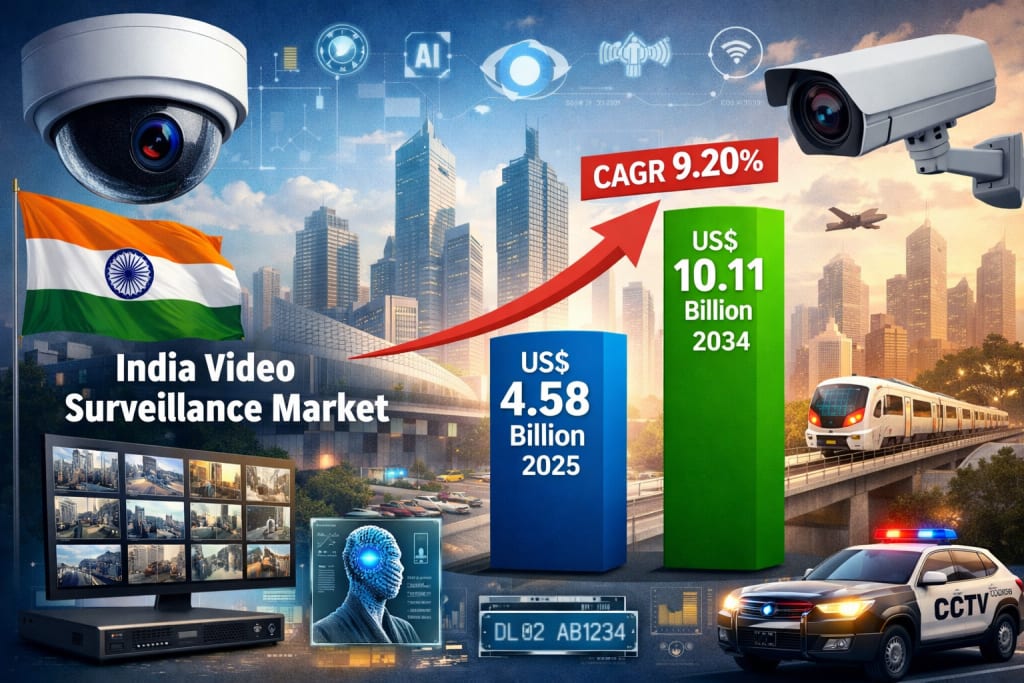
India’s rapid urbanization, digital transformation, and growing focus on public safety are redefining how security is planned and implemented across the country. One of the most visible outcomes of this shift is the accelerated adoption of video surveillance technologies across public, commercial, residential, and defense sectors. According to Renub Research, the India Video Surveillance Market is expected to grow from US$ 4.58 Billion in 2025 to US$ 10.11 Billion by 2034, registering a strong CAGR of 9.20% during the period 2026–2034.
This impressive growth trajectory is being driven by rising awareness of safety and security, expanding smart city projects, increasing infrastructure investments, and rapid technological advancements in artificial intelligence (AI), analytics, and IP-based surveillance systems. Video surveillance in India is no longer limited to basic CCTV monitoring—it is evolving into a smart, data-driven ecosystem that supports crime prevention, traffic management, operational efficiency, and even urban planning.
As cities become smarter and businesses more security-conscious, video surveillance is emerging as a strategic necessity rather than a discretionary investment. From airports and highways to shopping malls, housing societies, factories, and border areas, cameras and intelligent monitoring systems are becoming an integral part of India’s modern infrastructure story.
India Video Surveillance Market Overview
Video surveillance refers to the use of cameras, recording devices, and software platforms to monitor, record, and analyze activities in both public and private spaces. Traditional systems relied mainly on analog CCTV cameras and local recording devices. However, today’s solutions increasingly use IP cameras, network video recorders (NVRs), cloud storage, and AI-powered analytics to deliver far more advanced capabilities.
Modern video surveillance systems in India now support features such as facial recognition, motion detection, license plate recognition, crowd analytics, behavior analysis, and real-time alerts. This technological evolution has transformed surveillance from a passive recording tool into an active decision-support system for security agencies, businesses, and facility managers.
In the Indian context, video surveillance has gained strong momentum due to expanding urban infrastructure, rising crime awareness, and large-scale government initiatives focused on public safety and smart city development. Surveillance cameras are now commonly seen in roads, airports, railway stations, metro systems, government buildings, educational institutions, commercial complexes, and residential societies.
The commercial sector—including retail, banking, manufacturing, IT parks, and corporate offices—has also embraced video surveillance to prevent theft, improve workplace safety, enhance productivity, and ensure regulatory compliance. Meanwhile, declining hardware costs, better internet connectivity, and rapid progress in AI-based analytics are making advanced surveillance solutions more accessible across different income and business segments.
Growth Drivers in the India Video Surveillance Market
Government Initiatives for Smart Cities and Public Safety
One of the strongest growth engines for India’s video surveillance market is the government’s heavy investment in smart cities, infrastructure modernization, and public safety programs. The Smart Cities Mission, digital policing initiatives, and transport infrastructure upgrades have significantly increased the deployment of surveillance cameras, command-and-control centers, and intelligent traffic management systems.
Video surveillance is now widely used in transport hubs, highways, public buildings, educational campuses, and crowded urban areas to deter crime, manage traffic, and enable faster emergency response. The integration of AI-powered analytics, facial recognition, and automated traffic enforcement tools has further improved the effectiveness of these systems.
Importantly, state and local governments increasingly view surveillance as a preventive tool rather than just a reactive measure. Public-private partnerships are also playing a key role in accelerating deployment while managing budget constraints. Multiple agencies—including the Ministry of Home Affairs, state police forces, and national security organizations—are actively involved in expanding surveillance coverage to strengthen overall public safety infrastructure.
Rising Security Awareness in Commercial and Residential Segments
Growing concerns about theft, vandalism, employee safety, and personal security are fueling demand for video surveillance across both business and residential environments. Commercial establishments such as shopping malls, offices, factories, hospitals, warehouses, and hotels are investing in surveillance systems to reduce losses, monitor operations, and ensure compliance with safety regulations.
At the same time, residential adoption is rising rapidly. Apartments, gated communities, and individual homes are increasingly installing cameras, driven by greater awareness, falling prices, and the availability of user-friendly, mobile-connected solutions. Cloud-based storage, smartphone monitoring, and instant alerts have made home surveillance more convenient and attractive for middle-class families.
Real estate developers are also integrating video surveillance as a standard feature in new projects, further boosting market demand. In December 2025, for example, CP PLUS partnered with Qualcomm Technologies to launch next-generation AI-powered video security solutions for India, combining advanced chipsets with large-scale distribution capabilities—highlighting how innovation and partnerships are reshaping the industry.
Technological Advancements in AI, Analytics, and IP-Based Systems
Technology is playing a transformative role in the evolution of India’s video surveillance market. The shift from analog to IP-based systems allows for higher resolution imaging, easier system integration, and more flexible remote access.
AI and video analytics have unlocked powerful new use cases, including facial recognition, object detection, intrusion alerts, crowd management, and behavioral analysis. These features extend the value of surveillance far beyond simple recording, enabling predictive and proactive security management.
Cloud-based platforms are further reducing storage costs and making it easier for multi-site organizations to manage large camera networks. Falling prices of HD cameras and improving internet infrastructure are also accelerating adoption across urban and semi-urban areas. Events like IFSEC India 2025, which showcased AI and IoT-based security solutions from hundreds of brands, reflect the growing industry focus on intelligent, scalable surveillance technologies.
India Video Surveillance Market – Key Challenges
Privacy Concerns and Regulatory Uncertainty
Despite strong growth prospects, the market faces challenges related to privacy, data protection, and regulatory clarity. The widespread installation of cameras in public and private spaces has raised concerns about data misuse, unauthorized access, and lack of consent.
India’s evolving data protection framework creates uncertainty for companies regarding data storage, retention, and access policies. Public resistance to facial recognition and mass surveillance in some contexts may also slow adoption in sensitive areas. Balancing security needs with ethical considerations and transparency will remain a critical challenge for both policymakers and industry players.
High Implementation and Infrastructure Costs
Although demand is strong, infrastructure limitations—especially in rural and semi-urban areas—continue to pose challenges. Reliable power supply, high-speed internet, and skilled technical manpower are not uniformly available across the country.
Advanced AI-based or large-scale surveillance deployments can be expensive, particularly for small businesses and budget-constrained public bodies. Ongoing costs related to maintenance, upgrades, cybersecurity, and system management also add to the total cost of ownership, potentially slowing adoption in price-sensitive segments.
Indian Video Surveillance Software Market
The software segment is growing rapidly as customers seek smarter and more integrated security solutions. Video management platforms allow users to monitor, analyze, and control multiple cameras from a centralized interface in real time.
AI-powered software enables features such as facial recognition, license plate reading, motion detection, and anomaly detection, making these systems valuable for applications in airports, smart cities, retail analytics, and industrial safety. Cloud-based deployment models are further enhancing remote access and scalability, making software a key value driver in the overall market.
India Video Surveillance Services Market
Services form a crucial part of the ecosystem, covering system design, installation, integration, maintenance, and managed services. As surveillance systems become more complex, professional support is increasingly essential to ensure reliability and performance.
Managed services, including remote monitoring and cloud-based management, are gaining popularity among organizations that lack in-house technical expertise. Recurring revenue models and growing demand for analytics and support services are strengthening this segment’s role in the market.
India Video IP Surveillance Market
IP-based systems are steadily replacing analog solutions due to their superior image quality, remote accessibility, and advanced analytics capabilities. These systems are widely adopted in smart cities, corporate campuses, transportation networks, and large commercial facilities.
With declining hardware costs and increasing digital infrastructure, most new installations in India are now IP-based, making this segment a major contributor to market growth.
India Hybrid Surveillance Systems Market
Hybrid systems, which combine analog and IP technologies, offer a cost-effective migration path for organizations with existing infrastructure. Instead of replacing entire systems, users can gradually upgrade to digital platforms while continuing to use legacy equipment.
This approach is especially attractive for small businesses, educational institutions, and local government bodies operating under tight budgets, making hybrid systems an important transitional solution in the Indian market.
India Residential Video Surveillance Market
The residential segment is among the fastest-growing in India’s surveillance landscape. Rapid urbanization, the rise of nuclear families, and increasing security awareness are driving adoption in apartments and individual homes.
Affordable cameras, easy installation, smartphone connectivity, and cloud storage options have made home surveillance accessible to a broader population. Many housing societies are also deploying shared systems in common areas such as entrances, corridors, and parking lots.
India Military & Defense Video Surveillance Market
Defense and border security applications demand high-performance, mission-critical surveillance systems, often integrated with thermal imaging and advanced sensors. These technologies are used in border areas, sensitive installations, and strategic locations to enhance situational awareness and threat detection.
Ongoing defense modernization and national security priorities ensure steady and long-term demand for advanced surveillance solutions in this segment.
Regional Insights
North India: Strong demand driven by government institutions, infrastructure projects, and major cities such as Delhi, Jaipur, and Chandigarh. Smart city initiatives and law enforcement adoption are key growth factors.
East India: Growing adoption due to urbanization, industrial development, and government security initiatives, though connectivity challenges remain in some areas.
South India: The most technologically advanced region, with high adoption in IT hubs, business parks, residential complexes, and transport infrastructure. Cities like Chennai and Bengaluru are leading examples of AI-enabled surveillance deployment.
Market Segmentation
By Component: Hardware, Software, Services
By System Type: Analog Surveillance, IP Surveillance, Hybrid Surveillance
By Application: Public Facilities, Commercial, Residential, Industrial, Military & Defense, Infrastructure
By Top States: Maharashtra, Tamil Nadu, Karnataka, Uttar Pradesh, Gujarat, West Bengal, Rajasthan, Telangana, Andhra Pradesh, Madhya Pradesh, Other States
Key Companies Covered
Honeywell International Inc.
Robert Bosch GmbH
Schneider Electric SE
Panasonic Holdings Corporation
Samsung Electronics Co. Ltd.
Videocon Industries Ltd.
Zicom Electronic Security Systems
D-Link India Limited
(Each company analyzed through overview, key person, recent developments, SWOT analysis, and revenue analysis.)
Final Thoughts
The India Video Surveillance Market is entering a decisive growth phase, driven by smart city development, rising security awareness, and rapid technological innovation. With the market projected to grow from US$ 4.58 Billion in 2025 to US$ 10.11 Billion by 2034 at a CAGR of 9.20%, video surveillance is set to become a cornerstone of India’s digital and physical security infrastructure.
While challenges around privacy, regulation, and cost remain, the long-term outlook is undeniably strong. As AI, cloud computing, and IP-based systems continue to mature, video surveillance in India will evolve from a security tool into a strategic enabler of safer, smarter, and more efficient cities and organizations.
About the Creator
Sakshi Sharma
Content Writer with 7+ years of experience crafting SEO-driven blogs, web copy & research reports. Skilled in creating engaging, audience-focused content across diverse industries.
Keep reading
More stories from Sakshi Sharma and writers in Trader and other communities.
Japan Pet Food Market Size and Forecast, 2026–2034
Introduction Japan’s pet food industry is entering a decisive decade of transformation. While the country faces well-known demographic challenges such as population aging, shrinking households, and limited urban living spaces, the emotional bond between people and their pets has never been stronger. This shift is changing how Japanese consumers think about pet care, especially nutrition.
By Sakshi Sharmaabout 15 hours ago in Trader
United States Payment Gateways Market Size, Share, Growth, Trends Analysis, Forecast 2034
Why the United States Payment Gateways Market Is Accelerating: Trends & Future Outlook The United States Payment Gateways Market is experiencing rapid growth as digital commerce, mobile payments, and fintech innovation reshape the financial ecosystem. Payment gateways play a critical role in enabling secure online transactions between customers, merchants, and financial institutions. As consumer preferences shift toward seamless, contactless, and mobile-first experiences, the demand for reliable payment processing solutions continues to rise.
By Jackson Watsona day ago in Trader



Comments
There are no comments for this story
Be the first to respond and start the conversation.