
In-Vitro Diagnostics Enzymes Market Expands with AI-Driven Precision and Next-Gen Diagnostic Innovation
The In-Vitro Diagnostics (IVD) Enzymes Market is experiencing significant growth driven by the increasing demand for accurate, rapid, and cost-effective diagnostic solutions.

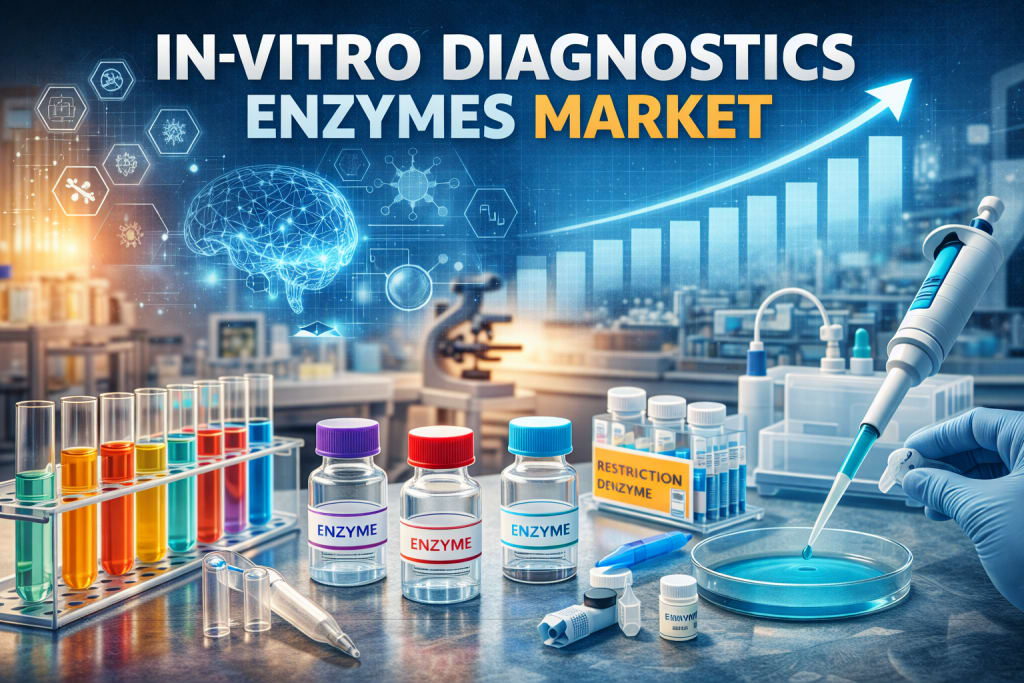
In-Vitro Diagnostics Enzymes Market Overview
In-vitro diagnostic enzymes are specialized biological catalysts used in laboratory tests performed outside the human body to detect diseases, infections, metabolic disorders, and genetic conditions. These enzymes are essential components in clinical chemistry analyzers, polymerase chain reaction (PCR) testing kits, biosensors, and immunoassay platforms.
The growing burden of infectious diseases, cancer, diabetes, cardiovascular disorders, and genetic conditions has increased the need for reliable diagnostic tools. IVD enzymes enable high sensitivity and specificity in testing, supporting accurate medical decision-making. With the global healthcare sector emphasizing preventive care and early intervention, demand for enzyme-based diagnostics continues to rise.
Technological advancements in biotechnology and molecular biology have expanded the applications of enzymes in diagnostic testing, particularly in nucleic acid amplification and biomarker detection.
Request a Sample PDF Report "In-Vitro Diagnostics Enzymes Market"
Key Enzyme Types in the Market
The IVD enzymes market comprises several critical enzyme categories:
Polymerases: Used in PCR and DNA amplification tests.
Reverse Transcriptases: Essential for RNA-based testing, including viral diagnostics.
Proteases: Applied in sample preparation and protein analys
Oxidases and Dehydrogenases: Widely used in glucose monitoring and clinical chemistry assays.
Restriction Enzymes: Utilized in genetic and molecular diagnostic applications.
Each enzyme type plays a distinct role in improving assay performance, speed, and reliability.
AI Impact on the IVD Enzymes Market
Artificial Intelligence is reshaping the diagnostic landscape and significantly influencing the growth of the IVD enzymes market.
1. Enhanced Diagnostic Accuracy
AI-powered algorithms analyze complex diagnostic data sets to improve result interpretation. By integrating enzyme-based assay outputs with machine learning models, healthcare providers can achieve higher accuracy in detecting diseases, particularly in oncology and infectious disease testing.
2. Automated Laboratory Workflows
AI-enabled laboratory automation systems streamline sample processing, reagent management, and quality control. This reduces human error and enhances efficiency in high-throughput diagnostic laboratories.
3. Predictive Healthcare Analytics
AI models use diagnostic enzyme test results combined with patient data to predict disease progression and treatment responses. This supports precision medicine and personalized treatment strategies.
4. Optimized Enzyme Development
Biotechnology companies are using AI-driven molecular modeling to design more stable and efficient enzymes. Computational simulations accelerate enzyme engineering, reducing development time and improving assay sensitivity.
5. Point-of-Care Testing Advancements
AI-integrated diagnostic devices allow real-time analysis in decentralized settings. Portable diagnostic tools using enzyme-based biosensors are gaining traction in rural healthcare systems and emergency settings.
Market Growth Drivers
Rising Prevalence of Chronic and Infectious Diseases
The global increase in chronic illnesses such as diabetes, cardiovascular diseases, and cancer is boosting demand for routine diagnostic testing. Enzyme-based assays are fundamental in monitoring glucose levels, cholesterol, and other key biomarkers.
Growing Adoption of Molecular Diagnostics
Molecular testing has become a cornerstone of modern healthcare, particularly after the global focus on infectious disease detection. PCR-based testing, which heavily relies on enzymes, continues to drive strong market demand.
Expansion of Personalized Medicine
As healthcare moves toward individualized treatment plans, precise diagnostic testing becomes essential.
Latest News and Developments:
April 2025: SEKISUI Diagnostics launched the Metrix® COVID/Flu Test, a rapid in-vitro diagnostics enzyme-based molecular assay that in 20 minutes identifies and differentiates SARS-CoV-2, Influenza A, and B. Designed for point-of-care and home use, the test expands access to affordable, multiplex diagnostics, marking a strategic advancement in SEKISUI’s enzyme-driven diagnostic portfolio.
April 2025: QIAGEN is developing plans to offer three new sample preparation equipment—QIAsymphony Connect in 2025, followed by QIAsprint and QIAmini in 2026—to enhance lab automation and efficiency. The QIAsymphony Connect, featuring improved automation, higher assay sensitivity, and in-vitro diagnostics (IVD) compatibility, supports workflows in oncology, genomics, and pathogen detection.
March 2025: Greylynx, a VivaChek subsidiary, earned the IVDR self-testing certificate for its Strep A Rapid Test, reinforcing its focus on accessible in-vitro diagnostics. This enzyme-based test delivers results in 5 minutes without equipment, supporting accurate self-screening across various settings.
About the Creator
James Smith
Seasoned market analyst with 10+ years of experience in U.S. economic trends and stock market insights.
Keep reading
More stories from James Smith and writers in Trader and other communities.
Destination Wedding Market Flourishes as Couples Seek Experiential, Luxury, and Culturally Immersive Celebrations
There is a moment — somewhere between the candlelit vows on a cliffside in Santorini and the first dance under a canopy of fairy lights in Rajasthan — when it becomes clear that a destination wedding is not simply a wedding. It is an event, a journey, a statement. And increasingly, it is an industry.
By James Smitha day ago in Trader
Online Event Ticketing Market Size and Forecast 2025–2033
Online Event Ticketing Market: A Digital Gateway to Live Experiences The global entertainment industry is in the middle of a powerful digital transformation, and few segments reflect this shift as clearly as online event ticketing. From concerts and sports matches to movies and live performances, the way people discover, purchase, and access events has changed dramatically over the past decade. What was once dominated by physical box offices and long queues has now become a mobile-first, app-driven experience built around speed, convenience, and personalization.
By shibansh kumar5 days ago in Trader



Comments
There are no comments for this story
Be the first to respond and start the conversation.