
Female Infertility Market: AI-Powered Solutions Transforming Reproductive Health
The Female Infertility Market is experiencing rapid growth as increasing awareness of reproductive health, delayed pregnancies, lifestyle changes, and technological advancements drive demand for infertility diagnosis and treatment solutions. Artificial intelligence (AI) is playing a transformative role in the market, from improving diagnostics and treatment personalization to enhancing in-vitro fertilization (IVF) outcomes and patient monitoring. This AI-focused overview examines market dynamics, growth drivers, segmentation, emerging trends, challenges, and the future outlook of the female infertility industry.

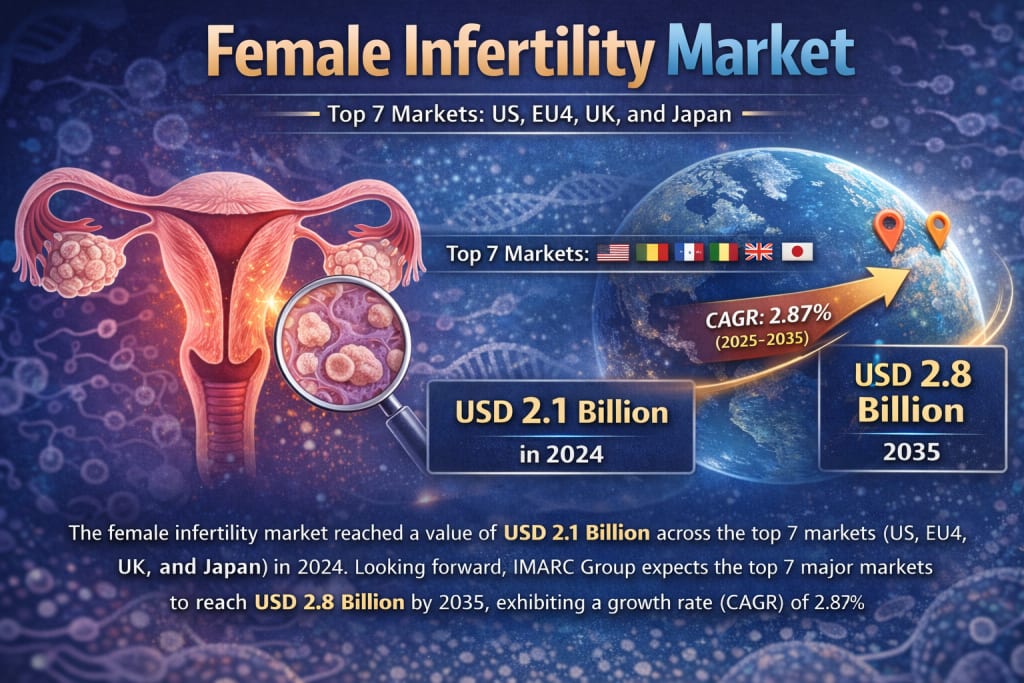
AI Overview of the Female Infertility Market
Female infertility, a complex reproductive health issue, arises from various factors including hormonal imbalances, ovulatory disorders, fallopian tube damage, endometriosis, and age-related fertility decline. Traditional infertility treatments involve hormonal therapy, assisted reproductive technologies (ART), and surgical interventions. The integration of AI is reshaping the approach to infertility management by enabling data-driven decision-making, predictive analytics, and personalized care plans.
AI algorithms analyze large datasets from patient histories, hormonal profiles, imaging, and genetic tests to predict fertility outcomes and recommend optimal treatment protocols. In IVF clinics, AI-powered imaging and embryo selection tools improve implantation success rates, reduce trial-and-error cycles, and optimize resource utilization.
Request a Sample PDF Report "Female Infertility Market"
Market Overview
The female infertility market encompasses diagnostics, treatment, and assisted reproductive services. Rising awareness about fertility issues, delayed childbearing due to professional commitments, increasing prevalence of polycystic ovary syndrome (PCOS) and endometriosis, and technological advances in reproductive medicine are driving market expansion.
Fertility clinics, hospitals, and specialized reproductive centers form the primary service providers, offering solutions ranging from ovulation induction and intrauterine insemination (IUI) to advanced IVF, intracytoplasmic sperm injection (ICSI), and egg freezing.
Global demand is further fueled by government initiatives, insurance coverage expansion, and the growing adoption of telemedicine and digital health solutions.
Key Market Drivers
1. Rising Incidence of Infertility
According to global health data, approximately 10–15% of couples face infertility challenges, with female infertility accounting for nearly half of these cases. Age-related decline in ovarian function and lifestyle factors such as stress, obesity, and poor nutrition contribute significantly.
2. Technological Advancements
AI-assisted IVF, embryo assessment tools, robotic interventions, and genetic testing are enhancing treatment efficacy. Machine learning models help predict implantation potential and personalize therapy.
3. Increasing Awareness and Accessibility
Educational campaigns, fertility counseling, and digital health platforms increase awareness and encourage early diagnosis and treatment.
4. Rising Delayed Parenthood Trends
Women postponing childbirth due to career and lifestyle choices are increasingly seeking fertility preservation and assisted reproductive technologies.
5. Government Support and Insurance Coverage
Regulatory frameworks and public health initiatives supporting fertility treatments enhance market accessibility, particularly in developed regions.
Market Segmentation
By Treatment Type
Assisted Reproductive Technology (ART): IVF, ICSI, embryo cryopreservation
Fertility Drugs: Hormonal therapy, ovulation induction drugs
Surgical Interventions: Laparoscopy, hysteroscopy, tuboplasty
ART represents the largest market share due to increasing success rates, technological integration, and patient preference for advanced reproductive solutions.
By End-User
Fertility Clinics
Hospitals & Reproductive Centers
Research Institutions
Fertility clinics dominate due to specialized services and advanced technological adoption, while hospitals and academic institutions contribute through diagnostic and clinical research services.
By Region
North America: Leading the market due to advanced healthcare infrastructure, insurance coverage, and early adoption of AI technologies.
Europe: Strong growth driven by fertility awareness and supportive policies.
Asia-Pacific: Fastest-growing market owing to rising infertility rates, urbanization, and expanding fertility clinic networks.
Latin America & Middle East: Emerging markets with increasing healthcare investments.
Role of AI in Female Infertility Management
Artificial intelligence enhances reproductive healthcare in multiple ways:
Predictive Analytics
AI evaluates hormonal levels, ovarian reserve, and patient history to predict fertility potential, enabling timely intervention.
Embryo Selection and IVF Optimization
AI-assisted imaging platforms assess embryo quality and select those with the highest implantation probability, increasing IVF success rates.
Personalized Treatment Plans
Machine learning models recommend tailored drug regimens and treatment cycles, reducing complications and enhancing outcomes.
Remote Monitoring
Telemedicine platforms powered by AI allow clinicians to track patient progress, adjust treatments, and provide timely guidance without requiring frequent clinic visits.
Data-Driven Research
AI accelerates research by analyzing genetic, epigenetic, and clinical data to uncover novel infertility biomarkers and treatment pathways.
Emerging Trends
Fertility Preservation
Egg freezing and ovarian tissue cryopreservation are gaining popularity among women delaying childbirth, supported by AI-assisted success prediction.
Telehealth Integration
Digital fertility platforms enable remote consultation, monitoring, and AI-guided treatment planning, enhancing patient convenience.
Adoption of Wearables
Smart devices track ovulation, hormonal cycles, and physiological parameters, feeding AI systems for better treatment predictions.
Sustainable and Cost-Effective Solutions
AI optimizes drug dosing and resource utilization, reducing overall treatment costs and improving accessibility.
Challenges
High cost of advanced fertility treatments
Ethical and regulatory concerns related to AI and reproductive technologies
Limited accessibility in low-income regions
Emotional and psychological impact of infertility on patients
Overcoming these challenges requires combining technological innovation, regulatory compliance, and patient-centered support programs.
Future Outlook
The female infertility market is expected to grow steadily, fueled by technological integration, rising awareness, and increasing healthcare investments. AI will continue to enhance patient outcomes by enabling early detection, optimizing treatment strategies, and improving IVF success rates.
Hybrid models combining in-clinic procedures with AI-powered remote monitoring and telehealth services are likely to dominate the market. Increasing adoption of fertility preservation techniques and personalized treatment plans will further expand market reach.
In the long term, AI-driven insights and predictive models may transform reproductive healthcare, making treatments more accessible, effective, and patient-friendly global
Conclusion
The Female Infertility Market is evolving rapidly with the integration of artificial intelligence, advanced diagnostics, and assisted reproductive technologies. Rising infertility prevalence, delayed parenthood trends, and growing patient awareness are key growth drivers.
AI is transforming the landscape by enabling predictive analytics, personalized care, embryo selection optimization, and efficient clinical monitoring. With continued technological advancements, regulatory support, and global adoption, the market is poised for sustained growth and improved reproductive health outcomes for women worldwide.
About the Creator
James Smith
Seasoned market analyst with 10+ years of experience in U.S. economic trends and stock market insights.
Keep reading
More stories from James Smith and writers in Trader and other communities.
Bladder Cancer Market: AI-Driven Innovation Reshaping Diagnosis and Treatment
AI Overview of the Bladder Cancer Market Bladder cancer is a malignancy that affects the urinary bladder and represents a significant healthcare burden globally. Its incidence is higher among older adults, particularly men, and risk factors include smoking, chemical exposure, and chronic bladder inflammation. Traditional diagnosis and treatment pathways, including cystoscopy, imaging, surgery, chemotherapy, and immunotherapy, are now being complemented by AI-driven tools.
By James Smithabout 19 hours ago in Trader
Australia Fuel Station Market: Navigating the Road Ahead Amid Energy Transition
The Australia Fuel Station Market has demonstrated steady expansion in recent years, underpinned by changing consumer preferences, infrastructure development, and broader energy transitions. According to IMARC Group’s latest analysis, the market size reached USD 1.1 billion in 2025, is projected to grow to USD 1.5 billion by 2034, and is expected to expand at a compound annual growth rate (CAGR) of 3.46% between 2026 and 2034.
By Rashi Sharma2 days ago in Trader
When the Shelter Closes
Across the street from my house, a man slept under a tree, his dog by his side. My first, naive thought: he must be traveling through. But he kept coming back, often sleeping there during the day. Then it hit me—that person might not have a home.
By Bride of Sound6 days ago in Humans



Comments
There are no comments for this story
Be the first to respond and start the conversation.