
Canada Construction Market Size Growth, Trends & Forecast 2034
Canada Construction Market was valued at USD 280.30 Billion in 2025 and is projected to reach USD 430.98 Billion by 2034, growing at a CAGR of 4.70% during 2026–2034.

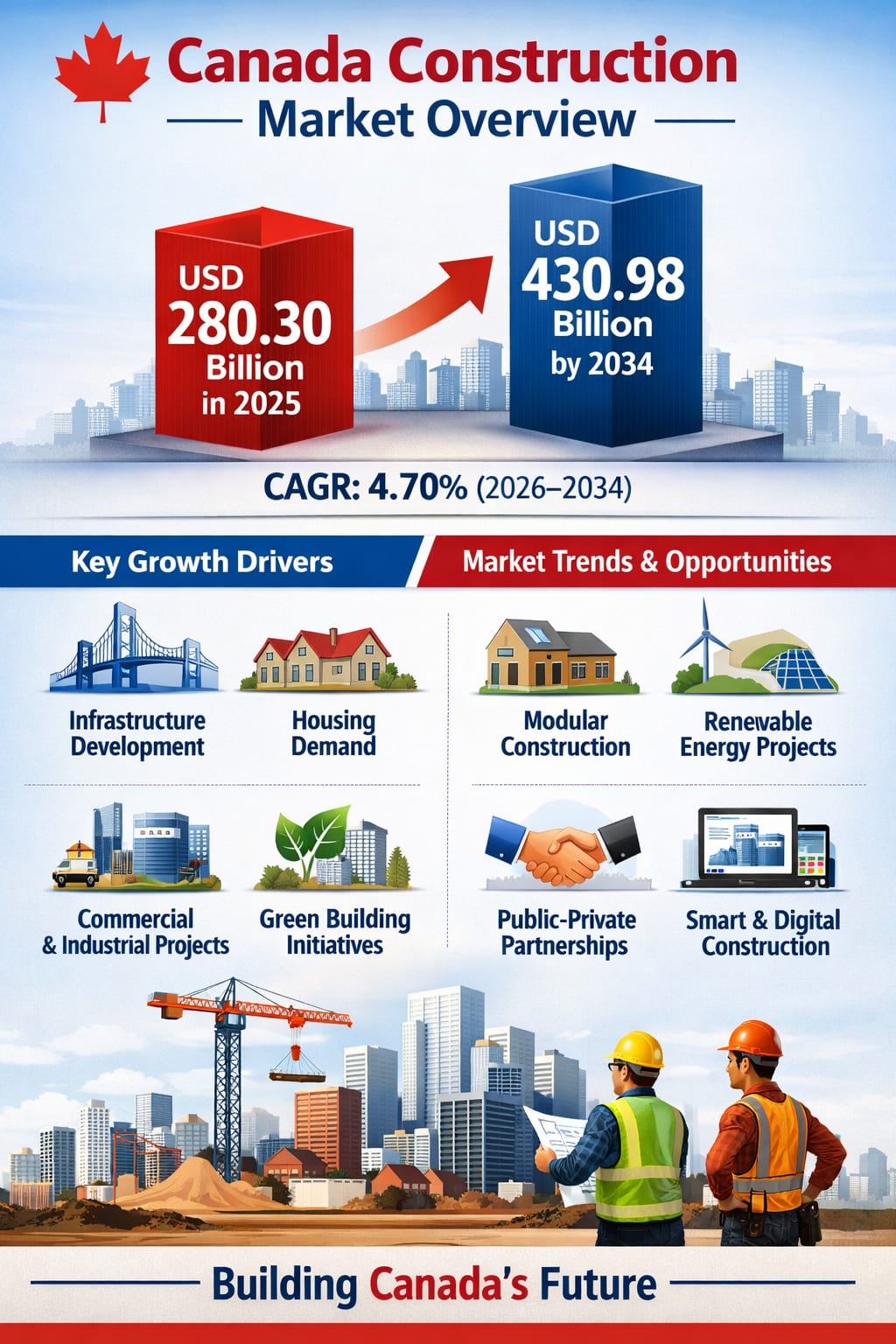
Canada Construction Market Overview
The Canada Construction Market is witnessing steady expansion, supported by infrastructure modernization, residential development, commercial expansion, and government-backed investment programs. Construction activities across transportation, energy, institutional, and housing sectors are playing a crucial role in strengthening the country’s economic growth.
The Canada construction market size was valued at USD 280.30 Billion in 2025 and is projected to reach USD 430.98 Billion by 2034, growing at a CAGR of 4.70% during 2026–2034. The market’s growth trajectory reflects sustained public and private sector investments, urban development initiatives, and rising demand for sustainable infrastructure solutions.
Key Takeaways and Insights:
• By Sector: Residential dominates the market with a share of 58.4% in 2025, driven by strong immigration inflows, federal housing incentives, and widening adoption of prefabrication that addresses skilled labor scarcity across major metropolitan areas.
• By Region: Ontario leads the market with a share of 39% in 2025, owing to concentrated construction activity in Toronto and surrounding metropolitan areas, supported by major transit infrastructure projects and robust commercial development initiatives.
• Key Players: The Canada construction market exhibits a moderately fragmented competitive landscape, with established domestic contractors competing alongside regional builders across multiple sectors. Some of the key players operating in the market include, Aecon Group Inc., Kentel Construction Ltd., PCL Construction, EllisDon, Graham Construction, Kiewit Canada, Ledcor Group, Bird Construction, Flynn Group of Companies, Broccolini Construction, and Pomerleau
Key Market Growth Drivers
Infrastructure Development Programs
Federal and provincial governments are investing heavily in transportation networks, highways, bridges, public transit systems, and energy infrastructure, driving long-term construction demand.
Residential Housing Demand
Population growth, immigration, and urbanization are increasing demand for new housing units, multi-family developments, and affordable housing projects.
Commercial and Industrial Expansion
Growth in logistics hubs, data centers, office spaces, and manufacturing facilities is strengthening non-residential construction activities.
Green Building Initiatives
Sustainability regulations and environmental awareness are accelerating the adoption of energy-efficient building materials and green construction standards.
Technological Advancements
Digital construction tools such as Building Information Modeling (BIM), prefabrication techniques, and smart construction technologies are improving project efficiency and cost control.
Key Market Trends
Rise of Sustainable Construction
Green building certifications and low-carbon materials are becoming industry standards across new projects.
Growth of Infrastructure Modernization
Aging infrastructure replacement and smart city development are fueling long-term investments.
Modular and Prefabricated Construction
Off-site construction methods are gaining traction due to cost efficiency and reduced construction timelines.
Public-Private Partnerships (PPPs)
Collaborations between government and private firms are accelerating large-scale infrastructure projects.
Digitalization of Construction Processes
The integration of AI, IoT, and advanced analytics is improving project planning, safety, and operational management.
Market Forecast and Outlook (2026–2034)
The Canada Construction Market is expected to grow from USD 280.30 Billion in 2025 to USD 430.98 Billion by 2034, reflecting stable growth at a CAGR of 4.70%. The forecast period will be driven by:
• Continued infrastructure investment
• Expansion of renewable energy projects
• Increasing demand for residential housing
• Industrial electrification and manufacturing growth
• Climate-resilient construction initiatives
Long-term growth remains positive as Canada prioritizes economic development and sustainable urban planning.
Market Challenges
• Rising material and labor costs
• Skilled labor shortages
• Supply chain disruptions
• Regulatory and permitting complexities
• Economic uncertainties affecting investment cycles
Addressing workforce gaps and improving supply chain efficiency will be critical for sustaining growth.
Market Opportunities
• Expansion of green and net-zero building projects
• Growth in renewable energy infrastructure
• Smart city and digital infrastructure development
• Affordable housing initiatives
• Investment in transportation and transit expansion
These opportunities position Canada as a key market for long-term infrastructure and construction investment.
Competitive Landscape and Key Players
The Canada Construction Market includes large construction firms, engineering contractors, real estate developers, and specialized infrastructure companies. Market participants are focusing on:
• Strategic partnerships and acquisitions
• Adoption of digital construction technologies
• Sustainable building solutions
• Project portfolio diversification
• Public infrastructure contract expansion
Competition is driven by project scale, technological capability, and sustainability compliance.
Conclusion
The Canada Construction Market is set for consistent growth through 2034, supported by infrastructure investment, housing demand, and sustainability initiatives. With a projected CAGR of 4.70%, the market presents stable opportunities for contractors, developers, investors, and technology providers.
As urbanization and infrastructure modernization continue, the construction sector will remain a cornerstone of Canada’s long-term economic development.
About the Creator
Kim Soo hyun
My name is Kim Soo hyun, and I am a research analyst at IMARC Group, specializing in market trends and data analysis to provide insights and support strategic decision-making.
Keep reading
More stories from Kim Soo hyun and writers in Trader and other communities.
United States Organic Food Market Growth, Trends & Outlook 2034
United States Organic Food Market Overview The United States Organic Food Market continues to expand steadily as consumers increasingly prioritize health, nutrition, and sustainability. Organic food products, including fruits, vegetables, dairy, meat, packaged foods, and beverages, are gaining widespread popularity due to growing awareness about chemical-free farming and environmentally responsible production practices.
By Kim Soo hyuna day ago in Trader
United States Payment Gateways Market Size, Share, Growth, Trends Analysis, Forecast 2034
Why the United States Payment Gateways Market Is Accelerating: Trends & Future Outlook The United States Payment Gateways Market is experiencing rapid growth as digital commerce, mobile payments, and fintech innovation reshape the financial ecosystem. Payment gateways play a critical role in enabling secure online transactions between customers, merchants, and financial institutions. As consumer preferences shift toward seamless, contactless, and mobile-first experiences, the demand for reliable payment processing solutions continues to rise.
By Jackson Watsona day ago in Trader




Comments
There are no comments for this story
Be the first to respond and start the conversation.