
Biopreservation Market Size and Forecast 2026–2034: Powering the Future of Regenerative Medicine and Precision Healthcare
With rising demand for cell therapies, biobanking, and advanced biomedical research, the global biopreservation market is entering a decade of rapid transformation and sustained growth.

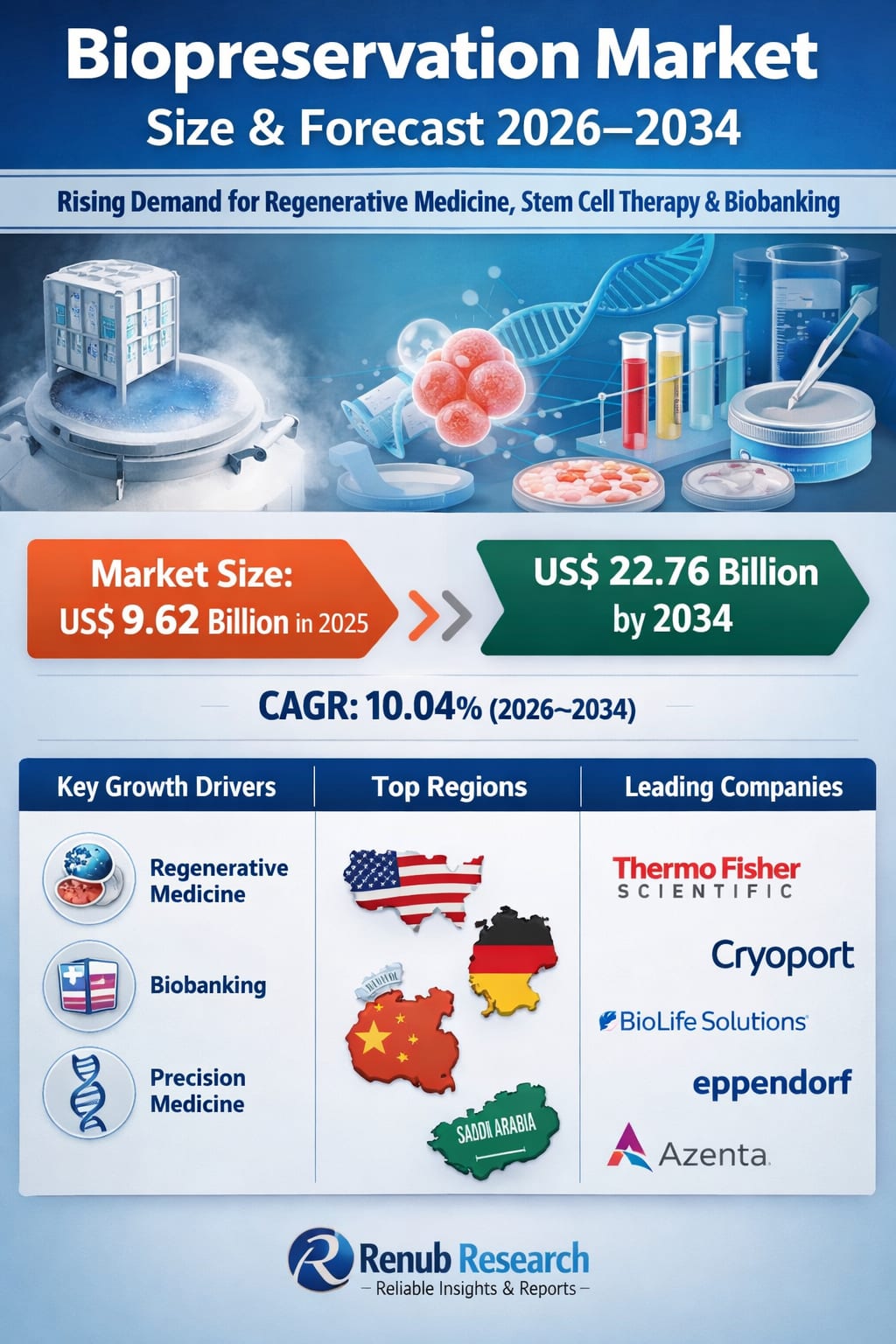
Biopreservation Market
The global Biopreservation Market is expected to reach US$ 22.76 billion by 2034, growing from US$ 9.62 billion in 2025, at a CAGR of 10.04% from 2026 to 2034. This impressive growth reflects the accelerating importance of preserving biological materials across modern healthcare, biotechnology, and pharmaceutical research.
Rising demand for regenerative medicine, stem cell therapies, and personalized medicine is significantly driving the biopreservation market forward. At the same time, the expansion of biobanking activities, increasing R&D investments in cell-based research, and growing adoption of advanced preservation technologies are strengthening the market’s foundation. As healthcare systems worldwide move toward more precise, data-driven, and biologically complex treatments, biopreservation has become a critical enabling technology.
From vaccine development and gene therapy to long-term storage of tissues, cells, and DNA, biopreservation ensures that biological materials remain viable, functional, and reliable over extended periods. This capability is no longer optional—it is essential for the future of medicine.
Biopreservation Industry Overview
Biopreservation refers to the process of maintaining the integrity, viability, and functionality of biological samples over time using controlled storage and preservation methods. These samples include cells, tissues, organs, DNA, vaccines, and other biologics used in research, diagnostics, and clinical applications. Techniques such as cryopreservation, vitrification, hypothermic storage, and freeze-drying enable long-term storage while minimizing damage to biological structures.
Biopreservation plays a central role in biobanking, regenerative medicine, cell therapy manufacturing, and drug discovery. It supports global healthcare and scientific progress by ensuring that high-quality biological materials remain usable for diagnostics, therapeutic development, and advanced research.
The market is being driven by the growing adoption of regenerative medicine, the rapid expansion of biobanking, and the increasing demand for cell- and gene-based therapies. The rising prevalence of chronic diseases has further increased the need for preserved biological samples to support diagnostics and treatment development. At the same time, advances in cryopreservation equipment, cold-chain logistics, and preservation media are improving storage efficiency, safety, and reliability.
Pharmaceutical and biotechnology companies are investing heavily in stem cells, immunotherapies, and precision medicine, all of which depend on reliable long-term sample preservation. Government funding for biomedical research and the commercialization of cell therapies continue to reinforce sustained market growth worldwide.
Growth Drivers for the Biopreservation Market
Expansion of Regenerative Medicine and Cell Therapy
The rapid growth of regenerative medicine—including stem cell therapy, gene therapy, and tissue engineering—is one of the most powerful drivers of the biopreservation market. These therapies rely on the availability of viable, high-quality cells and tissues that must be preserved under highly controlled conditions.
As the number of clinical trials and approved therapies increases, so does the demand for advanced preservation technologies and cryogenic storage solutions. Biopreservation ensures that biological materials remain intact from early research stages through clinical application and commercialization.
In addition, the global rise in chronic diseases such as cancer, diabetes, and cardiovascular disorders is increasing the need for regenerative and cell-based treatments. Government initiatives, academic research programs, and growing biotechnology investments are expanding infrastructure for cell-based science, directly increasing the demand for robust biopreservation systems.
Growth of Biobanking and Precision Medicine
Biobanking has become a cornerstone of modern biomedical research. It enables the long-term storage of biological samples used to study diseases, drug responses, and genetic variations. The expansion of population-based biobanks and personalized medicine programs has significantly fueled demand for reliable preservation technologies.
As healthcare systems shift toward individualized treatment strategies, researchers require large, diverse, and high-quality sample libraries, including blood, tissues, stem cells, and DNA. Biopreservation systems ensure sample viability and consistency, which is essential for generating accurate clinical, genomic, and epidemiological insights.
The integration of digital technologies, automated storage systems, and AI-powered data management is further enhancing biobanking efficiency and scalability. Public–private partnerships, government funding, and pharmaceutical collaborations continue to broaden the scope and sophistication of biobanking initiatives worldwide.
Technological Advancements in Preservation and Storage Solutions
Technological innovation remains a major catalyst for biopreservation market growth. Continuous improvements in cryogenic storage, preservation media, and automated monitoring systems are raising performance standards across the industry.
Advances in non-toxic cryoprotectants, vitrification techniques, and controlled-rate freezing are improving post-thaw cell viability and reducing damage during freezing and thawing processes. A notable milestone occurred in March 2025, when Teknova and Pluristyx introduced PluriFreeze™, an integrated cryopreservation system designed to improve cell-therapy viability and shorten development timelines. This solution streamlines freezing workflows and supports higher post-thaw recovery, directly benefiting cell and gene therapy manufacturing.
Meanwhile, innovations in ultra-low-temperature freezers, smart sensors, and automated storage platforms are strengthening reliability, traceability, and regulatory compliance. These advancements are critical for applications in stem cell banking, biologics manufacturing, vaccine development, and precision medicine. As demand for high-quality biological materials continues to rise, cutting-edge preservation systems are accelerating adoption across both clinical and research environments.
Challenges in the Biopreservation Market
High Cost of Equipment and Storage Infrastructure
One of the major challenges facing the biopreservation market is the high cost of advanced equipment and infrastructure. Cryogenic freezers, controlled-rate freezing systems, automated storage platforms, and cold-chain logistics require substantial upfront investment, making adoption difficult for smaller laboratories and institutions in developing regions.
In addition to capital expenditure, ongoing operational costs—including energy consumption, liquid nitrogen supply, maintenance, and compliance monitoring—add financial pressure. Regulatory validation and quality assurance processes further increase total costs. As biobanking and cell therapy manufacturing scale up, ensuring cost-efficient, scalable, and reliable preservation infrastructure remains a key challenge for broader global adoption.
Stringent Regulatory Requirements and Quality Control
Biopreservation involves storing biological materials intended for research, diagnostics, and therapeutic use, making regulatory compliance both essential and complex. Strict guidelines govern sample handling, storage conditions, cryoprotectant usage, and equipment performance.
Meeting these standards requires extensive documentation, validation protocols, and continuous quality monitoring. Any deviation can compromise sample viability, potentially leading to research inaccuracies or clinical setbacks. Moreover, differences in regulatory frameworks across countries create additional challenges for multinational biobanks and therapy developers. Maintaining consistent quality across large, distributed storage networks is increasingly demanding as sample volumes grow.
Regional Market Insights
United States Biopreservation Market
The United States represents one of the largest and most advanced biopreservation markets globally. Strong biotechnology, pharmaceutical, and healthcare sectors are driving demand for high-quality preservation technologies. Extensive investment in regenerative medicine, cell and gene therapy, and precision medicine continues to expand the need for reliable cryogenic storage and preservation solutions.
The country hosts a large number of biobanks, research institutions, and cell therapy manufacturers, supported by robust government funding and an active clinical trial environment. Advanced logistics infrastructure and well-established regulatory frameworks further strengthen the U.S. position in the global biopreservation landscape. The rising prevalence of chronic diseases adds another layer of long-term demand for preserved biological samples.
Germany Biopreservation Market
Germany is a key European market, supported by its strong biomedical research ecosystem and advanced biotechnology industry. The country invests heavily in stem cell research, personalized medicine, and biobanking initiatives, driving steady demand for high-performance preservation systems.
German research institutes and pharmaceutical companies frequently collaborate on innovative cell-based therapies, increasing the need for cryogenic equipment, preservation media, and automated storage solutions. Strict regulatory standards encourage the adoption of technologically advanced and compliant systems. Germany’s strength in engineering and precision manufacturing also supports innovation in ultra-low-temperature freezers and monitoring technologies.
China Biopreservation Market
China’s biopreservation market is expanding rapidly due to strong government investment in biotechnology, regenerative medicine, and large-scale biobanking infrastructure. Growth in stem cell research, gene therapy development, and population health studies is driving demand for advanced preservation solutions.
The rising number of biopharmaceutical companies and clinical research organizations is boosting demand for cryogenic freezers, preservation media, and automated storage platforms. Government-led precision medicine initiatives further support market growth. Although regulatory frameworks are still evolving, China is making significant progress in quality standards and research capabilities.
Saudi Arabia Biopreservation Market
Saudi Arabia’s biopreservation market is developing as part of the country’s broader healthcare and biotechnology expansion under Vision 2030. Investments in medical research, stem cell programs, and advanced diagnostics are increasing demand for preservation technologies.
The establishment of new research centers, biobanks, and academic institutions is driving adoption of cryogenic storage and preservation media. While the market is smaller compared to Western regions, infrastructure development and government support are accelerating modernization. Over time, Saudi Arabia’s focus on personalized medicine and genomic research is expected to sustain steady growth.
Recent Developments in the Biopreservation Market
May 2025: Azenta Inc. announced a strategic partnership with Form Bio to develop an integrated sequencing and AI-powered data analysis platform aimed at accelerating AAV gene therapy development.
March 2025: Johnson & Johnson revealed plans to invest more than USD 55 billion in its U.S. operations over the next four years, including new manufacturing facilities that will require advanced biopreservation technologies.
February 2025: Thermo Fisher Scientific introduced the Krios 5 Cryo-TEM, a next-generation cryo-electron microscopy platform featuring AI-driven automation to advance structural biology research.
January 2025: Azenta Inc. was selected by the UK Biocentre to implement its BioArc Ultra high-density automated storage system, expanding sample capacity by around 16 million.
June 2023: BioLife Solutions launched a new large-capacity controlled-rate freezer to support high-volume cell and gene therapy manufacturing.
January 2023: Thermo Fisher Scientific completed its acquisition of The Binding Site Group, strengthening its specialty diagnostics portfolio.
Market Segmentation
By Product:
Equipment
Media
Laboratory Information Management System (LIMS)
By Application:
Regenerative Medicine
Biobanking
Drug Discovery
By Region:
North America: United States, Canada
Europe: France, Germany, Italy, Spain, United Kingdom, Belgium, Netherlands, Turkey
Asia Pacific: China, Japan, India, South Korea, Thailand, Malaysia, Indonesia, Australia, New Zealand
Latin America: Brazil, Mexico, Argentina
Middle East & Africa: Saudi Arabia, UAE, South Africa
Key Players Analysis Includes:
Thermo Fisher Scientific Inc.
Cryport, Inc.
Eppendorf AG
BioLife Solutions Inc.
Azenta Inc.
Merck KGaA
Qiagen NV
Chart Industries, Inc.
(All analyzed from five viewpoints: Business Overview, Key Persons, Recent Developments & Strategies, SWOT Analysis, and Financial Insights.)
Final Thoughts
The biopreservation market is entering a decisive growth phase, driven by the rapid expansion of regenerative medicine, biobanking, and precision healthcare. With the market projected to grow from US$ 9.62 billion in 2025 to US$ 22.76 billion by 2034, the role of advanced preservation technologies will only become more critical in global healthcare and life sciences.
As innovation continues in cryogenics, automation, and data integration, biopreservation will remain a foundational pillar of modern medicine, enabling breakthroughs in cell therapy, gene therapy, and personalized treatment strategies. For healthcare systems, researchers, and biotechnology companies alike, the next decade will be defined by how effectively they preserve today’s biological materials to power tomorrow’s medical innovations.
About the Creator
Australia Feed Additives Market: Accelerating Growth in Animal Nutrition
In 2024, the Australia feed additives market reached a valuation of USD 1.2 billion, reflecting strong and consistent expansion in the use of nutritional, performance-enhancing, and health-support additives across livestock sectors. Looking ahead, the market is projected to grow to USD 2.0 billion by 2033, representing a compound annual growth rate (CAGR) of 5.60 percent over the 2025-2033 forecast period.
By Rashi Sharma4 days ago in Trader
In an equity offering, NioCorp raises $100 million to advance the Elk Creek Critical Minerals Project.
To advance its flagship Elk Creek Critical Minerals Project in Southeast Nebraska, NioCorp Developments Ltd., a developer of critical minerals that is listed on the U.S. stock exchange, has successfully completed a $100 million public equity offering. This latest financing marks a key step in the company’s ongoing strategy to secure funding for what it hopes will become a major domestic source of essential metals used in advanced manufacturing and clean-technology supply chains.
By Raviha Imran2 days ago in Trader


Comments
There are no comments for this story
Be the first to respond and start the conversation.