
Oleochemicals Market Size and Forecast 2026–2034: The Rise of Sustainable, Bio-Based Chemicals
Growing demand for biodegradable ingredients, expanding personal care and industrial applications, and global sustainability goals are reshaping the future of the oleochemicals industry.

Introduction: A Market Powered by Sustainability
The global chemicals industry is undergoing a structural transformation as manufacturers, regulators, and consumers increasingly prioritize sustainability, safety, and environmental responsibility. At the center of this transition is the oleochemicals market, which offers a renewable, biodegradable, and lower-toxicity alternative to traditional petroleum-based chemicals. Derived primarily from natural sources such as vegetable oils, animal fats, and in some cases algae, oleochemicals are now widely used across personal care, pharmaceuticals, food processing, plastics, lubricants, detergents, and a growing list of industrial applications.
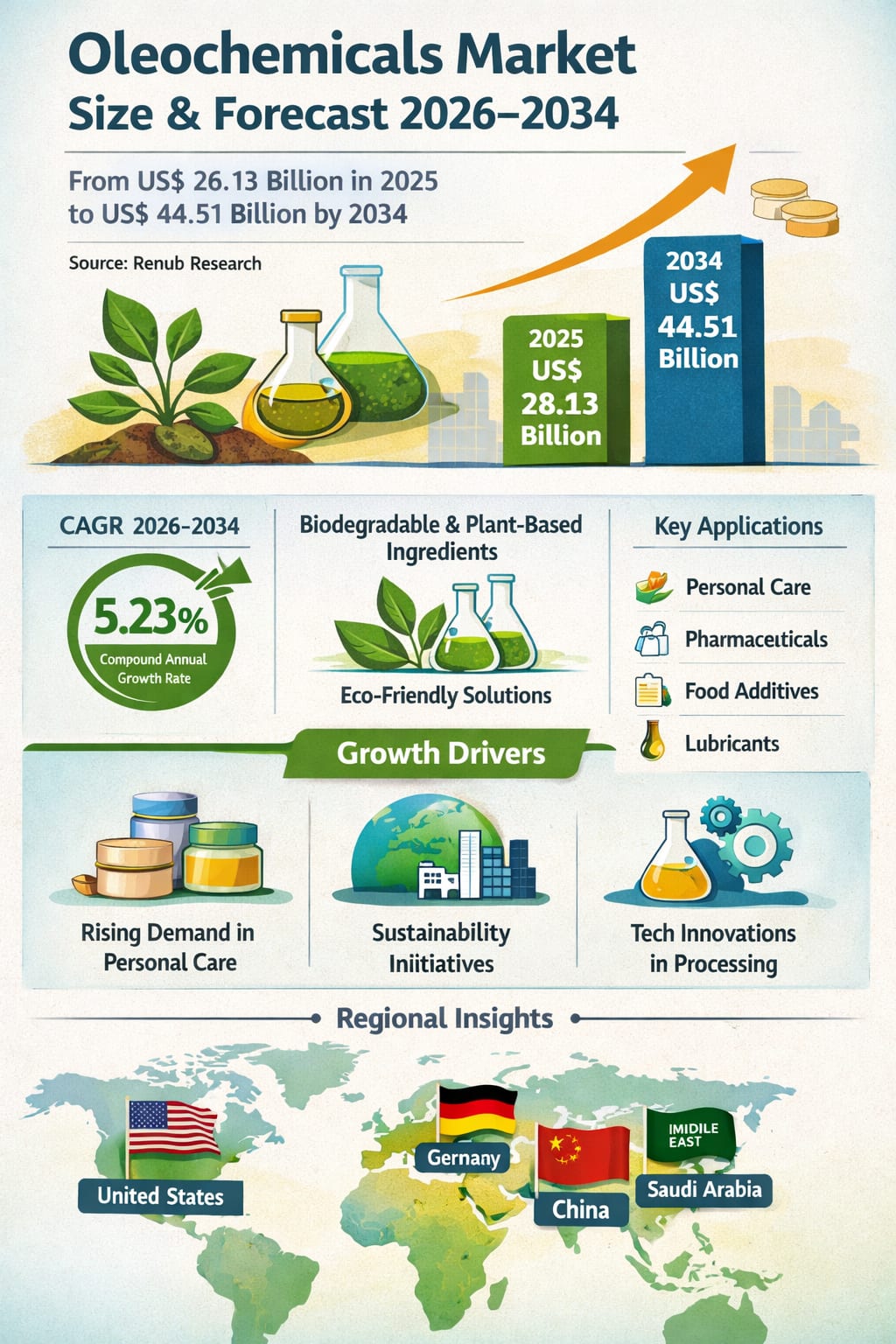
According to Renub Research, the Oleochemicals Market is expected to reach US$ 44.51 billion by 2034, up from US$ 28.13 billion in 2025, growing at a compound annual growth rate (CAGR) of 5.23% from 2026 to 2034. This steady expansion reflects not only rising demand for plant-based and biodegradable chemicals, but also the broader global push to reduce dependence on fossil fuels and lower the environmental footprint of industrial production.
Rising applications in personal care, pharmaceuticals, food additives, lubricants, and green surfactants are strengthening market momentum. At the same time, stricter environmental regulations and corporate sustainability commitments are encouraging manufacturers to shift away from petrochemical feedstocks toward renewable alternatives. Together, these factors are positioning oleochemicals as a critical pillar of the future bio-based chemicals economy.
Oleochemicals Industry Overview
Oleochemicals are chemical compounds produced from natural fats and oils, most commonly derived from palm oil, coconut oil, soybean oil, rapeseed oil, and animal fats. Key product categories include fatty acids, fatty alcohols, glycerol, esters, and soap noodles, which serve as essential building blocks for a wide range of consumer and industrial products.
What makes oleochemicals especially attractive is their biodegradability, low toxicity, and renewable origin. These characteristics align well with modern environmental standards and consumer expectations for safer, more sustainable products. In personal care, they are used to improve texture, moisturizing properties, and stability in cosmetics and toiletries. In industrial applications, they are increasingly found in biolubricants, surfactants, plastic additives, coatings, and specialty chemicals.
The market’s growth is also supported by technological advancements in biomass processing and improved oilseed cultivation, which are helping reduce costs and improve production efficiency. As a result, oleochemicals are becoming more competitive with conventional petrochemical derivatives, both in terms of performance and economics.
Market Outlook and Growth Momentum
The outlook for the oleochemicals market remains highly positive over the forecast period. Several structural trends are working in favor of long-term growth:
Consumer preference for natural and eco-friendly products is rising, especially in personal care, home care, and food-related applications.
Stricter environmental regulations across North America, Europe, and parts of Asia are pushing industries to adopt biodegradable and renewable raw materials.
Corporate sustainability commitments are accelerating the shift toward bio-based inputs across supply chains.
Innovation in processing technologies is improving yields, reducing waste, and expanding the range of high-value oleochemical derivatives.
As these trends converge, oleochemicals are moving from being niche alternatives to becoming mainstream industrial inputs. This transition is expected to keep demand strong across both developed and emerging markets through 2034.
Key Growth Drivers for the Oleochemicals Market
Increasing Applications in Personal Care
One of the strongest growth engines for the oleochemicals market is the global personal care and cosmetics industry. Consumers are increasingly seeking products that are natural, skin-friendly, and free from harsh synthetic chemicals. Oleochemicals, derived from plant and animal oils, fit perfectly into this trend.
Ingredients such as glycerin, fatty acids, and esters are widely used to enhance moisturization, spreadability, texture, and product stability in creams, lotions, shampoos, soaps, and makeup products. Their ability to act as emollients and solubilizers makes them highly valuable to cosmetic formulators.
Leading companies continue to expand their portfolios of sustainable oleochemical ingredients tailored specifically for beauty and personal care. Brands are also actively promoting the skin benefits of oleochemical-based ingredients, particularly glycerin, which is known for its strong moisturizing and barrier-protecting properties. Ongoing innovation, including the introduction of new glycerin derivatives and plant-based extracts, is further strengthening the role of oleochemicals in premium and mass-market personal care products alike.
As clean-label, vegan, and eco-conscious beauty trends continue to grow, the demand for oleochemical-based ingredients is expected to remain robust throughout the forecast period.
Advancements in Production Processes
Technological progress is playing a crucial role in improving the efficiency, scalability, and competitiveness of oleochemical production. Modern processing technologies are helping manufacturers increase yields, reduce energy consumption, minimize waste, and achieve higher purity levels, which are essential for applications in pharmaceuticals, food, and high-performance industrial uses.
New research centers, innovation hubs, and next-generation production facilities are accelerating this transformation. Equipment manufacturers are modernizing processing systems for vegetable oil refining and oleochemical conversion, while technology providers are introducing digital manufacturing and automation solutions to optimize operations.
At the same time, academic and industrial research is opening new pathways for producing oleochemicals from renewable feedstocks through biotechnology and fermentation-based methods. These approaches could further reduce dependence on traditional agricultural inputs and improve the overall sustainability profile of the industry.
Large chemical companies are also contributing by developing specialized catalysts and adsorbents designed specifically for oleochemical processing, helping improve efficiency and product quality. Collectively, these advancements are not only lowering production costs but also expanding the range of applications where oleochemicals can compete with or outperform petrochemical alternatives.
Favourable Government Initiatives
Government policy support is another important driver of market growth. Around the world, authorities are introducing stricter environmental regulations and promoting the use of renewable, low-carbon materials to reduce greenhouse gas emissions and environmental pollution.
In Europe, green chemistry and the circular economy are strongly supported through funding programs and regulatory frameworks aimed at encouraging bio-based industries. In the United States, initiatives such as the USDA BioPreferred Program promote the adoption of biobased products to reduce dependence on petroleum and support rural economies. Similar policies are being implemented across Asia and other regions to stimulate investment in sustainable materials and technologies.
In addition, several countries are working to strengthen domestic production of oilseeds and edible oils, which indirectly supports the oleochemicals industry by improving feedstock availability. For example, India’s National Mission on Edible Oils – Oil Palm (NMEO-OP) aims to increase domestic output and reduce import dependence, creating a more stable raw material base for downstream oleochemical manufacturers.
These supportive policy environments are expected to continue providing a favorable backdrop for market expansion over the coming decade.
Challenges in the Oleochemicals Market
Price Volatility of Raw Materials
Despite strong growth prospects, the oleochemicals market faces notable challenges, the most significant being raw material price volatility. Key feedstocks such as palm oil, coconut oil, soybean oil, and animal fats are heavily influenced by climatic conditions, agricultural yields, geopolitical factors, and global trade policies.
Supply disruptions, weather-related crop failures, or changes in export regulations can quickly lead to price spikes, directly impacting production costs and profit margins for manufacturers. Sustainability concerns related to palm oil cultivation, including deforestation and land-use restrictions, also add uncertainty to long-term supply stability.
This volatility makes long-term planning more difficult and can reduce the price competitiveness of oleochemicals compared to petrochemical alternatives, which often benefit from more predictable pricing structures.
Competition from Petrochemical Derivatives
Oleochemicals also continue to face strong competition from petrochemical-based products, which are often cheaper due to large-scale, well-established production infrastructure. In many applications, synthetic chemicals still dominate because of their lower cost and consistent performance.
Switching to bio-based alternatives typically requires reformulation, testing, certification, and sometimes changes in manufacturing processes, all of which involve additional costs and time. For price-sensitive industries, this can slow down the adoption of oleochemicals, even when sustainability benefits are clear.
While regulatory pressure and consumer demand are gradually shifting the balance, cost competitiveness remains a key hurdle for wider market penetration in certain sectors.
Regional Market Insights
United States Oleochemicals Market
The United States represents a mature and steadily growing market for oleochemicals. Growth is driven by strict environmental regulations, strong consumer demand for natural products, and expanding applications in personal care, food processing, and industrial lubricants. The clean-label movement and the rising popularity of plant-based ingredients support demand for biodegradable surfactants, emollients, and additives.
Advancements in biotechnology and biorefining are also encouraging domestic production of bio-based chemicals. Meanwhile, industries such as automotive and manufacturing are increasingly adopting biolubricants and green additives to meet corporate sustainability goals. Although competition from petrochemicals remains strong, supportive federal and state-level initiatives continue to encourage broader adoption of oleochemical solutions.
Germany Oleochemicals Market
Germany is one of Europe’s leading markets for oleochemicals, supported by strong environmental regulations, advanced manufacturing capabilities, and a robust personal care sector. The country’s ambitious climate and sustainability goals are pushing industries to replace petroleum-based chemicals with renewable alternatives.
German consumers show a high preference for natural and organic personal care products, boosting demand for fatty acids, esters, and glycerin. The industrial lubricants and specialty chemicals segments are also benefiting from the transition to biodegradable and high-performance bio-based formulations.
However, Germany’s dependence on imported raw materials can create supply chain vulnerabilities, particularly during periods of global agricultural volatility.
China Oleochemicals Market
China is among the fastest-growing oleochemicals markets globally, driven by rapid industrialization, expanding consumer markets, and strong government support for green chemistry. The country’s booming personal care, food processing, plastics, and home care industries are generating substantial demand for oleochemical derivatives.
China’s role as a major producer and processor of vegetable oils strengthens its manufacturing competitiveness. Increasing environmental awareness and tighter regulations on synthetic chemicals are further encouraging the use of bio-based surfactants and additives. The rise of domestic skincare brands and e-commerce-driven beauty consumption is also accelerating market growth.
At the same time, fluctuations in agricultural output and feedstock prices remain ongoing challenges for producers.
Saudi Arabia Oleochemicals Market
Saudi Arabia’s oleochemicals market is expanding as part of the country’s broader economic diversification strategy under Vision 2030. While the nation has traditionally been associated with petrochemicals, there is growing interest in sustainable and renewable chemical solutions.
Demand is rising across personal care, home care, food processing, pharmaceuticals, and industrial applications. Investments in specialty chemicals and green manufacturing, combined with strong logistics infrastructure and access to global markets, support local production and export potential.
However, the country’s reliance on imported vegetable oils exposes the market to global price fluctuations, which can affect cost stability.
Recent Developments in the Oleochemicals Market
The industry has seen several notable developments in 2024, reflecting both expansion efforts and strategic realignments:
May 2024: Corbion entered a strategic partnership with IMCD to expand the distribution of its food and beverage ingredient portfolio in Thailand, improving market reach and technical support for local manufacturers.
April 2024: Vantage Specialty Chemicals increased the production capacity of METAUPON* NMT at its Leuna facility to meet rising demand for mild, high-performance ingredients across personal care, household, and industrial applications.
March 2024: India’s Union Agriculture Minister announced a national mission to boost oilseed production, aimed at improving domestic supply and reducing import dependence.
February 2024: The Solvent Extractors' Association of India urged the government to introduce measures to protect the domestic oleochemicals sector amid rising imports.
February 2024: Bursa Malaysia Derivatives signed an agreement with the Dalian Commodity Exchange to use soybean oil futures settlement prices, supporting the launch of a new futures contract.
January 2024: Godrej Industries signed an MoU with the Gujarat government, committing USD 71.8 million over four years to expand oleochemical manufacturing capacity.
Market Segmentation Overview
By Product:
Specialty Esters
Fatty Acid Methyl Ester
Glycerol Esters
Fatty Amines
Others
By Application:
Personal Care & Cosmetics
Consumer Goods
Food Processing
Textiles
Paints & Inks
Industrial
Healthcare & Pharmaceuticals
Polymer & Plastic Additives
Others
By Region and Country:
North America: United States, Canada
Europe: France, Germany, Italy, Spain, United Kingdom, Belgium, Netherlands, Turkey
Asia Pacific: China, Japan, India, South Korea, Thailand, Malaysia, Indonesia, Australia, New Zealand
Latin America: Brazil, Mexico, Argentina
Middle East & Africa: Saudi Arabia, UAE, South Africa
Competitive Landscape and Key Players
The market features a mix of global chemical giants and specialized oleochemical producers. Key players include:
Cargill Inc.
Kuala Lumpur Kepong Berhad
BASF SE
Wilmar International Limited
Kao Corporation Plc
Evonik Industries AG
Procter & Gamble Company
Corbion N.V.
These companies are typically analyzed across five key dimensions: business overview, key persons, recent developments, SWOT analysis, and financial insights, reflecting a highly competitive and innovation-driven industry environment.
Final Thoughts: A Sustainable Future for Oleochemicals
The global oleochemicals market is clearly on a strong and sustainable growth path. With the market projected to rise from US$ 28.13 billion in 2025 to US$ 44.51 billion by 2034, the industry is benefiting from powerful long-term trends such as sustainability, regulatory support, and changing consumer preferences.
While challenges like raw material price volatility and competition from petrochemicals remain, ongoing technological innovation, supportive government policies, and expanding end-use applications are steadily strengthening the market’s foundation. As industries across the world continue to prioritize renewable and environmentally responsible solutions, oleochemicals are set to play an increasingly central role in shaping the future of the global chemicals sector.




Comments
There are no comments for this story
Be the first to respond and start the conversation.