Sports
For casual fans to hardcore athletes. All about Sports.




The Winter Olympic Games Through My Eyes: A Celebration of Ice, Snow, and Human Spirit
**The Winter Olympic Games Through My Eyes: A Celebration of Ice, Snow, and Human Spirit** The Winter Olympic Games have always felt special to me. There is something deeply inspiring about watching athletes compete in extreme cold, on ice and snow, pushing their bodies and minds to limits that most people will never experience. Unlike the Summer Games, the Winter Olympics carry a unique atmosphere, combining nature, danger, elegance, and raw power. Every edition tells stories of courage, discipline, and unforgettable moments that stay in the memory for years.
By America today a day ago in Cleats
John Jay Enters Passing Lanes in 71-62 Win
Scroll down for photos On Friday January 9, John Jay welcomed Hen Hud to the high school for some Friday night basketball and kicked off the festivities by taking an early 8-3. But the scoreboard wasn’t as telling as the style of play.
By Rich Monettia day ago in Unbalanced
Return of the Empire: The Patriots return to glory
A rebuild isn't supposed to be this quick. Once Tom Brady left the New England Patriots after the 2019 season, New England was expected to need some time to find it's way back to relevence. Sure seasons of Cam Newton, Brian Hoyer, Mac Jones and Bailey Zappe were hard to stomach.
By Ben Hercika day ago in Unbalanced
The Parade of Nations Is an Olympic Highlight. Italy Says, Let’s Have 4.. AI-Generated.
The Parade of Nations has long been one of the most beloved moments of every Olympic opening ceremony: athletes marching behind their national flags, waving to the world and officially launching the Games. For the Milan-Cortina Winter Olympics, Italy is preparing to rethink that tradition in an ambitious way. Instead of one parade, organizers plan to stage four separate parades across different host cities, reflecting the unique multi-venue structure of the 2026 Games. Italy’s proposal aims to celebrate the geographic and cultural diversity of the country while easing logistical pressures created by hosting events across northern Italy. The Winter Olympics will be split between Milan, Cortina d’Ampezzo, Verona, and Val di Fiemme, with competitions spread over hundreds of kilometers. Officials say a single massive opening ceremony no longer fits the reality of a decentralized Games. A New Format for a Classic Tradition The Parade of Nations typically takes place inside one stadium, with athletes from more than 90 countries marching together. For Milan-Cortina, organizers envision four synchronized ceremonies, each featuring a portion of the participating delegations. The events will be linked through live broadcasts and digital displays, creating what planners describe as “one opening ceremony in four chapters.” Each city will host a segment of the parade that highlights its regional identity. Milan’s ceremony is expected to focus on modern design and innovation, Cortina will emphasize alpine heritage, Verona will draw on its Roman and Renaissance history, and Val di Fiemme will showcase winter sports culture. “The Olympics are no longer confined to a single arena,” said one official involved in planning. “Our concept mirrors the reality of these Games — spread across regions but united in spirit.” Reducing Athlete Fatigue A key motivation behind the plan is athlete welfare. In past Olympics, competitors often waited hours to march in freezing temperatures or sit through lengthy ceremonies. Some athletes skipped the parade entirely to rest for upcoming events. With four ceremonies closer to competition venues, organizers hope athletes will be able to participate without long travel times or late-night schedules. Delegations will be assigned to the ceremony nearest their event locations. “This is a practical solution to a modern problem,” said a sports logistics expert in Rome. “Athletes want to experience the opening ceremony, but they also need sleep and recovery. Splitting the parade could improve both.” A Technical Challenge The proposal presents major technical hurdles. Broadcasting four ceremonies simultaneously will require precise coordination, advanced satellite links, and unified timing. Viewers worldwide must still feel they are watching one single global event rather than four separate shows. Italian broadcasters are reportedly working with international partners to ensure smooth transitions between cities, with shared music, countdowns, and symbolic moments such as the raising of the Olympic flag and the lighting of a central Olympic flame. There is also debate about whether the Olympic cauldron should be lit in one location or in four. Some designers are considering a main flame in Milan, accompanied by three smaller flames in the other cities. Mixed Reactions from the Olympic Community The International Olympic Committee (IOC) has welcomed the idea cautiously. Officials say they support innovation but stress that the unity of the Games must remain visible. “The Parade of Nations is a symbol of global togetherness,” said one IOC representative. “Any change must preserve that meaning.” Athletes have expressed curiosity and optimism. “It could be amazing to march in a place that reflects where you’re competing,” said an Italian alpine skier. “It makes the ceremony more personal.” However, some critics worry that splitting the parade may weaken the emotional impact of seeing all nations together in one space. The traditional image of a packed stadium filled with athletes from every corner of the world is considered iconic. “There is power in physical togetherness,” said a former Olympic organizer. “Four parades risk turning one powerful moment into several smaller ones.” Part of a Broader Olympic Shift The plan reflects a broader shift in how the Olympics are organized. Rising costs and public opposition to mega-stadium construction have pushed the IOC toward regional hosting models. Milan-Cortina is the first Winter Games to be formally designed as a multi-city event from the start. Italy’s experiment could shape future Olympics. If successful, it may encourage other host nations to rethink centralized ceremonies and explore regional participation. Environmental considerations also play a role. Fewer long-distance transfers of athletes and spectators could reduce the Games’ carbon footprint, a priority for both Italy and the IOC. Cultural Showcase on a National Scale Beyond logistics, Italy sees the four-parade format as a chance to present a richer cultural story. Each city will contribute music, architecture, and historical themes, offering a broader picture of Italian identity than a single stadium ceremony could provide. From Milan’s fashion and design legacy to Cortina’s alpine glamour, the ceremonies are expected to combine tradition with modern spectacle. A High-Risk, High-Reward Idea The success of the plan will depend on flawless execution. A fragmented ceremony could confuse audiences, but a well-coordinated event could redefine how the world experiences the Olympics. Italy’s gamble reflects a growing belief that the Games must evolve to remain relevant and sustainable. By transforming one of the Olympics’ most cherished traditions, the country hopes to show that unity does not require a single location — only a shared moment. Whether four parades will feel like one global celebration remains to be seen. But Italy’s bold approach has already ensured that the Parade of Nations will once again be one of the most closely watched elements of the Olympic opening ceremony.
By Fiaz Ahmed a day ago in Unbalanced
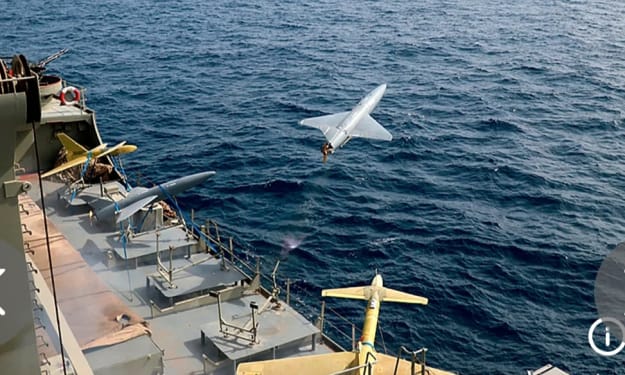
US Navy Shoots Down Iranian Drone in Arabian Sea. AI-Generated.
The United States Navy has reportedly shot down an Iranian drone flying over the Arabian Sea, marking another flashpoint in the already tense relationship between Washington and Tehran. The incident underscores the fragile security situation in one of the world’s most strategically important maritime regions, where global energy supplies, international shipping routes, and military interests intersect.
By Aarif Lashari2 days ago in Cleats