
U.S. Fuel Tanker Hit at Bahrain Port
An apparent attack on a U.S. fuel tanker at Bahrain’s main port raises fresh concerns over maritime security and the safety of military supply lines in the Gulf amid rising regional tensions.

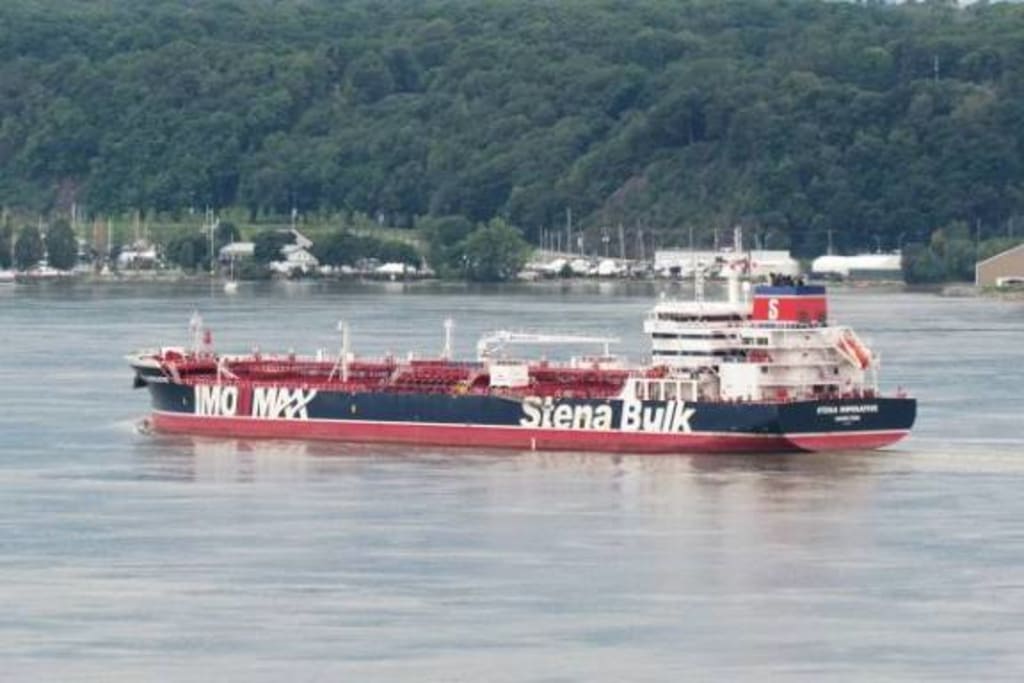
A U.S. fuel tanker operating at the strategic port of Bahrain was struck in what officials described as a targeted incident, heightening security concerns in one of the world’s most sensitive maritime regions. The tanker, supplying fuel to American and allied naval forces, was damaged while docked during routine logistical operations. No fatalities were reported, but the incident has triggered an immediate security review and raised fresh alarms over the vulnerability of critical supply lines in the Gulf.
According to preliminary statements from regional authorities, the tanker was conducting scheduled refueling support for vessels of the U.S. Navy when the impact occurred. Investigators are still determining whether the strike was caused by a drone, a small explosive device, or another form of attack. Officials have not publicly identified any group responsible, though intelligence agencies are treating the incident as deliberate rather than accidental.
Bahrain hosts the headquarters of the U.S. Fifth Fleet, making its ports and infrastructure critical hubs for operations across the Arabian Gulf, Red Sea, and Indian Ocean. Any disruption to fuel supply or port security carries major implications not only for U.S. forces but also for commercial shipping routes that pass through nearby waters.
Witnesses at the port reported a loud blast followed by smoke rising from the tanker’s midsection. Emergency crews quickly secured the area, and the vessel was evacuated for inspection and damage control. Firefighting teams managed to prevent further escalation, and port operations were temporarily suspended as a precautionary measure.
U.S. military officials confirmed that the tanker sustained structural damage but remained stable, with no major fuel leakage detected. “The safety of our personnel and the security of our facilities remain our top priority,” a Pentagon spokesperson said. “We are working closely with Bahraini authorities to determine the source and intent of this incident.”
The strike comes amid growing regional tensions linked to conflicts in the Middle East, where maritime assets have increasingly become targets of indirect warfare. Over the past year, several attacks on commercial vessels and military supply ships have been reported in nearby waters, often attributed to proxy groups seeking to pressure Western powers.
Security analysts say fuel tankers are especially attractive targets because they represent both logistical lifelines and symbolic assets. “Hitting a fuel tanker sends a message,” said one regional defense expert. “It doesn’t just threaten a ship; it challenges the operational endurance of naval forces in the region.”
Bahrain’s government issued a statement condemning the incident and reaffirming its commitment to protecting international forces and commercial shipping. The country has long positioned itself as a stable partner in regional security efforts, hosting multinational naval commands and participating in joint patrols to safeguard maritime corridors.
The economic impact of such an attack could be significant if similar incidents continue. Insurance premiums for ships operating in the Gulf have already risen due to geopolitical risks, and any perception that major ports are unsafe could disrupt trade and energy supplies. Bahrain’s port facilities play a key role in servicing not only military vessels but also regional commerce tied to oil and gas exports.
Diplomatic sources indicate that Washington is consulting with allies to strengthen port defenses and expand surveillance around key installations. Additional counter-drone systems and patrol vessels may be deployed in response to the incident, while intelligence sharing among regional partners is expected to intensify.
For the United States, the strike underscores the fragile balance between maintaining a military presence in the region and avoiding escalation. While officials have stopped short of announcing retaliatory measures, they have made clear that further attacks on U.S. assets would not be tolerated.
As investigations continue, the incident at Bahrain port serves as a stark reminder of how quickly regional instability can spill into critical infrastructure. Whether the tanker strike proves to be an isolated act or part of a wider pattern will shape security policy in the Gulf in the weeks ahead. For now, both U.S. and Bahraini authorities are focused on restoring normal operations while tightening defenses against any future threats.
About the Creator
Fiaz Ahmed
I am Fiaz Ahmed. I am a passionate writer. I love covering trending topics and breaking news. With a sharp eye for what’s happening around the world, and crafts timely and engaging stories that keep readers informed and updated.
Keep reading
More stories from Fiaz Ahmed and writers in The Swamp and other communities.
British Royal Air Force F-35 Stealth Fighter Jets Just Scored Their First-Ever Combat Kill
For the first time since entering operational service, Britain’s most advanced combat aircraft has achieved a confirmed air combat success. A Royal Air Force F-35 stealth fighter jet destroyed an incoming hostile aerial threat during a live operational mission, marking a historic milestone for the UK’s fifth-generation fighter fleet and underscoring the growing role of stealth aircraft in modern warfare. The engagement took place during a recent security operation in the Middle East, where British forces were supporting allied efforts to protect vital airspace and maritime routes. According to defence officials, the RAF F-35 detected and intercepted an unmanned aerial vehicle that posed a direct threat to coalition forces and regional infrastructure. The aircraft successfully engaged the target using precision-guided weaponry, neutralizing it before it could reach its intended objective. While the Ministry of Defence has not disclosed the exact location or the identity of the group responsible for launching the drone, officials confirmed that the operation was conducted under established rules of engagement and in close coordination with allied air and naval forces. No British or civilian casualties were reported. A Landmark Moment for the F-35 Program This incident represents the first confirmed “combat kill” by a British-operated F-35 Lightning II, a jet that has been in UK service for several years but had previously been used mainly for patrols, deterrence missions, and training exercises. The F-35’s stealth design, advanced sensors, and data-sharing capabilities make it one of the most sophisticated combat aircraft in the world. The RAF’s F-35 fleet is jointly operated with the Royal Navy as part of the UK’s Carrier Strike Group, allowing the aircraft to fly both from land bases and from aircraft carriers such as HMS Queen Elizabeth and HMS Prince of Wales. This flexibility gives Britain the ability to project air power far from home while maintaining a low radar profile. Defence analysts say the successful interception demonstrates how fifth-generation fighters are now being used not only against enemy aircraft but also against drones and cruise-missile-type threats. “This shows how modern air combat is evolving,” one expert noted. “The F-35 is as much a flying sensor and command node as it is a fighter jet.” Growing Drone Threats The incident comes amid a rise in drone and missile attacks across conflict zones in the Middle East. Armed groups increasingly rely on relatively cheap unmanned systems to challenge technologically superior militaries. These drones can be difficult to detect and intercept, especially when launched in swarms or from unexpected directions. The RAF’s F-35 used its advanced radar and electro-optical sensors to identify the target at long range. Networked with other allied systems, the jet was able to track the drone and destroy it with precision, preventing potential damage to military assets or civilian facilities. British officials emphasized that the mission highlighted the importance of continuous air patrols and rapid reaction capabilities. “Our pilots and crews performed exactly as trained,” a senior defence source said. “This proves the UK’s ability to respond decisively to emerging threats.” Political and Strategic Significance For the British government, the event is more than a tactical success; it carries political and strategic weight. Prime Minister Keir Starmer has pledged to maintain strong defence commitments and support allies in maintaining regional stability. The F-35’s first combat success reinforces arguments that investment in high-end military technology remains essential in an era of unpredictable security challenges. Opposition figures also welcomed the professionalism of the armed forces but called for transparency about the risks faced by British personnel overseas. Some lawmakers urged a broader debate in Parliament about the UK’s long-term military role in volatile regions. A Signal to Allies and Adversaries Internationally, the engagement sends a message to both allies and potential adversaries. For NATO partners, it demonstrates that the UK’s F-35 fleet is fully operational and capable of real-world combat missions. For hostile actors, it highlights the difficulty of penetrating defended airspace when confronted with stealth aircraft supported by modern surveillance and command systems. The F-35 program has often faced criticism over costs and delays, but supporters argue that moments like this validate the aircraft’s purpose. “You don’t buy these jets for parades,” said one former RAF commander. “You buy them for days when a real threat appears, and they have to perform.” Looking Ahead As investigations continue and operational details remain classified, defence officials say the RAF will study the engagement closely to refine tactics and improve counter-drone strategies. More F-35 deployments are expected as tensions persist in key regions. For now, the first combat kill by a British F-35 stands as a defining chapter in the aircraft’s service history — a sign that the UK’s stealth fighters are no longer just symbols of future warfare, but active participants in it.
By Fiaz Ahmed a day ago in The Swamp
A Gathering of Evil Bosses
“I’m the queen of chin jutting while I smooth my hair, attacking, insulting, and deflecting to protect my appointer.” “Oh, please, Blondi, my hair is curled, highlighted, and longer than yours. I feature television commercials telling immigrants that we will give them a free plane ride home, and if they voluntarily turn themselves in, they will be allowed to legally apply for re-entry. It runs everywhere, and I look good in it! You can’t compete because of your blond hair. Mine is nicer, and my lips are prettier than yours.”
By Andrea Corwin 15 days ago in The Swamp
Review of 'Man on the Run'
My wife and I saw Man on the Run, a nearly 2-hour documentary on Amazon Prime, about Wings, Paul McCartney's group that flew around the world from shortly after The Beatles broke up in early 1970 to shortly after John Lennon was murdered at the end of 1980, making a Beatles reunion forever impossible.
By Paul Levinson4 days ago in Beat




Comments
There are no comments for this story
Be the first to respond and start the conversation.