
British Royal Air Force F-35 Stealth Fighter Jets Just Scored Their First-Ever Combat Kill
The Royal Air Force confirms its F-35 stealth fighters achieved their first operational kill by intercepting and destroying a hostile drone during a live mission in the Middle East.

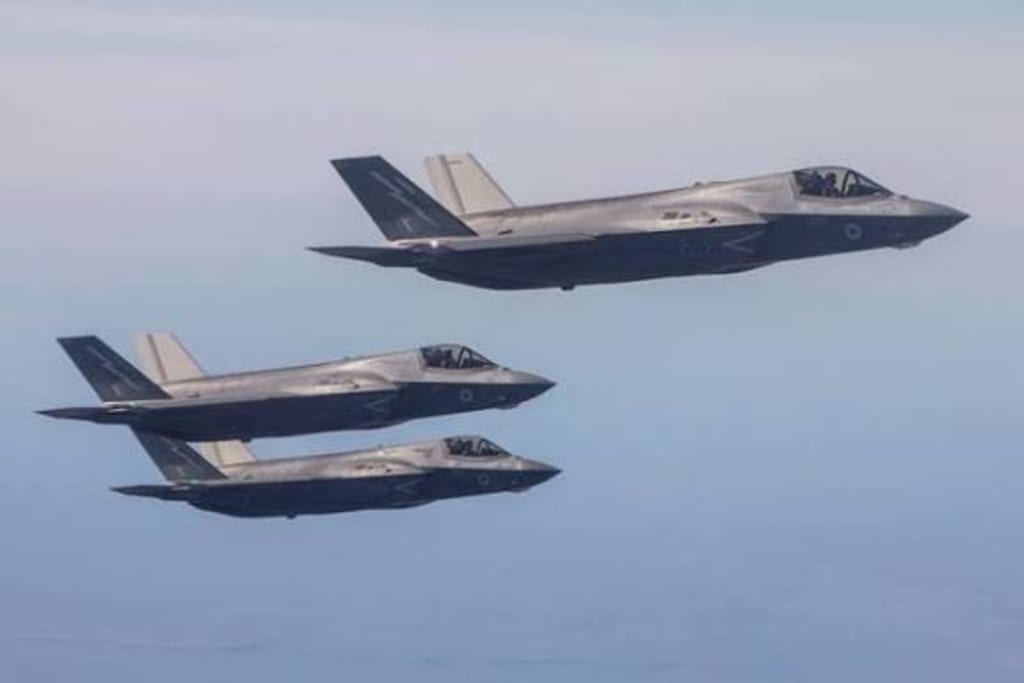
For the first time since entering operational service, Britain’s most advanced combat aircraft has achieved a confirmed air combat success. A Royal Air Force F-35 stealth fighter jet destroyed an incoming hostile aerial threat during a live operational mission, marking a historic milestone for the UK’s fifth-generation fighter fleet and underscoring the growing role of stealth aircraft in modern warfare.
The engagement took place during a recent security operation in the Middle East, where British forces were supporting allied efforts to protect vital airspace and maritime routes. According to defence officials, the RAF F-35 detected and intercepted an unmanned aerial vehicle that posed a direct threat to coalition forces and regional infrastructure. The aircraft successfully engaged the target using precision-guided weaponry, neutralizing it before it could reach its intended objective.
While the Ministry of Defence has not disclosed the exact location or the identity of the group responsible for launching the drone, officials confirmed that the operation was conducted under established rules of engagement and in close coordination with allied air and naval forces. No British or civilian casualties were reported.
A Landmark Moment for the F-35 Program
This incident represents the first confirmed “combat kill” by a British-operated F-35 Lightning II, a jet that has been in UK service for several years but had previously been used mainly for patrols, deterrence missions, and training exercises. The F-35’s stealth design, advanced sensors, and data-sharing capabilities make it one of the most sophisticated combat aircraft in the world.
The RAF’s F-35 fleet is jointly operated with the Royal Navy as part of the UK’s Carrier Strike Group, allowing the aircraft to fly both from land bases and from aircraft carriers such as HMS Queen Elizabeth and HMS Prince of Wales. This flexibility gives Britain the ability to project air power far from home while maintaining a low radar profile.
Defence analysts say the successful interception demonstrates how fifth-generation fighters are now being used not only against enemy aircraft but also against drones and cruise-missile-type threats. “This shows how modern air combat is evolving,” one expert noted. “The F-35 is as much a flying sensor and command node as it is a fighter jet.”
Growing Drone Threats
The incident comes amid a rise in drone and missile attacks across conflict zones in the Middle East. Armed groups increasingly rely on relatively cheap unmanned systems to challenge technologically superior militaries. These drones can be difficult to detect and intercept, especially when launched in swarms or from unexpected directions.
The RAF’s F-35 used its advanced radar and electro-optical sensors to identify the target at long range. Networked with other allied systems, the jet was able to track the drone and destroy it with precision, preventing potential damage to military assets or civilian facilities.
British officials emphasized that the mission highlighted the importance of continuous air patrols and rapid reaction capabilities. “Our pilots and crews performed exactly as trained,” a senior defence source said. “This proves the UK’s ability to respond decisively to emerging threats.”
Political and Strategic Significance
For the British government, the event is more than a tactical success; it carries political and strategic weight. Prime Minister Keir Starmer has pledged to maintain strong defence commitments and support allies in maintaining regional stability. The F-35’s first combat success reinforces arguments that investment in high-end military technology remains essential in an era of unpredictable security challenges.
Opposition figures also welcomed the professionalism of the armed forces but called for transparency about the risks faced by British personnel overseas. Some lawmakers urged a broader debate in Parliament about the UK’s long-term military role in volatile regions.
A Signal to Allies and Adversaries
Internationally, the engagement sends a message to both allies and potential adversaries. For NATO partners, it demonstrates that the UK’s F-35 fleet is fully operational and capable of real-world combat missions. For hostile actors, it highlights the difficulty of penetrating defended airspace when confronted with stealth aircraft supported by modern surveillance and command systems.
The F-35 program has often faced criticism over costs and delays, but supporters argue that moments like this validate the aircraft’s purpose. “You don’t buy these jets for parades,” said one former RAF commander. “You buy them for days when a real threat appears, and they have to perform.”
Looking Ahead
As investigations continue and operational details remain classified, defence officials say the RAF will study the engagement closely to refine tactics and improve counter-drone strategies. More F-35 deployments are expected as tensions persist in key regions.
For now, the first combat kill by a British F-35 stands as a defining chapter in the aircraft’s service history — a sign that the UK’s stealth fighters are no longer just symbols of future warfare, but active participants in it.
About the Creator
Fiaz Ahmed
I am Fiaz Ahmed. I am a passionate writer. I love covering trending topics and breaking news. With a sharp eye for what’s happening around the world, and crafts timely and engaging stories that keep readers informed and updated.
Keep reading
More stories from Fiaz Ahmed and writers in The Swamp and other communities.
How Escalating Iran Conflict Is Driving Up Oil and Gas Prices – A Visual Guide
The ongoing conflict in the Middle East, particularly the confrontation between Iran and a coalition involving the United States and Israel, has triggered significant disruptions in global energy markets. As geopolitical tensions rise, investors, traders, and policymakers are watching closely how supply fears are translating into rising oil and gas prices around the world. 1. Conflict and Supply Risk: The Strait of Hormuz Effect A central factor in today’s energy price surge is the Strait of Hormuz, a narrow waterway between Iran and Oman that serves as a key global oil and gas transit point. Roughly one-fifth of the world’s crude oil and a significant share of liquefied natural gas (LNG) flows through this chokepoint. Even the fear of disruption in this region can add a “risk premium” to energy prices, pushing benchmarks higher. In recent weeks, attacks on regional infrastructure — including reported assaults on vessels and energy facilities — have led many shippers to avoid the strait, effectively slowing or halting cargo movements. Insurers have raised premiums, and some carriers have suspended routes through the region, adding to concerns about the reliability of oil and gas supplies. 2. Immediate Market Reaction: Crude Oil Spikes The most visible impact of the conflict has been sharp increases in crude oil prices. Benchmark prices such as Brent crude and West Texas Intermediate (WTI) have climbed dramatically as traders price in potential supply disruptions and geopolitical risk. Markets often react not only to actual outages but also to anticipation of disruption, which itself can drive prices upward. In early March 2026, Brent crude surged more than 10% to around $80 per barrel, while U.S. crude benchmarks also posted significant gains. Analysts warn that if the conflict continues to extend or if the Strait of Hormuz is effectively blocked, crude prices could climb to $90–$100 per barrel or higher. 3. Gas Prices and Regional Impacts Oil is not the only commodity affected. Natural gas markets have experienced volatility as well. In Europe, gas prices spiked as shipments were disrupted and critical LNG production — particularly from major exporters such as Qatar — was temporarily halted amid safety concerns. A meeting of EU gas supply officials was convened to assess these risks. These price increases have real implications for households and industries. Higher oil and gas costs feed into broader inflationary pressures, raising the cost of transportation, electricity, and manufacturing — and ultimately affecting consumer prices across multiple sectors. 4. Global Economic Consequences Rising energy prices put upward pressure on global inflation. Economists note that even a sustained rise of $10 per barrel in oil prices can have a meaningful impact on inflation and economic growth, particularly in energy-importing regions. Central banks — already grappling with post-pandemic recovery and other macroeconomic challenges — face difficult choices as energy cost pressures persist. Energy price surges also influence currency markets, consumer sentiment, and investment decisions. In regions highly dependent on imported fuel, the cost increases can erode purchasing power and slow economic activity. In contrast, major oil exporters could benefit from higher price environments, boosting revenue even if production levels remain steady. 5. Long-Term Considerations and Market Volatility While short-term price spikes garner headlines, longer-term trends and geopolitical risks shape the broader energy outlook. Prolonged conflict could lead to sustained disruption of Middle Eastern supply chains, tightening global markets further. Energy analysts emphasize that modern commodity markets are sensitive not only to physical shortages but also to perceived risk. Even if the conflict de-escalates, the memory of disrupted supplies may keep a risk premium embedded in prices, meaning that oil and gas costs could remain elevated compared with pre-conflict levels. This volatility underscores the interconnected nature of global energy markets and how geopolitical flashpoints can ripple through economies worldwide. Conclusion The escalating Iran conflict has driven up oil and gas prices through a combination of supply disruption risk, fear of chokepoint closures, and shifts in market sentiment. While the supply fundamentals may technically remain intact, geopolitical uncertainty alone can send energy prices sharply higher. As traders and policymakers navigate this environment, consumers around the world may feel the effects at the pump, in home heating costs, and across broader economic activity.
By Fiaz Ahmed 2 days ago in The Swamp
A Gathering of Evil Bosses
“I’m the queen of chin jutting while I smooth my hair, attacking, insulting, and deflecting to protect my appointer.” “Oh, please, Blondi, my hair is curled, highlighted, and longer than yours. I feature television commercials telling immigrants that we will give them a free plane ride home, and if they voluntarily turn themselves in, they will be allowed to legally apply for re-entry. It runs everywhere, and I look good in it! You can’t compete because of your blond hair. Mine is nicer, and my lips are prettier than yours.”
By Andrea Corwin 15 days ago in The Swamp




Comments
There are no comments for this story
Be the first to respond and start the conversation.