
Trump, the Court, and 2026
The Year the Supreme Court Stops Being Background Noise

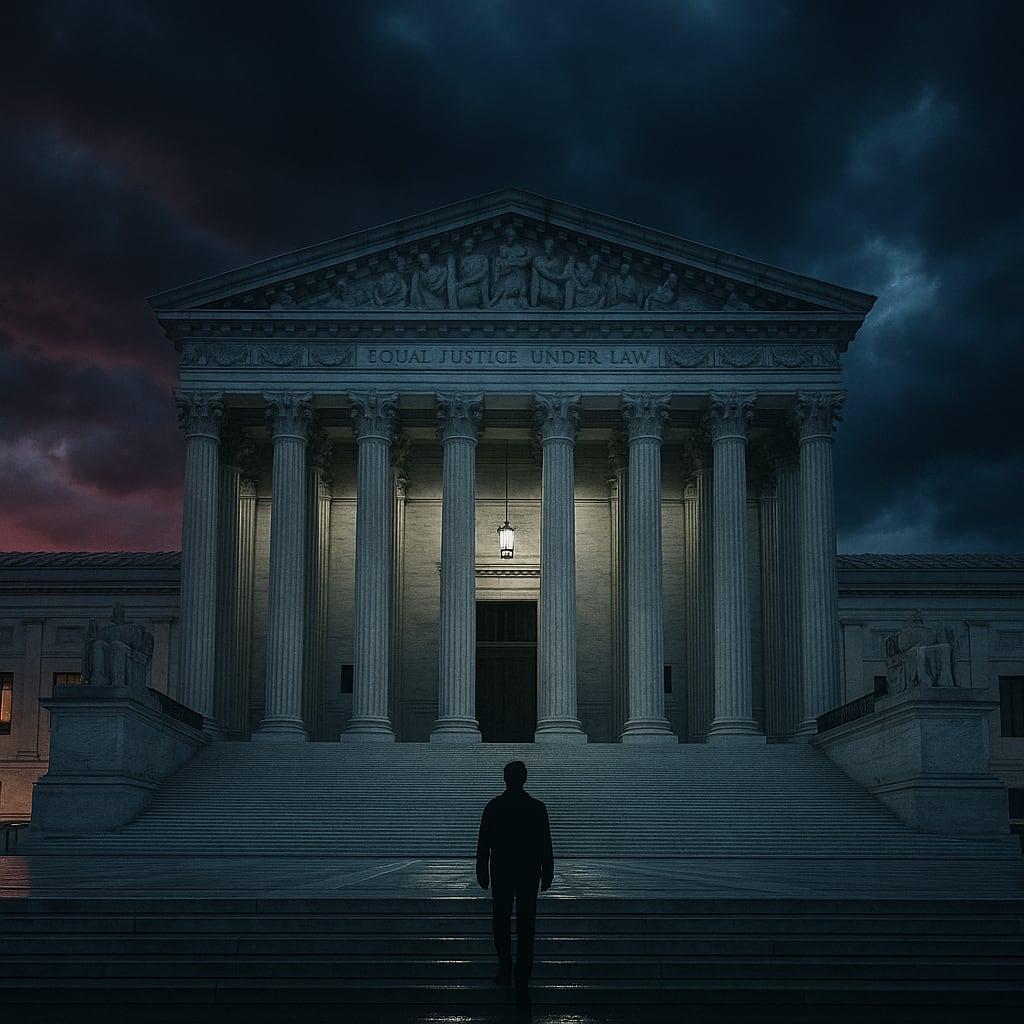
How quiet retirements, secret hospital stays, and one election no one’s ready for could blow up the balance of power—and the culture war—by 2026
I remember the exact moment the Supreme Court stopped feeling like marble statues and started feeling like the floor moving under my feet.
It was the morning Roe fell. I wasn’t watching C‑SPAN, I was in line for coffee. A notification lit up my phone, and suddenly the line got weirdly quiet as other screens lit up too. A woman near me muttered, “They actually did it,” the way you’d say, “The bridge actually collapsed.”
Since then, every time I see that row of black robes, I don’t think of “checks and balances” or neat civics diagrams.
I think: eight unelected people I’ll never meet can wake up one day, vote, and change how I live, where I can move, what health care I can get, who my friends can marry, what my kids are taught, and whether my vote actually counts.
And now people are quietly starting to say the thing out loud:
2026 might be the year all of that gets scrambled—again.
Not in a headline-grabbing way like Roe. In a slow, unnerving way: hospitalizations, whispered retirement rumors, declining approval ratings, and a possible second Trump term all converging on one fragile institution that was never built for this level of pressure.
We’re closer to a Supreme Court earthquake than most people realize.
And if Trump is back in the White House by then, the aftershocks could define the rest of our lives.
The Court Suddenly Got Old, Loud, and Political—and It’s Not Aging Gracefully
When I was a kid, Supreme Court justices were like weather patterns. You knew they existed. You just accepted whatever rolled in.
Now we know their group chats. Their spouses have texted with coup-plotters. Their real estate deals, billionaire vacations, and private jets are public scandals. Their decisions look less like “neutral interpretation” and more like someone’s decades-long wish list finally got stapled to the Constitution.
And underneath all of that drama is something oddly simple: age.
By 2026, here’s what the bench looks like in human terms, not just ideological labels:
Clarence Thomas will be pushing 78
Samuel Alito will be in his mid‑70s
Sonia Sotomayor will be in her early‑70s and has had public health concerns
John Roberts will be in his early‑70s, still trying to convince people the Court isn’t broken
Elena Kagan, Neil Gorsuch, Brett Kavanaugh, and Amy Coney Barrett will be in their 50s and 60s
Ketanji Brown Jackson will still be the “newest,” in her mid‑50s
Those ages aren’t neutral. Federal judges tend to stay until something forces them to leave—illness, exhaustion, or the realization that if they wait too long, a president they hate might replace them.
The polite phrase is “strategic retirement.” The human version is:
“How much longer can I hang on before the wrong person is sitting in the Oval Office when I finally can’t?”
By 2026, we’ll be deep into that danger zone.
If a Democrat wins in 2024 and holds the Senate, the pressure shifts to:
Sotomayor: Should she retire while she still can guarantee a liberal replacement?
Maybe even Kagan: Does she wait and gamble, or step down while a friendly president is in office?
If Trump wins in 2024 and Republicans control the Senate, the shadow game flips:
Thomas and Alito: Do they feel liberated to retire, knowing they’ll be replaced by younger, equally (or more) conservative justices who will lock in their legacy?
The marble building stays the same. The public tours continue. The audio transcripts get posted.
But one health scare or one quiet resignation letter in 2026 could tilt the Court for a generation.
2026 Under Trump: What a “Locked-In” Supreme Court Would Actually Mean
The phrase “Trump consolidating power over the Supreme Court” sounds abstract until you translate it into what would actually be on the chopping block.
Not just “abortion” and “guns” and the usual cable news buzzwords—whole categories of modern life that seem settled right now but really aren’t.
By 2026, with a second Trump term underway and possibly one or two additional Supreme Court appointments, you’re looking at something like a 7–2 or 6–3 locked-in conservative majority that isn’t nervous about public backlash anymore.
The docket could become a conveyor belt of once-fringe legal ideas suddenly turning into binding law.
Here’s what that might look like in actual life:
Abortion bans without escape hatches
Today, some blue states are sanctuary states for abortion. A more aggressive Court—especially one shaped even further by Trump—could entertain lawsuits arguing that states can’t shield providers from other states’ criminal laws. The idea sounds wild until you remember: Roe seemed unkillable too.
The end of “we’re a pro‑choice company”
If corporations can claim religious rights, a Trump-shaped Court could go further and say: employers don’t have to cover certain medications, procedures, or benefits they object to—abortion, IVF, certain forms of birth control. It’s not just about choice. It’s about having to disclose your medical life to your boss to get basic care.
A new era of “religious freedom” that looks a lot like discrimination
It’s not hard to imagine this Court greenlighting a wider range of “conscience exemptions.” Not just a baker and a cake, but schools, hospitals, therapists, adoption agencies, and even government contractors being allowed to deny services to LGBTQ+ people while calling it “freedom.”
Voting rights in a slow bleed
Gutting the Voting Rights Act was just the opening act. A fortified conservative Court in 2026 could sign off on more aggressive partisan gerrymanders, stricter voting regulations, and creative new theories about how state legislatures can ignore popular vote outcomes. That’s not tinfoil-hat territory; we already watched the Court flirt with the “independent state legislature” theory.
Presidential power re‑written around one man
Imagine Trump back in the Oval Office while the Court hears cases about presidential immunity, control over federal agencies, and what counts as “abuse of power.” Decisions made in that moment won’t just protect Trump’s past—they’d define what any future president can get away with.
If you’re waiting for some institutional grown-up to step in and say “this goes too far,” you might be waiting on a Court that no longer sees itself that way.
2026 could be the year that shift hardens into reality.
The Culture War Won’t Just Be Online—It’ll Be Written Into Constitutional Law
We love to pretend our culture wars are mostly noise: comment sections, viral clips, shouty school board meetings.
But by 2026, under a Trump-influenced Court, those culture war battles are likely to show up in Supreme Court case names that kids will read in textbooks one day.
Think about these flashpoints:
Trans rights and gender‑affirming care
Multiple states have already passed or proposed bans on gender‑affirming care for trans youth, and some are eyeing adult restrictions. Court challenges are moving upward. A Trump-loaded Supreme Court could decide, once and for all, whether states can flat‑out criminalize doctors and parents for following mainstream medical guidelines.
Book bans and curriculum wars
Right now, school boards are yanking books and rewriting history curriculums. It feels local. But when the lawsuits hit, and the issue becomes: “Do parents have a constitutional right to shield kids from certain ideas?” that’s when the Supreme Court steps in. A 2026 Court could either put a brake on this or greenlight a wave of sanitized public education.
Campus speech and protest crackdowns
You can feel something building on college campuses: protests, counter‑protests, demands to discipline students and professors. State legislatures are writing bills to clamp down. With a conservative Court, “free speech” could be redefined to favor certain viewpoints and punish others, especially when the politics align with the majority.
Tech platforms and “censorship”
A Court more aligned with Trump is more likely to entertain the idea that big platforms can’t “discriminate” against conservative viewpoints—even if those platforms are private companies. Suddenly, content moderation looks less like policy and more like a constitutional minefield.
The culture war stops being a food fight and starts being a catalog of constitutional decisions that will outlast all of us.
And the thing about Supreme Court decisions is: even when they get overturned decades later, the people who lived through the old rules don’t get that time back.
The Strange Fragility of One Human Body in a Country of 330 Million
I keep coming back to this uncomfortable fact: everything I’m talking about—these giant cultural and legal battles—might hinge on one person’s health in 2026.
Not in an abstract “health and longevity” think-piece way. In the brutally specific math of Supreme Court demographics.
A justice gets pneumonia. A quiet cancer diagnosis becomes less quiet. A car accident no one saw coming.
We pretend our system is this sturdy machine of checks and balances. But the entire balance of power over abortion, voting rights, climate policy, immigration, LGBTQ+ rights, and presidential accountability can swing because one 70‑something judge has a bad year.
Think about the emotional whiplash of Ruth Bader Ginsburg’s death.
Liberals went from “she’s indestructible” memes and “Notorious RBG” mugs to watching her seat immediately filled by Amy Coney Barrett in a rush that felt almost indecent. Both of those responses—hero worship and sheer panic—were fueled by the same truth: we had built our sense of justice on the spine of one aging woman.
We’re doing it again, on both sides of the aisle.
And 2026 is exactly when the bill might come due.
Conservatives quietly watch Thomas and Alito and wonder if they’ll hang on. Progressives quietly watch Sotomayor and think the same thing. The justices know it. You can feel it in how carefully some of them talk about retirement—or avoid talking about it completely.
We don’t have a clean, dignified, depoliticized way for these transitions to happen anymore. Every vacancy is loaded with existential fear.
And if Trump is in power when the next vacancy opens, that fear becomes a weapon.
What Regular People Get Wrong About the Supreme Court (And What We Can Actually Do)
Most people I talk to fall into one of two camps when it comes to the Court:
“They’re all the same, they’re just politicians in robes.”
“There’s nothing we can do; they’re there for life.”
Both of those reactions are understandable. Neither is fully true.
The Court isn’t just nine mini‑presidents. They’re bound by precedent, institutional norms, and the need to write decisions that lower courts can actually follow. But they’re also not neutral oracles floating above politics.
They read the news. They know which party appointed them. They feel the public anger or approval.
And despite the “lifetime appointment” myth, there are levers—messy ones, but real.
By 2026, if Trump is in office and the Court is drifting into open culture‑war partisanship, here are the pressure points that still exist:
Elections still matter, even for a “fixed” Court
Congress can shape the Court’s jurisdiction, set ethical rules, and write clearer statutes that leave less room for extreme reinterpretations. That only happens if voters treat down-ballot races like they’re as urgent as the presidency.
Public legitimacy is a real constraint
The Court doesn’t have an army. It’s powerful because people, including lower courts and government officials, obey it. When approval tanks and open defiance grows, even conservative justices start worrying about “institutional legitimacy.” That’s not just a phrase—they’ve used it in their opinions.
Court reform goes from fringe to mainstream under enough pressure
Term limits. Mandatory retirement ages. Ethics codes with actual teeth. Expanding the number of justices. These ideas used to sound radical. But Gallup numbers creeping down and headline after headline about conflict-of-interest scandals are changing that.
No, you and I can’t walk into that marble building and swap out a justice.
But we’re not as powerless as we’re trained to feel.
Every time we act like the Court is some mystical fate machine, we make it easier for whoever’s in power—Trump included—to treat it like a private weapon.
Living With a Future You Can’t Fully Predict
Sometimes, late at night, I scroll back through old headlines like a time capsule.
“Trump’s candidacy is a joke.”
“Roe is settled law.”
“No way the Court would actually do that.”
There’s a particular kind of arrogance buried in those statements: the assumption that the future will be reasonable, that certain lines won’t be crossed because…well, they just won’t.
2026 is another one of those foggy years in front of us.
We don’t know if Trump will be back in office. We don’t know who will still be sitting on the Supreme Court. We don’t know which case name high school juniors in 2045 will underline in their civics textbooks and think, “Wow, that must have been intense to live through.”
But we do know this much:
The fight over the Court isn’t just about judges and legal doctrines and arcane phrases. It’s about who gets to draw the boundaries of “normal life” in this country.
Can a teenager in Texas get birth control without fear?
Can a Black voter in Georgia cast a ballot without waiting in line for five hours?
Can a trans kid in Florida see a doctor without their parents risking a felony charge?
Can any of us trust that the next election will actually stick?
Those aren’t abstract questions. They’re the quiet, ordinary details of whether a person feels safe enough to build a life.
Trump’s potential grip on the Court in 2026 is terrifying to some and thrilling to others. But either way, it forces a more honest acknowledgment:
We built a system where nine aging humans can tilt the horizon for 330 million people—and then we acted surprised when politics found its way into their veins.
Maybe the real question isn’t just what Trump and the Court might do in 2026.
It’s what we’re willing to admit about the fragility of the rules we live under—and whether we care enough to push for something less dependent on the health report of one justice, or the mood of one president, or the outcome of one election that half the country will swear was rigged no matter what happens.
The Court feels untouchable until suddenly it’s not.
And when the next notification lights up your phone—some breaking case, some unexpected retirement, some rushed confirmation—you’ll know this wasn’t random.
It was a story we all watched unfolding in slow motion.
The only real choice is whether we keep pretending we’re just spectators.
About the Creator
abualyaanart
I write thoughtful, experience-driven stories about technology, digital life, and how modern tools quietly shape the way we think, work, and live.
I believe good technology should support life
Abualyaanart
Keep reading
More stories from abualyaanart and writers in The Swamp and other communities.
A Gathering of Evil Bosses
“I’m the queen of chin jutting while I smooth my hair, attacking, insulting, and deflecting to protect my appointer.” “Oh, please, Blondi, my hair is curled, highlighted, and longer than yours. I feature television commercials telling immigrants that we will give them a free plane ride home, and if they voluntarily turn themselves in, they will be allowed to legally apply for re-entry. It runs everywhere, and I look good in it! You can’t compete because of your blond hair. Mine is nicer, and my lips are prettier than yours.”
By Andrea Corwin 9 days ago in The Swamp
The photos that have kept former Prince Andrew in the public eye
For more than a decade, a small number of photographs have played an outsized role in shaping public perceptions of Prince Andrew, the former senior royal whose reputation has been defined less by official duties and more by images that refuse to fade from public memory. These photographs, repeatedly reproduced in newspapers, documentaries, and court filings, have become enduring symbols of controversy surrounding the Duke of York and his place within the British monarchy. The most widely circulated image shows Prince Andrew smiling with his arm around a young woman later identified as Virginia Giuffre, inside a London townhouse belonging to the late financier Jeffrey Epstein’s associate. The photograph, taken in 2001, has been central to allegations that later led to a civil lawsuit in the United States. Though Prince Andrew has consistently denied wrongdoing, the image has come to represent the broader questions surrounding his judgment and associations. An Image That Defined a Crisis When the photograph resurfaced during renewed scrutiny of Epstein’s network, it quickly became a focal point of global media attention. Legal analysts noted that while a single image cannot determine guilt or innocence, it carried powerful symbolic weight. The picture appeared repeatedly in court documents and news coverage, reinforcing public narratives that placed Prince Andrew close to individuals accused of serious crimes. The Duke’s 2019 televised interview, intended to address the controversy, only intensified attention on the photograph. Viewers watched as he attempted to explain the circumstances under which the image was taken, offering accounts that were widely criticized for lacking clarity and empathy. Rather than dispelling doubts, the interview amplified the photograph’s impact and kept it firmly in the public consciousness. The Role of Visual Evidence In an era of digital media, photographs have a unique ability to shape opinion more powerfully than statements or legal arguments. For Prince Andrew, these images became shorthand for controversy, repeated across social platforms and news outlets whenever his name appeared. Another set of images showing the Duke attending social gatherings with Epstein further fueled criticism. Though such photographs did not prove any criminal behavior, they raised uncomfortable questions about proximity to individuals later exposed as serial abusers. Critics argued that the repeated publication of these photos demonstrated a failure of judgment unbefitting a senior royal. Supporters, however, maintain that the images have been stripped of context and used to construct a narrative that ignores the presumption of innocence. They point out that social photographs are common in elite circles and that no criminal charges were ever brought against Prince Andrew. Impact on the Monarchy The persistence of these images has had consequences not only for Prince Andrew but also for the wider British royal family. Palace officials moved swiftly in recent years to distance the institution from the controversy. The Duke was stripped of his military titles and royal patronages, and he withdrew from public duties. Royal historians say the power of the photographs lies in their simplicity. “Images are easier to remember than legal nuance,” one analyst observed. “For many members of the public, those photos became the entire story.” The monarchy’s efforts to project stability and continuity were complicated by the continued circulation of these visuals. Each reappearance reignited debate over accountability, privilege, and the limits of royal protection. A Legal Resolution, but Not a Visual One The civil lawsuit brought by Giuffre was settled in 2022 without any admission of liability by Prince Andrew. While the legal case ended, the images did not disappear. They remain embedded in documentaries, archives, and online discussions, ensuring that the controversy continues to define how he is remembered. Media experts say this reflects a broader truth about modern scandal: resolution in court does not always translate into resolution in the public imagination. Once an image becomes iconic, it often outlives the facts that surround it. Looking Ahead Today, Prince Andrew lives largely outside the public spotlight, making rare appearances and avoiding formal royal duties. Yet the photographs that once dominated headlines continue to resurface whenever discussions of royal accountability arise. They stand as a reminder of how visual moments can eclipse decades of service and reshape public identity. For Prince Andrew, these images have become inseparable from his legacy — not as a royal figure of influence, but as a symbol of how association and appearance can transform a life of privilege into one defined by controversy.
By Fiaz Ahmed 7 days ago in The Swamp



Comments
There are no comments for this story
Be the first to respond and start the conversation.