
Trump’s 2026 Legal Strategy Explained
The Quiet Plan Behind the Public Chaos

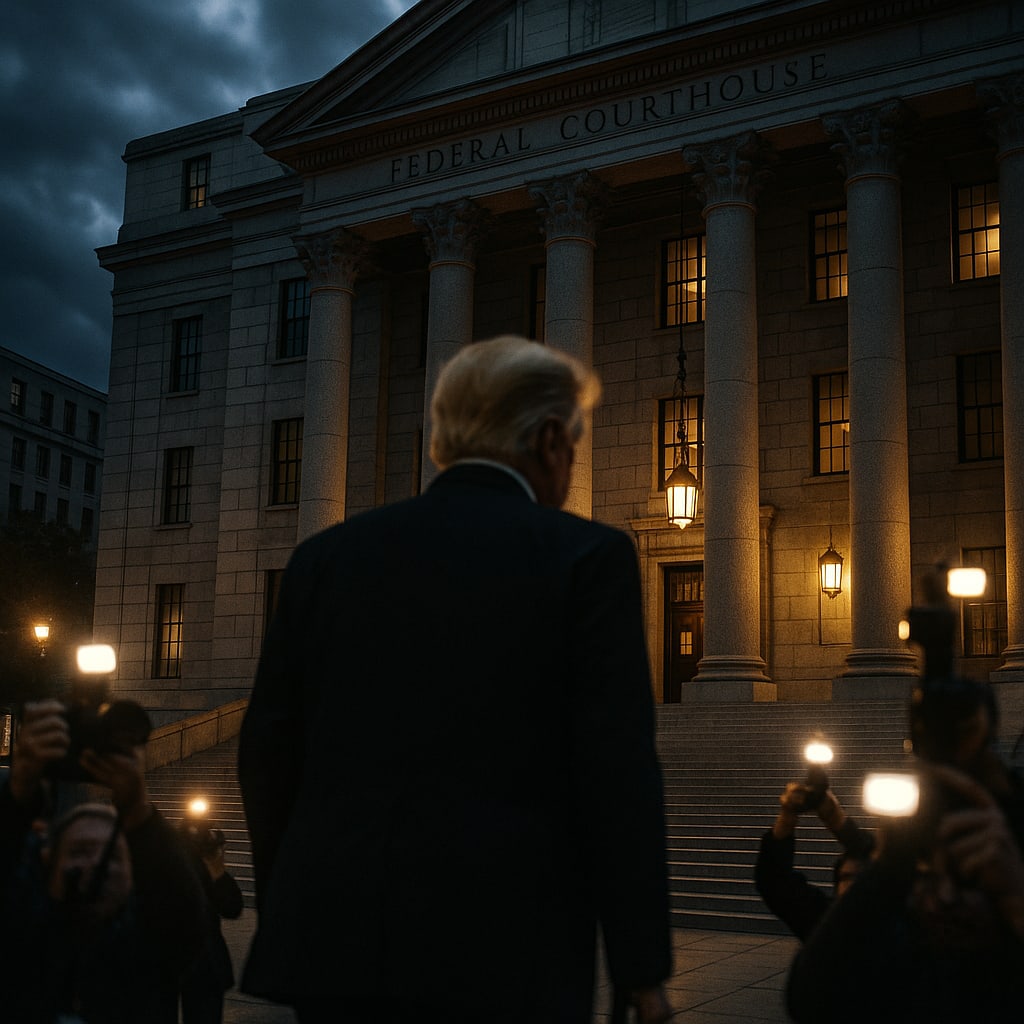
What Trump Is Really Playing For, and Why 2026 Might Be the Year Everything Snaps
The night I realized Trump’s legal cases weren’t just “a lot of noise” was the night I tried to map them out on a whiteboard.
Four markers, three colors, one headache.
Criminal charges in one column, civil cases in another, Supreme Court petitions scribbled in the margins, and, right in the middle, a single word in all caps: TIME.
Because underneath all the shouting, fundraising emails, and cable news panels, Trump’s 2026 legal strategy isn’t actually about winning every case.
It’s about surviving long enough, politically and personally, that the calendar starts doing more work for him than any lawyer ever could.
And that strategy—if it holds—turns 2026 into the year where court deadlines, appeals, and politics collide in a way this country has never seen before.
The Central Strategy: Delay, Defer, and Outlast
When you zoom out from the noise, Trump’s legal approach has three pillars:
Delay everything he can.
Defer what he can’t delay.
Outlast everyone else—judges, prosecutors, witnesses, even public outrage.
He’s not the first powerful person to turn the legal system into a maze, but he might be the first to do it while openly running for office and fundraising off every twist.
Appeals aren’t just legal tools for him; they’re political oxygen.
Every motion to dismiss doubles as another “witch hunt” email.
Every procedural fight becomes content.
And every delay pushes decisions into a later season—especially into 2026, when several of his cases may hit critical stages at the same time.
The point isn’t to win every case.
It’s to make them all feel endless, confusing, and exhausting enough that a lot of people just… emotionally check out.
That vacuum is part of the strategy too.
The Four Legal Fronts Shaping 2026
By 2026, Trump is likely to be fighting on four main legal fronts, each moving at its own speed, with its own risks.
And they all feed into each other.
1. Criminal Cases and the Risk of Actual Prison Time
Even if you can’t recite the case names anymore (who can?), the stakes are simple: some of these charges carry very real prison time.
The big buckets:
Federal election-related charges (January 6th, attempts to overturn the 2020 election).
State-level election interference cases (like Georgia).
Cases tied to classified documents and obstruction.
A lot of the “why hasn’t anything happened yet?” frustration comes down to this: criminal cases move slowly even when they’re not historic, politically explosive, and drenched in appeals.
By 2026, several things may be true at the same time:
Some trials may have finally concluded.
Some convictions (if they happened earlier) may be on appeal.
New appeals may be working their way up toward higher courts.
If you’re Trump, 2026 is the year where you’re trying to turn any guilty verdict into a long, drawn-out appeal, and any unresolved case into another “see, they still haven’t proven anything” talking point.
The legal fight becomes a story of martyrdom.
Every hearing is cast as persecution.
Every ruling is either proof of “vindication” or fuel for more outrage.
2. Civil Cases and the Money Problem
People tend to mentally rank civil cases as “less serious” than criminal ones, but that’s not how Trump’s world works.
Civil judgments hit money, reputation, and business operations—things he uses as proof of success.
By 2026, several things could be happening at once:
Large judgments from earlier civil cases might be in active collection, with ongoing battles over assets, bonds, and appeals.
New defamation or civil suits tied to political statements or media appearances might be working their way through the courts.
State-level regulators could still be circling around his businesses, licensing, or real estate.
The strategy here is similar: appeal, stall, negotiate, and keep as much wealth intact as possible.
But there’s a twist.
Every time he portrays himself as financially targeted—“They’re trying to take my buildings, my name, my family’s livelihood”—it feeds his political narrative.
The courtroom and the campaign rally become two stages of the same show.
3. Supreme Court Gambits and the Search for a Lifeline
If 2024 and 2025 are the years of trial courts and appellate courts, 2026 is when you really start to see which issues might land in front of the Supreme Court.
Think about the kinds of questions that could rise that high:
How far does presidential immunity really go?
Can certain actions taken in office be prosecuted years later?
Where exactly is the line between political speech and criminal incitement?
Trump’s legal team will try to push as many core questions as possible toward the Supreme Court because:
It buys time. Petitions, briefs, and scheduling alone stretch months into years.
It creates a “big stakes” narrative: this isn’t just about him, it’s about the presidency, the Constitution, the future.
It opens the door for partial wins—narrow rulings that shave off some charges or limit certain evidence, even if they don’t wipe out entire cases.
From the outside, Supreme Court petitions sound dry.
On the inside, they’re the Hail Mary passes of Trump’s legal strategy.
Not guaranteed.
Always dramatic.
And timed in a way that can easily bleed into the 2026 political calendar.
4. State vs. Federal: A Jurisdictional Tug-of-War
One of the most underappreciated pieces of Trump’s legal puzzle is this:
Federal and state cases don’t care about each other’s timing.
A state judge in Georgia isn’t going to stop just because a federal issue is heating up somewhere else.
That creates two realities:
Trump’s lawyers are constantly arguing for delays, citing conflicts with other trials, elections, or appeals.
Judges are increasingly being asked to decide how much weight to give the political calendar versus the idea that the law should run on its own track.
By 2026, we’re likely to see more judges simply draw a line and say: no more special treatment, this case moves forward.
That’s when the façade of control starts to crack.
When not all delays work.
When the system finally asserts itself, even imperfectly.
The Clock: How the Legal Timeline Collides With 2026 Politics
Here’s the part that keeps me up more than any single case: the timing.
Not the specific dates—those slip like sand through fingers—but the shape of the calendar.
Imagine 2026 as a crowded hallway.
Appeals, resentencing, status conferences, enforcement of prior judgments, new Supreme Court petitions, and the constant drumbeat of “what does this mean for the next election?”
Even if you strip out the drama, a few collision points are easy to imagine:
Appeals of earlier criminal convictions might finally be argued or decided.
Civil judgments could move from “on paper” to “in your bank accounts and properties.”
New indictments in still-open investigations are less likely but not impossible.
By 2026, we might not be asking “Will Trump be charged?” as much as “What do we do with a political figure who is already convicted, appealing, and still commanding a massive base of support?”
That question is bigger than Trump.
It’s about what kind of country we are when law and politics refuse to run on separate tracks.
Why Delay Is the Strategy—and the Vulnerability
Delaying everything has one huge advantage for Trump: he’s very good at thriving in chaos.
The more confusing the landscape, the easier it is to claim victimhood and frame everything as “they’re scared of me, that’s why they won’t leave me alone.”
But delay has a cost.
And that cost is uncertainty.
Legal uncertainty. Political uncertainty. Emotional uncertainty.
For him, but also for the rest of us.
Delay means:
Witnesses’ memories fade, but so does public patience.
Cases become harder to try cleanly, but easier to question publicly.
The country lives in a constant state of “still not resolved,” like a never-ending season finale with no actual finale.
In 2026, that uncertainty hits a wall.
Judges, juries, voters, donors—eventually, someone has to act, even in incomplete clarity.
Delay works… until it doesn’t.
And when it stops working, it tends to fail loudly.
The Political Fallout: Rally Fuel, Fatigue, and the Breaking Point
When I talk to people about Trump’s legal troubles, the responses usually fall into three camps:
“They’re finally going to get him this time.”
“This is all political theater; none of it matters.”
“I’m exhausted. Just tell me when something actually changes.”
Trump’s 2026 legal strategy thrives on the existence of all three.
The true believers see every case as proof of persecution.
The skeptics see the delays as proof the system is pointless.
The exhausted majority tunes out just enough for the most invested voices to dominate.
This is the emotional landscape going into 2026:
Rally fuel for his base. Every court date becomes a campaign day. Every filing becomes content for social media and fundraising.
Fatigue for everyone else. People who might care about the rule of law simply get worn down. “I can’t follow it all,” quietly turns into, “I don’t want to.”
A potential breaking point. At some stage, whether it’s a sentencing, a Supreme Court decision, or a major asset seizure, the legal system will do something that cannot be spun away as “nothing.”
2026 could be the year when those three audiences finally collide.
When the courts force a reality that politics can’t fully spin.
What that looks like in the streets, in Congress, online—nobody truly knows.
Anyone who claims to know is selling certainty in a moment that doesn’t have any.
What People Keep Getting Wrong About Trump’s Legal Fight
The biggest misconception I see is this idea that there will be one big, clean moment.
One verdict. One ruling. One headline.
A single “gotcha” or a single total exoneration.
That’s not how this is going.
It’s more like a series of waves:
A conviction in one jurisdiction followed by an appeal.
A partial legal win in another case that gets framed as a total victory.
A civil judgment that doesn’t send anyone to prison but quietly reshapes a financial empire.
None of these waves, on their own, feel decisive enough to satisfy people who want a clear ending.
But together, they change the shoreline.
Trump’s 2026 legal strategy is built on the hope that the public will never notice the shoreline changing because they’re focused on each wave in isolation.
The real story is cumulative.
Not cinematic.
Not tidy.
Just relentless.
How This Affects Us, Even If You’re Sick of Hearing His Name
I’m not writing this because I enjoy thinking about Trump’s court dates.
Honestly, I’m tired too.
But I’ve noticed something unsettling in myself and in people I talk to: the temptation to disengage.
To shrug and say, “They’ll never actually do anything,” or “It’s all corrupt anyway,” or “Wake me when it’s over.”
This is where his strategy spills over into our lives.
If enough of us decide the legal system is either hopelessly broken or just entertainment, then whatever actually happens in 2026—whether it’s a conviction upheld, a major ruling narrowed, or a financial empire dented—lands in a vacuum.
No shared reality.
Only separate narratives.
And that’s the real political fallout: not just what happens to Trump, but what happens to our collective ability to agree that something actually did happen.
The Takeaway: 2026 Won’t Give Us Closure, But It Will Tell Us Who We Are
If you’re waiting for a neat ending, 2026 will probably disappoint you.
There won’t be a single gavel bang that wraps this era in a bow.
Trump’s legal strategy is built on exactly that: scattering the story across so many cases, courts, and timelines that “the ending” is really just a slow, messy accumulation of consequences.
But that doesn’t mean 2026 is just another blur of headlines.
It’s the year we start to see the gap between what the law can do and what we, as a country, are willing to accept.
Will we treat court decisions as reality, even when they’re politically inconvenient?
Will we let exhaustion become indifference?
Will we allow delay to feel like immunity?
Trump’s lawyers will keep filing motions.
Prosecutors will keep pushing cases.
Judges will keep issuing orders.
But what 2026 ultimately reveals isn’t just how his legal strategy plays out.
It’s whether the rest of us still believe that the law is something more than a backdrop to someone’s campaign rally.
And that answer won’t come from a verdict.
It’ll come from how we react to it.
About the Creator
abualyaanart
I write thoughtful, experience-driven stories about technology, digital life, and how modern tools quietly shape the way we think, work, and live.
I believe good technology should support life
Abualyaanart
Keep reading
More stories from abualyaanart and writers in The Swamp and other communities.
The Saddest Thing - The Billionaires Who Rule America Aren't Even Enjoying Themselves
This single post says more about our ruling class than a thousand policy papers. The saddest thing about today's system is that the men robbing the rest of us - sabotaging our economic prospects, our pensions, our access to affordable healthcare - are not even happy.
By Scott Christenson🌴20 days ago in The Swamp




Comments
There are no comments for this story
Be the first to respond and start the conversation.