
The Future of Military Power Is Space Power
Is Space power is Military Power

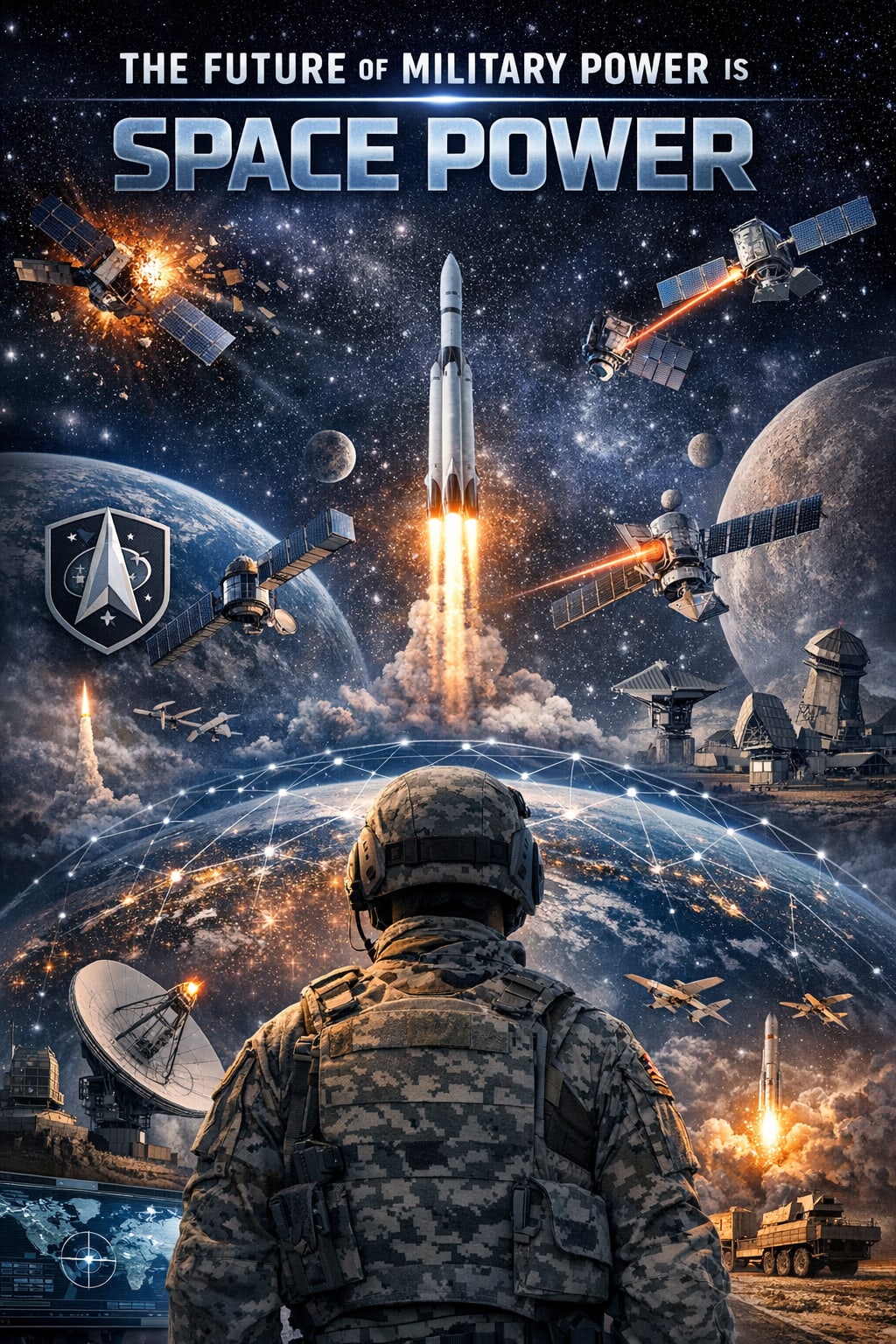
For centuries, military dominance has been defined by control over land and sea. In the 20th century, air power reshaped warfare, and nuclear weapons introduced a new level of deterrence. In the 21st century, however, a new domain is emerging as the decisive frontier of strategic competition: space. The future of military power is increasingly tied to space power—control of satellites, orbital infrastructure, and the technologies that operate beyond Earth’s atmosphere.
The Strategic Shift to Space
Space is no longer a distant scientific frontier reserved for exploration. It is a critical military domain. Modern armed forces rely heavily on satellites for communication, navigation, intelligence gathering, missile warning, and surveillance. Without space-based systems, many advanced militaries would struggle to function effectively.
For example, the United States formalized the importance of space by creating the United States Space Force in 2019. This move recognized space as a warfighting domain alongside land, sea, air, and cyberspace. Similarly, China has integrated space capabilities within the People's Liberation Army Strategic Support Force, highlighting its focus on space-based intelligence and electronic warfare. Russia, too, has emphasized space operations through its Aerospace Forces.
The militarization of space is not theoretical—it is already underway.
Satellites: The Backbone of Modern Warfare
Satellites are the invisible infrastructure of modern military operations. They provide GPS navigation for precision-guided missiles, enable encrypted global communications, and monitor enemy movements from orbit. Systems such as the Global Positioning System (GPS) allow forces to coordinate with extraordinary accuracy.
If these satellites were disabled or destroyed, military operations would face severe disruption. Precision strikes could miss their targets. Communication between units could collapse. Intelligence gathering could be severely degraded. In short, control of space assets is now as vital as control of airfields or naval ports.
This dependency creates vulnerability. Anti-satellite (ASAT) weapons—tested by countries like the United States, China, and Russia—demonstrate the capacity to target and destroy satellites. The ability to deny an adversary access to space may become a key strategy in future conflicts.
Space as a Domain of Deterrence
Just as nuclear weapons reshaped global strategy during the Cold War, space capabilities are redefining deterrence. A country with advanced satellite systems and missile-warning networks has a significant strategic advantage. Early-warning satellites can detect missile launches within seconds, giving leaders critical time to respond.
Moreover, space-based surveillance enables global transparency. Satellites can track troop movements, naval deployments, and weapons tests. This transparency can reduce the risk of surprise attacks but also intensifies competition, as nations seek to protect or conceal their capabilities.
Space is becoming both a shield and a sword—offering defensive advantages while enabling offensive strategies.
The Rise of Commercial Space Power
Another important dimension of space power is the growing role of private companies. Firms like SpaceX have revolutionized satellite deployment and reduced launch costs. Commercial satellite constellations now provide internet services, high-resolution imagery, and real-time communications.
In recent conflicts, commercial satellite networks have demonstrated their military value. Rapid deployment of satellite internet can maintain communications even when ground infrastructure is destroyed. This blurring of civilian and military space assets complicates warfare, as targeting commercial satellites could have global economic and political consequences.
The partnership between governments and private space companies suggests that future military power will depend not only on national defense budgets but also on technological innovation and commercial space infrastructure.
The Risk of Weaponizing Space
While space power offers strategic advantages, it also raises serious concerns. The deployment of weapons in orbit—whether kinetic interceptors, directed-energy weapons, or cyber tools—could destabilize global security. Debris from destroyed satellites can remain in orbit for years, threatening other spacecraft and potentially creating a cascading effect known as the Kessler Syndrome.
International treaties like the Outer Space Treaty of 1967 aim to prevent the placement of weapons of mass destruction in space. However, these agreements were drafted in a different era and may not fully address modern technologies such as anti-satellite missiles or cyber warfare targeting satellites.
Without updated norms and agreements, the competition for space dominance could escalate into a dangerous arms race.
Space and the Future Battlefield
Looking ahead, space will likely shape the character of warfare in several ways:
Integrated Multi-Domain Operations – Future conflicts will integrate land, sea, air, cyber, and space operations seamlessly.
Autonomous Systems – Drones and robotic platforms will rely on space-based navigation and data links.
Missile Defense – Space-based sensors may enhance missile interception systems.
Cyber-Space Convergence – Cyber attacks targeting satellites could become a primary tactic in disabling adversary capabilities.
The military power of tomorrow will depend less on the number of tanks or ships and more on orbital assets, data networks, and technological superiority in space systems.
Conclusion
The future of military power is undeniably linked to space power. As nations expand their capabilities beyond Earth, space is transforming from a peaceful scientific arena into a strategic high ground. Control over satellites, orbital infrastructure, and space-based technologies will determine not only military success but also global influence.
The challenge for the international community is clear: harness the strategic benefits of space while preventing it from becoming the next battlefield. Whether space becomes a domain of cooperation or confrontation will shape the balance of power for decades to come.
About the Creator
Ibrahim Shah
I am an Assistant Professor with a strong commitment to teaching,and academic service. My work focuses on fostering critical thinking, encouraging interdisciplinary learning, and supporting student development.
Keep reading
More stories from Ibrahim Shah and writers in The Swamp and other communities.
America’s labor Shortages Impact On Economy
The U.S. economy in 2026 is navigating a peculiar set of crosscurrents. On one hand, job growth has slowed, yet labor markets in key sectors remain stubbornly tight. On the other, a policy of intensified immigration enforcement 2026 is underway, aiming to significantly reduce the nation’s undocumented population. This creates a direct collision between immigration policy and economic necessity, forcing a difficult national conversation about trade-offs that are often overshadowed by political rhetoric.
By Ibrahim Shah a day ago in The Swamp
A Gathering of Evil Bosses
“I’m the queen of chin jutting while I smooth my hair, attacking, insulting, and deflecting to protect my appointer.” “Oh, please, Blondi, my hair is curled, highlighted, and longer than yours. I feature television commercials telling immigrants that we will give them a free plane ride home, and if they voluntarily turn themselves in, they will be allowed to legally apply for re-entry. It runs everywhere, and I look good in it! You can’t compete because of your blond hair. Mine is nicer, and my lips are prettier than yours.”
By Andrea Corwin 5 days ago in The Swamp
Vatican Says It Will Not Participate in Trump’s ‘Board of Peace’
The Holy See has made its position clear: it will not take part in former U.S. President Donald Trump’s newly announced initiative known as the “Board of Peace.” The decision, quietly confirmed by Vatican officials, has sparked discussion across diplomatic and religious circles about the limits of political partnerships and the role of faith institutions in global conflict resolution.
By Sajida Sikandar5 days ago in The Swamp




Comments
There are no comments for this story
Be the first to respond and start the conversation.