politics
Politics does not dictate our collective cultural mindset as much as it simply reflects it; We've got to look in the mirror sometimes, and we've got one.
Ukraine Just BUILT Something So INSANE It Could END the War. AI-Generated.
The war in Ukraine has entered a new technological phase — and it may change modern warfare forever. While much of the world focuses on traditional missiles, tanks, and artillery, Ukraine has quietly built something revolutionary: a new class of drone-missile hybrid weapons that could dramatically shift the balance of power.
By Adil Ali Khan2 days ago in The Swamp
Aircraft Involved in ‘Serious Incident’ Cleared to Return to Service After Safety Review. AI-Generated.
An aircraft involved in a “serious incident” while operating for Aurigny Air Services is set to return to commercial flights after undergoing thorough safety checks and evaluations. The move reassures passengers and industry watchers that the airline and aviation authorities prioritize safety, even when dealing with minor or unexplained anomalies.
By Ayesha Lashari2 days ago in The Swamp
Ukraine War Briefing: Rubio to Meet Zelenskyy in Munich as Russian Strikes Leave Thousands Without Power. AI-Generated.
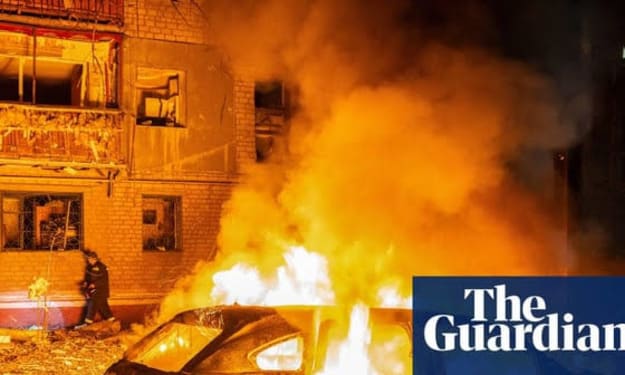
High-level diplomacy and renewed battlefield violence converge as Western leaders gather in Europe and Ukraine struggles with the humanitarian impact of fresh missile and drone attacks. Senior U.S. Senator Marco Rubio is set to meet Ukrainian President Volodymyr Zelenskyy on the sidelines of the annual Munich Security Conference, a key diplomatic gathering taking place in Munich. The meeting comes as Russia launched another wave of missile and drone strikes across Ukraine, damaging energy infrastructure and leaving tens of thousands of civilians without electricity in the middle of winter. Ukrainian officials said overnight attacks targeted power substations and transmission facilities in several regions, including central and eastern parts of the country. Emergency crews worked through the night to restore electricity, but authorities warned that full repairs could take days. Local governments urged residents to conserve energy and prepare for further outages as temperatures dropped. “This is a deliberate attempt to make civilian life unbearable,” Zelenskyy said in his nightly address, accusing Moscow of continuing its strategy of striking non-military targets to weaken morale. He added that Ukraine’s air defenses had intercepted many of the incoming missiles and drones but that the scale of the assault showed Russia’s continued capacity to mount large operations despite heavy battlefield losses. The attacks come as Ukraine faces increasing pressure on multiple fronts. Fighting remains intense in eastern regions where Russian forces have tried to gain ground through incremental advances. Military analysts say Moscow appears focused on wearing down Ukrainian defenses through constant bombardment while exploiting shortages of ammunition and air defense systems. Against this backdrop, Rubio’s planned meeting with Zelenskyy carries symbolic and political weight. The senator, a senior member of the U.S. Senate Foreign Relations Committee, is expected to discuss military aid, sanctions enforcement, and long-term security commitments. U.S. officials say the talks will also focus on sustaining international support at a time when political debates in Washington and some European capitals have slowed the delivery of weapons and financial assistance. The Munich Security Conference has traditionally served as a forum for Western allies to coordinate responses to global crises. This year, Ukraine is expected to dominate discussions as leaders debate how to counter Russia’s ongoing offensive and whether additional air defense systems and long-range weapons should be provided. Zelenskyy is also scheduled to meet several European leaders during the event. Diplomats familiar with the agenda say Rubio will emphasize the importance of unity among NATO partners and stress that Ukraine’s survival is tied directly to broader European security. “If aggression is rewarded, it sends a dangerous message to every authoritarian regime watching,” one U.S. official said. Meanwhile, the humanitarian toll of the latest Russian strikes is becoming clearer. Regional authorities reported that hospitals and schools were forced to switch to backup generators after power was cut. In some towns, public transport was suspended and water supplies were disrupted because pumping stations lost electricity. Aid organizations warned that vulnerable populations, including the elderly and displaced families, face heightened risks as winter conditions persist. Energy experts note that Russia’s renewed focus on infrastructure suggests a return to tactics seen earlier in the war, when systematic attacks on the power grid caused widespread blackouts. Ukraine has since strengthened its defenses around key facilities, but the sheer number of drones and missiles used in recent barrages makes it difficult to protect every site. International reaction to the strikes was swift. European Union officials condemned the attacks and reiterated calls for more advanced air defense equipment to be sent to Ukraine. Germany’s defense minister said the strikes demonstrated the urgency of accelerating weapons deliveries and improving coordination among allies. Russia, for its part, defended the attacks as legitimate military actions, claiming they were aimed at Ukraine’s “military-industrial complex.” The Kremlin has repeatedly denied targeting civilians, despite evidence from Ukrainian authorities and independent observers showing residential neighborhoods and civilian infrastructure among the damaged sites. The diplomatic dimension of the war is also evolving. Some Western officials hope that increased pressure on Russia through sanctions and military setbacks could eventually bring Moscow to the negotiating table. However, there are few signs of imminent talks, and both sides remain publicly committed to their military objectives. Zelenskyy is expected to use his meetings in Munich to press for additional Patriot missile systems and other advanced air defenses, arguing that protecting cities and energy infrastructure is as crucial as supporting troops on the front lines. He is also likely to warn that any slowdown in aid would embolden Russia to intensify its attacks. As Rubio prepares for his talks, political debates in the United States continue over the scale and duration of support for Ukraine. While bipartisan backing remains strong in many areas, divisions have emerged over budget priorities and foreign commitments. The senator has previously argued that helping Ukraine resist Russia is in America’s strategic interest, preventing a wider conflict in Europe. For ordinary Ukrainians, the immediate concern is survival through another round of blackouts and air raid sirens. In cities hit by the latest strikes, residents lined up for bottled water and used candles and portable heaters to cope with the outages. “We are used to this now, but it never gets easier,” said one woman in a central Ukrainian town affected by the attacks. The coming days will test both Ukraine’s resilience and the resolve of its allies. With Russian strikes continuing and diplomatic efforts intensifying, the meeting between Rubio and Zelenskyy in Munich underscores how closely military developments and international politics are now intertwined. As winter drags on, Ukraine’s battle is being fought not only on the front lines but also in conference halls where decisions about aid, security, and the future of the conflict are being shaped.
By Fiaz Ahmed 2 days ago in The Swamp
Japan Says It Seized Chinese Vessel Amid Rising Tensions With Beijing. AI-Generated.
Authorities say the ship entered Japanese territorial waters without permission, prompting diplomatic protests and renewed friction between Japan and China. Japan announced on Thursday that it had seized a Chinese vessel after it allegedly entered restricted waters near one of Japan’s southwestern island chains, a move that has intensified already strained relations with Beijing. The incident comes at a time of heightened regional tension over maritime boundaries and military activity in the East China Sea. According to officials from the Japanese Coast Guard, the Chinese-flagged ship was intercepted after failing to respond to repeated radio warnings. Authorities said the vessel was operating in waters Japan considers part of its territorial sea and appeared to be conducting activities that violated Japanese maritime regulations. The crew was detained for questioning, and the ship was escorted to a nearby port for inspection. In a statement, Japan’s Ministry of Foreign Affairs said the seizure was carried out “in accordance with domestic law” and stressed that the action was not intended to escalate tensions. “Japan will continue to firmly protect its sovereignty while acting calmly and responsibly,” the ministry said. It added that diplomatic channels had been used to inform Chinese authorities about the incident. China reacted sharply, demanding the immediate release of the vessel and its crew. A spokesperson for China’s foreign ministry accused Japan of “provocative actions” and claimed the ship had been operating in what Beijing considers Chinese waters. “Japan’s conduct is a violation of international norms and undermines regional stability,” the spokesperson said, warning of “necessary countermeasures” if the situation is not resolved quickly. The seizure highlights the fragile state of relations between the two Asian powers, which have been locked in disputes over a group of uninhabited islands known in Japan as the Senkaku and in China as the Diaoyu. Although the current incident did not occur directly at the islands, analysts say it reflects the broader contest for influence and control in strategically important sea lanes. Security experts note that confrontations at sea have become more frequent in recent years. Japan has repeatedly reported incursions by Chinese government and fishing vessels near its claimed waters, while China has accused Japan of strengthening its military posture in the region with support from the United States. These competing narratives have fueled mistrust and increased the risk of miscalculation. Local Japanese officials said the seized vessel appeared to be a modified fishing ship equipped with advanced navigation tools, raising questions about its purpose. While authorities stopped short of labeling it a surveillance ship, they confirmed that investigators were examining its equipment and cargo. “We are determining whether this was a simple navigation error or a deliberate violation,” one official said on condition of anonymity. The incident also drew international attention, with the United States urging both sides to avoid actions that could further destabilize the region. A U.S. State Department official said Washington was monitoring the situation closely and encouraged Japan and China to resolve the matter peacefully through dialogue. “Freedom of navigation and adherence to international law are essential to maintaining stability in the Indo-Pacific,” the official added. For Japan, the episode comes amid a broader shift in defense policy. The government has recently announced plans to expand military spending and strengthen coastal surveillance in response to what it describes as growing security challenges from neighboring states. Supporters argue these measures are necessary to deter aggression, while critics warn they could provoke stronger reactions from China and North Korea. In China, state media framed the seizure as part of what it called a pattern of “harassment” by Japan. Commentaries emphasized historical grievances and accused Tokyo of aligning too closely with Western powers. The nationalist tone in Chinese coverage suggests the issue could resonate with domestic audiences, making compromise more politically sensitive for Chinese leaders. Diplomatic efforts were underway late Thursday to de-escalate the situation. Japanese officials said they were in contact with their Chinese counterparts to clarify the circumstances and seek a resolution. Sources familiar with the talks indicated that Japan might consider releasing the vessel once the investigation is complete, provided no serious violations are found. Despite these assurances, analysts caution that incidents like this can quickly spiral into larger crises if handled poorly. “Maritime encounters are inherently risky because they involve armed forces and national pride,” said a regional security analyst in Tokyo. “Even a small misunderstanding can be amplified by political pressure on both sides.” The seizure of the Chinese vessel underscores the delicate balance in East Asian geopolitics, where economic interdependence coexists with deep strategic rivalry. Japan and China are major trading partners, but their relationship remains vulnerable to flare-ups over territory, history, and military posture. As the investigation continues, both governments face a test of diplomacy. Whether the incident becomes another chapter in a long list of confrontations or a moment of restraint will depend on how leaders in Tokyo and Beijing choose to respond in the coming days. For now, the episode serves as a reminder of how quickly tensions can rise in contested waters—and how fragile peace can be in one of the world’s most critical regions.
By Fiaz Ahmed 2 days ago in The Swamp
FTC Warns Apple Over Alleged Suppression of Conservative News in Apple News App. AI-Generated.
The United States Federal Trade Commission (FTC) has issued a formal warning to Apple Inc., alleging that its widely used news aggregation platform, Apple News, may be systematically sidelining conservative news sources in favor of left‑leaning outlets. This could potentially violate federal consumer protection statutes.
By Ayesha Lashari2 days ago in The Swamp
Helicopter Blade Misses Petrol Station After Crash. AI-Generated.
A potentially catastrophic disaster was narrowly avoided when a helicopter crashed near a busy petrol station, sending one of its rotor blades hurtling dangerously close to fuel pumps and nearby structures. Authorities confirmed that while the aircraft sustained severe damage, the petrol station was miraculously spared from impact, preventing what could have been a large-scale explosion in a densely populated area.
By Ayesha Lashari2 days ago in The Swamp
Trump revokes landmark ruling that greenhouse gases endanger public health. AI-Generated.
Subtitle: The rollback of the Obama-era “endangerment finding” signals a dramatic shift in U.S. climate policy and sets the stage for legal and political battles over the nation’s responsibility to curb emissions.In a move that reshapes the foundation of U.S. climate regulation, Donald Trump has formally revoked the landmark federal ruling that classified greenhouse gases as a threat to public health and welfare. The decision overturns the 2009 “endangerment finding,” which empowered the Environmental Protection Agency to regulate carbon dioxide and other heat-trapping emissions under the Clean Air Act. Administration officials described the action as a correction of what they called regulatory overreach. They argued the original finding relied on “uncertain climate projections” and imposed unnecessary costs on U.S. industries and consumers. The new directive instructs the EPA to withdraw the scientific and legal basis for treating greenhouse gases as pollutants that threaten human health. “This is about restoring balance and protecting American jobs,” a senior official said during the announcement. “We are ensuring that environmental policy does not become a weapon against economic growth.” The endangerment finding, introduced during the Obama administration, was a cornerstone of federal climate policy. It provided the legal justification for limits on emissions from power plants, automobiles, and industrial facilities. By rescinding it, the Trump administration effectively removes the EPA’s authority to regulate greenhouse gases nationwide unless Congress passes new legislation. Environmental groups and public health advocates reacted with alarm. They warned that the decision ignores decades of scientific research linking climate change to rising heat deaths, worsening air quality, stronger storms, and the spread of infectious diseases. Several organizations vowed to challenge the move in court, arguing that the EPA is legally obligated to consider scientific evidence and protect public welfare. “This is not just a policy change—it is a rejection of established science,” said one environmental lawyer involved in preparing litigation. “The courts have already affirmed that greenhouse gases can be regulated when they endanger health. Undoing that will not be easy.” Legal experts expect a protracted battle. The original endangerment finding was upheld by federal courts, and any attempt to withdraw it must survive judicial review. Critics say the administration must provide stronger scientific justification than it has so far presented, or risk having the reversal blocked. Industry groups, however, welcomed the announcement. Energy producers and manufacturing associations have long complained that climate regulations increase operating costs and put U.S. companies at a disadvantage compared with foreign competitors. They argue that market forces and innovation, rather than federal mandates, should drive emissions reductions. Internationally, the decision has drawn sharp criticism from U.S. allies and climate diplomats. Observers say it weakens American credibility in global climate negotiations and could slow momentum toward collective action. Several European officials expressed concern that the U.S. is retreating from commitments to address a problem that scientists describe as accelerating. Public reaction at home has been divided. Supporters of the move see it as consistent with Trump’s campaign promises to dismantle what he called burdensome environmental rules. Opponents view it as a step backward that puts vulnerable communities at greater risk from pollution and extreme weather. The rollback comes amid increasing evidence of climate impacts across the United States, including record-breaking heat waves, more intense wildfires, and rising coastal flooding. Health organizations warn that these trends disproportionately affect the elderly, children, and low-income populations. Whether the revocation ultimately stands will depend on the courts and future administrations. For now, the decision marks one of the most consequential reversals of environmental policy in modern U.S. history—one that reopens a fundamental question: should greenhouse gases be treated as a public health threat, or as an economic variable beyond the reach of federal regulation?
By Fiaz Ahmed 2 days ago in The Swamp
Ex-Pakistan PM Imran Khan left with 15% vision in right eye, court told. AI-Generated.
Medical report submitted to the court reveals lasting damage from the 2022 assassination attempt, renewing debate over prison healthcare and political violence in Pakistan. A Pakistani court has been informed that former prime minister Imran Khan has suffered permanent damage to his right eye and is left with only 15% vision following the assassination attempt that injured him during a political rally in November 2022. The disclosure came during legal proceedings concerning Khan’s medical condition and access to specialized treatment while in custody. According to medical documents presented before the court, doctors concluded that the firearm injury caused irreversible harm to the optic structures of his right eye, significantly reducing his eyesight and raising concerns about long-term complications. Khan, who was shot while traveling in a convoy in Wazirabad, Punjab, had initially undergone emergency surgery and treatment at military and civilian hospitals. At the time, doctors said multiple pellets struck his leg and upper body, but later assessments revealed that one projectile or fragment had caused trauma near the eye area, leading to progressive vision loss. The medical report stated that despite treatment and follow-up care, full recovery of vision in the affected eye is not possible. Physicians warned that prolonged strain, stress, or inadequate medical supervision could worsen his condition and potentially affect his remaining eyesight. Defense lawyers told the court that Khan’s health has deteriorated in prison and that his limited vision now interferes with daily activities, including reading legal documents and attending lengthy hearings. They argued that his condition requires regular monitoring by ophthalmology specialists and access to diagnostic facilities that are not fully available inside detention centers. Government representatives acknowledged the medical findings but maintained that Khan is receiving appropriate healthcare under prison rules. Officials said that arrangements have been made for periodic checkups and that he can be transferred to a hospital if doctors deem it necessary. They rejected claims of negligence, calling them politically motivated. The revelation has revived memories of the 2022 shooting, which shocked the country and intensified political polarization. Khan had accused elements within the state of being involved in the attack, allegations that authorities denied. A suspect was arrested at the scene and investigations were launched, but the case remains a symbol of Pakistan’s volatile political climate. Supporters of Khan’s Pakistan Tehreek-e-Insaf (PTI) party reacted strongly to the court disclosure, calling it proof that he continues to suffer because of political violence. Party leaders demanded that independent medical boards be allowed to examine him and that he be granted medical relief in line with constitutional rights. “This is not just about one man’s eyesight,” a PTI spokesperson said. “It is about the safety and dignity of political leaders and the rule of law in Pakistan.” Human rights groups have also weighed in, urging authorities to ensure transparency regarding Khan’s medical treatment. They noted that prisoners, regardless of political status, are entitled to healthcare consistent with international standards. Legal analysts say the medical evidence could influence ongoing petitions seeking bail or temporary release on health grounds. However, they caution that Pakistani courts traditionally require clear proof that treatment cannot be provided within the prison system before granting such relief. The case also highlights broader concerns over security at political gatherings and the risks faced by public figures in Pakistan. Attacks on politicians have historically altered the country’s political trajectory, and Khan’s injury remains a powerful reminder of those dangers. As proceedings continue, the court is expected to review additional medical evaluations and determine whether special measures are needed to safeguard Khan’s health. For now, the confirmation that he retains only 15% vision in his right eye adds a new and sobering dimension to his legal and political struggles, underscoring the lasting personal cost of violence in Pakistan’s turbulent political arena.
By Fiaz Ahmed 2 days ago in The Swamp