
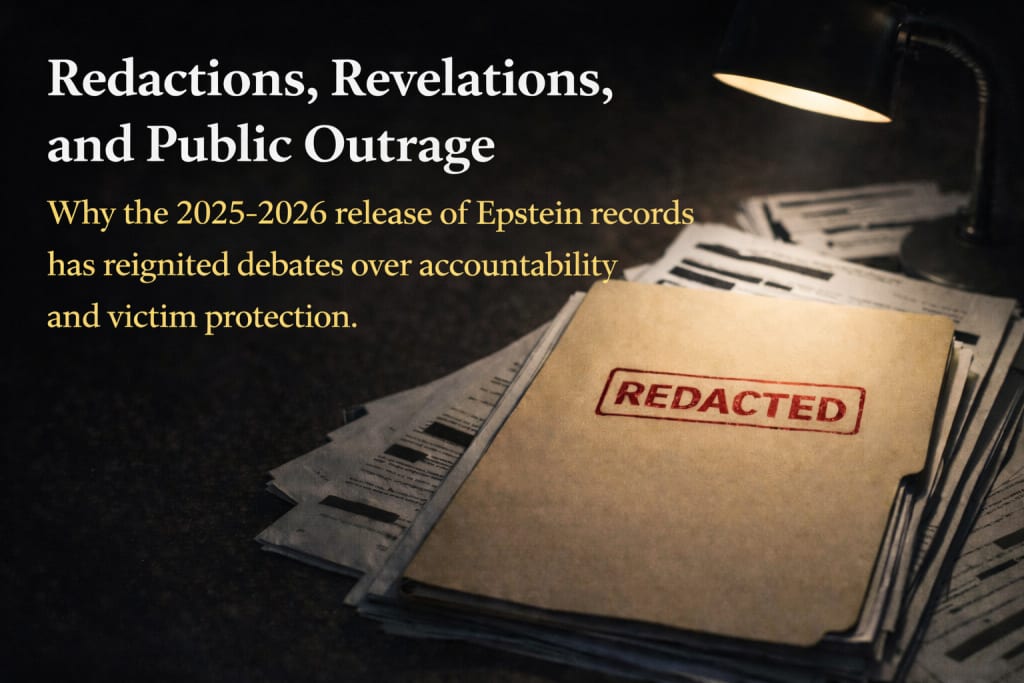
Redactions, Disclosures, and Public Outrage
Why the 2025–2026 Release of Epstein Records Rekindled Debates Over Accountability and Victim Protection.

The name Jerry Epstein still evokes fear, questions, and uncertainty in many countries around the world. The case has become a symbol of a systemic problem—not just one individual, but of powerful individuals, institutional failures, and a disregard for victims’ rights.
The largest documentary releases related to the case emerged in 2025 and 2026, including millions of pages, photographs, reports, letters, visitor logs, interviews, and other documents. The releases raised public expectations, as everyone wanted the full facts of a long and complex case to be revealed.
But in reality, despite the sheer volume of documents, the revelations were limited, and heavy redactions obscured many important questions. This is why the release not only sparked public interest but also criticism, anger, and debate.
History and Background of the Release
The release of the Epstein trial documents was the result of years of legal struggle, public pressure, and sustained media scrutiny.
Victims and human rights organizations wanted this information to be made public so that such incidents could be prevented in the future.
Government agencies insisted that the release be limited to information that met legal, ethical, and security standards.
The millions of pages included in the release were collected from various agencies and spanned decades.
The release reveals the depth of the investigation that went into the trial and how the various agencies failed to handle this complex case.
Redactions and Public Questions
The redactions are the most controversial aspect of the release. Blackouts, names, and important information are hidden on the pages.
Officials explained the redactions, saying that these measures were taken for the following reasons:
- Privacy and protection of victims
- Protection of ongoing cases and legal sanctions
- Protection from false accusations by unrelated individuals
But the question arose among the public and media circles that what is the real purpose of transparency when everything is being hidden?
The redactions further fueled the debate and people expressed their concerns on various platforms, saying that it is a process that affects public trust and questions the accountability of institutions.
Disclosures: Some small but important facts
While the release was short on major revelations, small facts caught the public’s attention:
- The complaints of victims were ignored several times.
- Lack of communication between different agencies complicated the case.
- There were delays in processing reports and evidence, making it difficult to identify those responsible.
- The investigation continued to be weakened in the face of powerful individuals.
All these facts make it clear that Epstein's case is not just about one person, but a symptom of a systemic failure.
The Voice of the Victims and Their Struggle
The most important aspect of the release is the victims’ statements. Statements made years ago are still present in these documents and provide the basis for the case.
These statements make it clear that:
- The victims’ complaints were not taken seriously
- The investigation was weakened by the influence of powerful individuals
- Some incident reports were filed late or ignored
These documents remind us that the voices of the victims are the most important part of the case, and the truth lies in their statements.
Public reaction and anger
The release was met with strong public and media reactions.
- Debates and protests on social media
- Criticism from lawmakers
- Strong condemnation from human rights organizations
- Demands for legal and moral accountability
This anger is a sign that the public is sensitive to facts and transparency and expects accountability from institutions.
The importance of the release and its impact
Although the release did not reveal everything, it is important because:
- It revealed details of the failures of the institutions
- It brought the struggles of the victims to global attention
- It made it clear that transparency and reform were needed for such cases in the future
- It provided an opportunity to understand the impact of the decline in public trust
The release also proves that transparency is not always about sensational revelations, but rather a way to reveal the truth and evaluate the performance of institutions.
Future prospects
The question now arises, what will happen next?
- Organizations representing victims will continue to demand transparency
- Institutions will continue to explain redactions and legal boundaries
- Public interest and investigation will continue
This case is not over yet and the debate over Epstein’s records will continue in the future.
Redactions, revelations, and public anger show that justice exists not only in the courts but also in public consciousness, the media, and documentary evidence.
About the Creator
Echoes of Life
I’m a storyteller and lifelong learner who writes about history, human experiences, animals, and motivational lessons that spark change. Through true stories, thoughtful advice, and reflections on life.
Keep reading
More stories from Echoes of Life and writers in The Swamp and other communities.
What do the Epstein files really show?
The case of Jerry Epstein has been the center of much controversy, questioning, and debate around the world. The complexity of the case and the powerful individuals involved have made it more than just a legal matter, but a subject of public interest. In 2025 and 2026, the largest documentary releases related to Epstein once again captured the world’s attention.
By Echoes of Lifeabout 18 hours ago in The Swamp
The Saddest Thing - The Billionaires Who Rule America Aren't Even Enjoying Themselves
This single post says more about our ruling class than a thousand policy papers. The saddest thing about today's system is that the men robbing the rest of us - sabotaging our economic prospects, our pensions, our access to affordable healthcare - are not even happy.
By Scott Christenson🌴4 days ago in The Swamp
Exclusive: Some UAE Companies Pull Out of Saudi Defence Show as Gulf Rift Spills Into Business
In a development that highlights the lingering fault lines within the Gulf, several companies based in the United Arab Emirates have quietly withdrawn from a major defence exhibition in Saudi Arabia, according to industry sources. While official statements remain scarce, the pullouts point to how unresolved political and strategic tensions between regional heavyweights are beginning to spill over into business, even in sectors long viewed as insulated from diplomatic disagreements.
By Sadaqat Ali4 days ago in The Swamp


Comments
There are no comments for this story
Be the first to respond and start the conversation.