
Canada, Australia Strengthen Ties as PM Mark Carney Urges ‘Strategic Cousins’ to Push Back Against Dominant Superpowers
Canadian PM Mark Carney urges closer Canada–Australia cooperation as “strategic cousins,” calling on middle powers to collaborate on defAustralian Parliament global order.

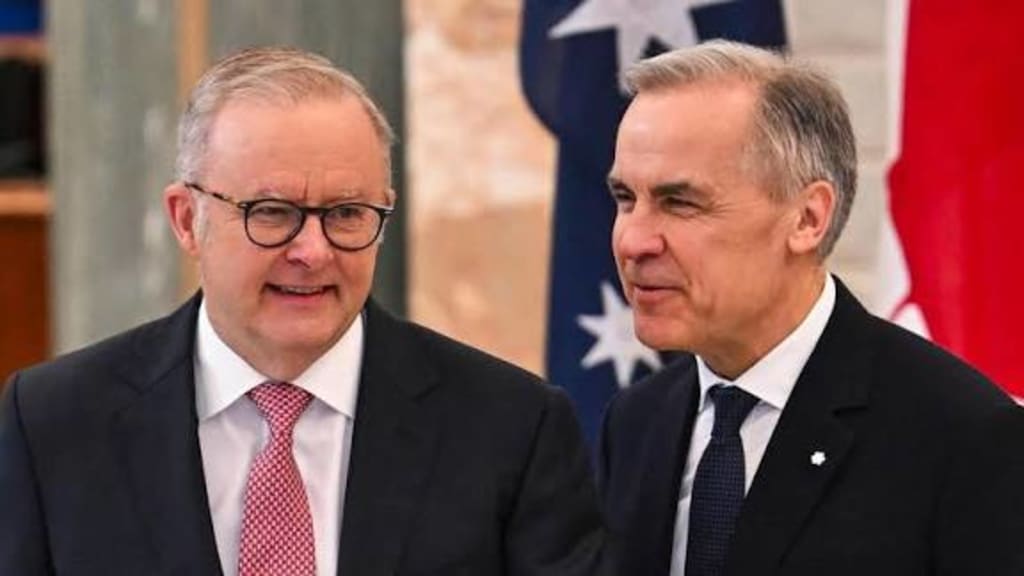
In a striking address to Australian Parliament, Mark Carney used his first official visit as prime minister to call for closer alignment between Canada and Australia — describing the two nations as “strategic cousins” capable of shaping global affairs alongside, or in resistance to, dominant superpowers. His speech underscored a broader vision for middle‑power cooperation on defence, trade, technology, and economic sovereignty in an era marked by geopolitical strain and uncertainty.
Carney’s message — delivered against the backdrop of increasing tensions in the Middle East, economic competition between major powers, and questions over the resilience of the post‑World War II rules‑based order — called on like‑minded countries to stop “negotiating from a position of weakness” and instead build cohesive partnerships that reflect shared interests and values.
A New Strategic Partnership
Carney’s visit followed a series of diplomatic and economic engagements across the Indo‑Pacific, including visits to India, Japan, and now Australia, as part of a tour to strengthen alliances amid global volatility. In Canberra, he and Anthony Albanese reaffirmed the longstanding bilateral relationship between their countries, signing agreements and outlining plans to deepen cooperation on investment, supply chains, and strategic sectors such as defence and technology.
Central to Carney’s pitch was the idea that Canada and Australia — two of the world’s most prosperous and stable democracies — possess the credibility, legitimacy, and shared values needed to influence global outcomes. “Great powers can compel” by virtue of economic or military might, Carney told lawmakers. “But compulsion comes with costs — reputational, financial, and political.” By contrast, he argued, middle powers acting collaboratively can create durable partnerships that align interests without coercion.
Shared Strengths and Strategic Priorities
Carney described Canada and Australia not just as allies but as partners with complementary strengths. Both countries are major producers of critical minerals — including lithium, uranium, iron ore, and other resources vital for batteries, clean energy systems, and defence technologies — and together they account for a substantial share of global critical material production. Australia’s recent accession to the G7 Critical Minerals Production Alliance, a Canada‑led initiative, underscores this strategic alignment and aims to reduce dependency on dominating suppliers for essential resources.
Beyond minerals, Carney emphasised cooperation in defence, cybersecurity, and artificial intelligence (AI), suggesting that pooling resources and technical expertise could strengthen each nation’s sovereign capabilities while offering alternatives to reliance on major powers like the United States or China. Proposed initiatives include joint investments in advanced surveillance systems, satellite communications, and defence equipment standardisation.
Rethinking Global Engagement
Carney’s remarks did not simply advocate closer Canada–Australia ties; they formed part of a broader critique of the current global order. Speaking to parliament, he echoed earlier warnings that the traditional architecture that guided international relations for decades is “breaking down” in the face of consecutive crises — from geopolitical conflicts to economic disruptions — and that middle powers must step forward to shape the next era of international cooperation.
Carney’s theme of “strategic cousins” went beyond a rhetorical flourish. It captured a philosophy that nations with shared democratic traditions and institutional strengths can, and should, leverage their collective influence to advance stability, prosperity, and resilience. This approach reflects a growing consensus among policymakers in Ottawa and Canberra that a multipolar world — rather than one dominated by a handful of superpowers — requires agile, collaborative leadership from smaller but capable states.
Reception and Regional Context
Carney’s speech received broad support from Australian leaders, with Albanese and other officials welcoming the call for enhanced cooperation. The move comes amid wider international discussions about supply chain diversification, economic security, and reducing dependencies on singular geopolitical actors. Analysts see the Canada‑Australia partnership as emblematic of a broader effort by middle powers — including Japan, South Korea, and members of the Comprehensive and Progressive Agreement for Trans‑Pacific Partnership (CPTPP) — to assert their interests and promote balanced, rules‑based engagement in global affairs.
Looking Ahead
As Carney’s visit continues and negotiations unfold, the strategic cousins initiative is expected to yield concrete outcomes in trade, defence, technology, and critical materials investment. By forging deeper ties, Canada and Australia hope not only to fortify their respective economic and security positions but also to set an example for other mid‑level nations seeking greater agency in a changing global landscape.
Whether this coalition of middle powers can truly reshape global dynamics remains to be seen, but Carney’s vision marks a defining moment in how countries traditionally seen as secondary actors are positioning themselves amidst the competing interests of dominant superpowers.
About the Creator
Fiaz Ahmed
I am Fiaz Ahmed. I am a passionate writer. I love covering trending topics and breaking news. With a sharp eye for what’s happening around the world, and crafts timely and engaging stories that keep readers informed and updated.
Keep reading
More stories from Fiaz Ahmed and writers in The Swamp and other communities.
China Tells Top Refiners to Halt Diesel and Gasoline Exports
China has instructed its largest oil refiners to suspend exports of diesel and gasoline, a dramatic move that reflects growing global energy market fears as Middle Eastern tensions disrupt crude supply chains. The directive was issued amid escalating conflict in the Gulf, where military action involving the United States, Israel and other forces has closed key shipping routes through the Strait of Hormuz — a vital channel responsible for transporting roughly one‑fifth of the world’s seaborne oil. According to industry sources, representatives from the National Development and Reform Commission (NDRC), China’s top economic planning body, met with executives from major refiners including PetroChina, Sinopec, CNOOC, Sinochem Group, and private refiner Zhejiang Petrochemical. The refiners were told to “immediately suspend exports of diesel and gasoline, stop signing new export contracts, and negotiate to cancel already agreed shipments,” according to Bloomberg News sources. Exceptions were made for jet fuel and bunkering supplies destined for bonded storage or transit to Hong Kong and Macau. Strategic Concerns Over Fuel Supplies China is a net importer of crude oil, with around 57 % of its direct seaborne crude imports coming from the Middle East in 2025. Those supplies have become increasingly vulnerable as the war in the Gulf disrupts tanker movements through the Strait of Hormuz — a chokepoint whose closure often sends shockwaves through global energy markets. The sudden halt in diesel and gasoline exports is part of a broader pattern of energy risk management across Asia. Nations dependent on Middle Eastern crude are reducing exports of refined products and adjusting domestic refinery operations in anticipation of prolonged supply uncertainty. Japan, for example, has already asked its government to tap strategic reserves to keep fuel markets stable. China’s move comes not because it is a major source of fuel exports — its refined product shipments are modest compared with leaders such as South Korea and Singapore — but because Beijing wants to prioritise domestic fuel availability amid growing uncertainty in energy markets. State planners are keen to ensure that internal demand for diesel and gasoline is met even as global crude disruptions worsen. Impact on Regional Markets The suspension of diesel and gasoline exports by Chinese refiners is expected to tighten markets across Asia. Diesel is a cornerstone fuel for trucking, shipping, and industry, while gasoline touches everything from passenger vehicles to logistics and agriculture. Reduced shipments from China — even temporarily — may strain supply balances in countries like South Korea, Japan, and Indonesia, which both import fuel and source crude through disrupted Middle Eastern channels. Refining margins across the region have already surged as a result of crude supply constraints. In markets such as Singapore, refining profits have hit multi‑year highs, pushing up prices for jet fuel and diesel as global refining capacity faces pressure. Industry and Policy Reactions The directive to halt exports has prompted varied reactions from analysts and markets. Regional refiners, particularly those outside China, have seen stock rallies based on expectations that reduced Chinese competition could boost demand for their own products. For example, shares of India’s major refiners such as Reliance Industries and MRPL rose sharply after the news broke, reflecting investor optimism about tighter regional supply and higher margins. Governments and industry bodies are also monitoring the situation closely. Regional energy ministers and trade groups are evaluating whether strategic reserves need to be deployed or whether alternative crude sources can be secured to mitigate shortages. Some have urged refiners to cut production to conserve crude stocks, while others push for diplomatic moves to stabilise navigation through the Strait of Hormuz. Longer‑Term Implications While China’s suspension of diesel and gasoline exports is formally described as a temporary measure, its broader implications are significant: Supply Security Focus: China is signalling that fuel security is a national priority when global supplies are at risk. Market Ripples: Asian fuel markets may see more volatility as both crude and product flows adjust to geopolitical realities. Refining Strategy: Refiners may increasingly align with national policy goals rather than purely export‑driven strategies. Market watchers caution that if crude supply interruptions persist, refiners worldwide may have to recalibrate production, prioritise domestic markets, and negotiate new trade arrangements, potentially reshaping the global energy landscape. Conclusion China’s instruction to halt diesel and gasoline exports marks a rare intervention by Beijing into refined fuel trade policy, driven by concern over Middle East supply shocks and the potential for prolonged disruptions. By prioritising domestic fuel security, China joins a broader regional pattern of precautionary measures that could reshape energy markets, refine global pricing structures, and influence everything from logistics costs to consumer fuel availability in the months ahead — underscoring the profound downstream effects of geopolitical conflicts on everyday energy supplies.
By Fiaz Ahmed about 6 hours ago in The Swamp
The Saddest Thing - The Billionaires Who Rule America Aren't Even Enjoying Themselves
This single post says more about our ruling class than a thousand policy papers. The saddest thing about today's system is that the men robbing the rest of us - sabotaging our economic prospects, our pensions, our access to affordable healthcare - are not even happy.
By Scott Christenson🌴26 days ago in The Swamp
Flower Bloom 369
FLOWER Bloom 2/25/26 Wednesday By Mariann Carroll Karen had been with Tony for 7 years. Tony started acting strangely after her surgery. He would mow the lawn in the rain and be on his cellphone. He started pushing Karen away. Tony came clean about seeing someone. Karen moved out two months later. Karen moved in with a friend. She felt betrayed.
By Mariann Carroll7 days ago in Fiction


Comments
There are no comments for this story
Be the first to respond and start the conversation.