stigma
People with mental illness represent one of the most deeply stigmatized groups in our culture. Learn more about it here.
The R-Word Is Unacceptable Here or Anywhere
Dear Comedians, My name is Texxx-Man Cosplay and I'm not only a LGBTQ+ cosplayer, but I'm also a cosplayer with a disability. I was diagnosed with Autism, which is a developmental disorder characterized by troubles with social interaction and communication and by restricted and repetitive behavior. My autism is mild, meaning that I may find work settings more challenging than an individual with greater language challenges but fewer sensory or social problems. Later on in my adult life, I was diagnosed with Aspergers. As a kid, I struggled to communicate with the other children and was isolated all the time. Now as an adult, I still feel isolated from my friends and everyone that supports and loves me. I still go through so many challenges daily like I did in my younger years.
By Mark Wesley Pritchard 7 years ago in Psyche
This Is Why Men & Women Dealing with Mental Illness Don't Talk About It
“Shoot, if it was me, I’d take a vacation instead.” I could not believe my ears when I heard those words, but that is what the CVS Pharmacy tech said to me after I paid $143.60* for one of my monthly prescriptions. Without fail, every month when I pick this up, the tech asks me if I am aware that it costs $143, as if I should reply, “Oh, no thanks- I actually don’t need that medicine after all.”
By Stephanie King8 years ago in Psyche
We Must Stop Stigmatizing Mental Health
"She's mentally ill, therefore she is violent." Time and time again through my own long experience of mental health problems, and as a mental health champion, have I heard this. Yes, it is true, there are some mental health problems that can be violent at times, but it is THE 'mental health problem,' not the person, who is violent.
By Carol Ann Townend8 years ago in Psyche
Language and Mental Health
We all have used words to emphasize how we feel. "I feel depressed." "I'm OCD." "I'm having a panic attack." However, using language like this in everyday life may have a negative impact on those with mental illness. It contributes to stereotypes and creates stigma. These terms and phrases are often used incorrectly and may contribute to negative stereotypes about mental health issues.
By Lorraine Woiak8 years ago in Psyche
Living with a Mental Illness
First off, I'm going to let it be known right here and now that I am not ashamed to admit that I have a mental illness and I somehow manage to make it through each and every single day of my life without hurting myself or anyone else. Some days this is not an easy task. Some days it takes all I have inside of me just to get up out of bed in the morning. I honestly hate it. There is not one single day where I do not know that I have it because each day it presents a new challenge to my life in one way or another. Please allow me to explain.
By Phoenix Cobain8 years ago in Psyche
"Crazies"
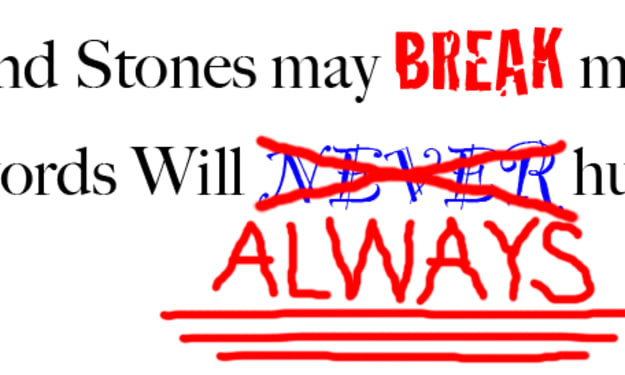
It's the words they use to define you that hurt the most; mental, barmy, drama queen, CRAZY! There's that old saying "Sticks and stones may break my bones but words will never hurt me." Well, let me tell you something, words do hurt. They really hurt. Especially when it's over something you can't control. No one asks for a mental illness, no one asks to feel depressed, no one asks to feel anxious. It’s not something we choose, it just happens.
By Crazy Unicorn8 years ago in Psyche
Growing Up Introverted
Growing up introverted and not knowing what it even means to be introverted can be a very scary thing. I want to shed light onto my own experience with growing up and how I managed to come to peace with myself and accept myself for who I truly am despite what the people around me think. I spent my whole childhood and teenage years wasting them away because I was afraid of my own self and capabilities and was too focused on fitting in rather than being happy. I wanted to be like the people I loved and admired rather than put in effort to search for what made me feel comfortable.
By Julie Smith8 years ago in Psyche
Suicide Is Not Selfish
Life with mental health, like any other illness, comes with its own unique set of struggles one must learn to overcome. Yet, for many, the biggest struggle it seems is the way in which people treat, speak to, and see those who live every day with the diseases. The dialogue that surrounds mental health can be quite discouraging for those who have the diseases, which makes it incredibly difficult for them to reach out, get help, and get support. One of the worst infractions I notice is when the topic of mental health comes up, we use a vastly different dialogue for it versus when someone has a physical illness. When someone has a physical illness, they are met with support, with empathy, with understanding, with so many wonderful things. Yet, when someone has a mental illness they are met with ire, with things like “Just be positive.” “So and so has it worse than you.” “You should try X, Y, or Z.” “Oh so and so has it, and they treated it like this.” “Why can’t you just be happy?” Honestly, I could go on for hours with the asinine things that have been said to myself as well as others like me, and while most mean well, they do not understand how their words, their actions, and their suggestions make those with the diseases feel. Many treat us like we are pariahs, like we are something to be feared, like we are broken, like we are something that must be fixed. Especially with all the mass shootings going on in the US right now, the first thing that most people talk about is how the shooter must have or did have some form of mental illness. Yet, the conversation we should be having is how we can better assist those with poor mental health rather than blaming the diseases further, rather than creating more of a divide between those who live with poor mental health and those who don’t, rather than villainizing the diseases and those of us who live with it, and rather than further perpetuating the fears and stigmas surrounding it.
By Courtney Luke8 years ago in Psyche